


MST Architecture: The Multi-System Tension Framework (MST) is the analytical tool through which the CSR method observes the structural state of geopolitical macro-regions.
The regional assessments produced through the framework are then integrated into the classified document Global System Assessment (GSA), which expresses the state of the international system in the considered analysis cycle.
The public summary of such assessment is made available in the Global Systemic State Dashboard.
MST Architecture: Systemic Compression Principle
The MST framework is based on the observation that geopolitical crises rarely emerge as sudden events.
More often, they are the outcome of a progressive compression: systemic pressures that accumulate across different domains, converge and, in some cases, become synchronized across regional systems, gradually reducing the system’s overall capacity to absorb stress.
Primary Unit of Observation: Macro-Area
A macro-area does not coincide with a single State.
It is a relational configuration characterised by:
– internal equilibrium
– structural interdependencies
– absorption margin
– systemic position
– multidomain dynamics.
Each MST assessment always refers to the macro-area observed in the analytical cycle.
The Six Fundamental Domains
For each macro-area, the framework observes the level of structural pressure across six fundamental domains.
Security and Strategic Postures
Deterrence postures, regional frictions, alliance recalibrations and security configurations.
Energy and Infrastructure Architectures
Critical supply chains, logistical nodes, physical networks and energy choke points.
Financial and Monetary Circuits
Sanctions regimes, capital flow stress, monetary leverage, and systemic interdependencies.
Regulatory and Normative Standards
Standards, compliance mechanisms, and systemic constraints embedded in economic and institutional rules.
Cognitive and Informational Domain
Strategic narratives, construction of perceived risk, and normalization of political and economic options.
Technological–Industrial Ecosystems
Strategic industrial supply chains, access to critical components, and competition over technological standards.
The domains they do not describe isolated events.
They describe Persistent structural conditions that can alter the strategic balance over time.
The comparability between macro-areas derives from the use of the same domains and the same observation logic.
Measurement in domains
The Domain Score (DS)
For each domain, a Domain Score (DS) is assigned: a value on a scale of 1–5 that expresses the intensity of the structural pressure observed in the domain during the analysis cycle.
The DS does not reflect individual events. It is the result of the intensity of the observed pressures, their persistence over time, and their degree of interconnection within the domain.
Adaptive Capacity Index (ACI)
In addition to structural pressure, the framework assesses the macro-area's capacity to withstand and absorb such pressure without generating systemic discontinuities. This dimension is measured by the Adaptive Capacity Index (ACI), expressed on a scale of 1-5.
A high ICA indicates a resilient structure capable of containing pressure. A low ICA signals systemic fragility: even moderate pressures can produce disproportionate effects.
The ICA is not calculated on all six domains. It is based on four core domains—Security, Energy, Finance, and Cognitive—which constitute the structural pillars of a macro-area's adaptive capacity.
For each of these domains, the evaluation is structured around four transversal dimensions:
– Robustnessthe robustness of the fundamental structures of the domain.
– Redundancythe availability of alternative routes, reserves, and structural backups.
– Adaptability: speed and shock response capability.
– Cohesionthe system's ability to act in a coordinated manner under pressure.
For each core domain, the ICA value summarizes the four dimensions of robustness, redundancy, adaptability, and cohesion. The overall ICA for the macro-area is derived from the integration of the four core domains.
The ICA is not recalculated entirely with each cycle. Cyclic updating is bound by precise conditions: it requires documented structural variations in distinct domains, with verified persistence and inter-domain convergence. Full recalculation is permitted only in the presence of extraordinary systemic events or during periodic reviews.
Net Domain (ND)
Net Domain (ND) integrates pressure and absorption capacity into a single value for each domain.
It expresses not only the intensity of a pressure, but the actual weight that such pressure exerts on a structure with a specific holding capacity. An identical DS produces different DNs depending on the available absorption margin: the same pressure weighs differently on different systems.
The DN constitutes the operational unit used by the framework to compare different domains and build the synthetic score for the macro-area.
The synthetic score: MST Score
The MST Score is the score that synthesizes the overall structural state of the macro-area in the analysis cycle. It is derived from the weighted integration of the Net Scores of the six observed domains.
A Convergence Factor (CF) is applied to the resulting value: a coefficient that measures the degree of synchronization between domains. The Convergence Factor does not measure the severity of individual pressures, but rather the extent to which they tend to reinforce each other.
When pressures in different areas do not operate independently but amplify each other, the overall systemic risk is greater than the sum of individual pressures. The FC captures this dimension and incorporates it into the final score.
The MST Score is then placed on the MacroBase scale, which allows reading the structural configuration of the macro-area in the considered cycle and following its evolution over time.
The MacroBase Scale
The MacroBase scale articulates structural space into five configurations, each corresponding to a different level of systemic compression.
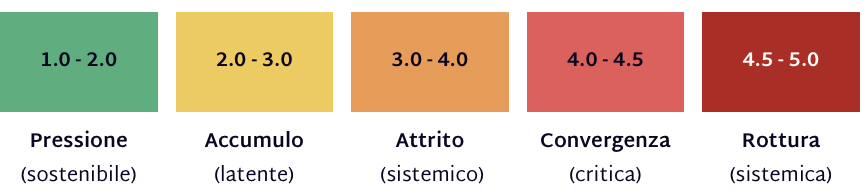
Configurations do not describe discrete states. The system can be in transition between thresholds, and the direction of movement—in addition to the absolute position—has autonomous analytical meaning.
Structural pressure and absorption margin
Tensions emerge within the domains.
Structural pressure represents the systemic intensity of those tensions.
It does not derive from a single event, but from the combination of:
— density of tensions
— persistence over time
— interconnection across domains.
Alongside pressure, the framework also considers the absorption margin, that is, the capacity of the macro-area to sustain those pressures without generating systemic discontinuities.
The systemic equilibrium of a macro-area therefore depends on the relationship between the intensity of structural pressure and the absorption capacity of the regional system.
Pressure, configuration and category
Within the MST framework, three analytical levels describe the state of the system: the systemic pressure observed across domains, the resulting configuration within macro-areas, and the systemic category synthesized in the GSA.
| Level | Description | Where this is being observed |
|---|---|---|
| Systemic Pressure | What emerges in the domains | Domains of the macro-area |
| Configuration | the form taken by pressures within the macro-area, which contributes to the configuration of the global cycle | Assessment of macro-area |
| Systemic category | the position of the system on the structural scale of the GSA | Global System Assessment (GSA) |
Systemic pressure emerges within the domains, takes shape in the macro-areas, and is ultimately synthesized in the Global System Assessment, which expresses the overall state of the international system.
Dinamic of Systemic Configuration
Systemic configurations evolve primarily through two mechanisms.
Multidomain Convergence
When pressures in different domains begin to align and amplify one another.
Intra-Domain Persistence
When high pressure persists over time, progressively compressing the system's equilibrium.
Convergence is not an event. It's a structural configuration.
It is in the configuration that the level of accumulation, friction, or systemic compression is measured.
From Macro-Area level to Global System
From the Macro-Area Level to the Global System
Within the MST framework, the global level is not observed as an independent object. It is an emergent property resulting from the integration of macro-area configurations.
The condition of the international system therefore derives from the combination of:
— macro-area configurations
— the degree of synchronization between them
— the intensity of observed multi-domain pressures
— the persistence of pressures across different domains.
Strategic Nodes and Inter-Regional Synchronization
Regional systems are not the only source of pressure within the international system. Certain dynamics operate through infrastructures, networks, and functional architectures that simultaneously span multiple macro-areas and multiple domains.
To capture this dimension, the CSR framework integrates macro-area analysis with the assessment of Strategic Nodes.
A Strategic Node is a non-territorial systemic structure whose functionality simultaneously influences multiple regions and multiple domains of the international system. Strategic Nodes may take different forms:
— critical energy infrastructures
— logistical and trade corridors
— maritime chokepoints
— financial and monetary architectures
— digital and technological networks
— regulatory systems and global standards.
Unlike macro-areas, Strategic Nodes do not represent territories but systemic functions. Their relevance derives from their ability to transfer, amplify, or synchronize pressures across different regional systems.
Within the CSR methodology, Strategic Nodes are assessed through a dedicated framework and contribute to the Global System Assessment through the analysis of their inter-regional propagation.
When a Strategic Node generates simultaneous effects across multiple macro-areas, the framework records the observed degree of synchronization through the Inter-Regional Synchronization Index (ISIR).
The ISIR does not measure the severity of the pressure generated by the Node, but rather its ability to transmit systemic effects across different regions. It is structured in progressive levels that express the degree of inter-regional involvement: from transmission limited to a single area, to configurations in which the Node generates simultaneous and amplified effects across multiple regions of the international system.
The integration of territorial analysis (macro-areas) and functional analysis (Strategic Nodes) makes it possible to observe not only where pressures accumulate, but also through which architectures they propagate throughout the global system.
In the current CSR model:
— macro-areas explain where pressure accumulates
— Strategic Nodes explain how pressure is transmitted
— the ISIR measures how much that transmission is systemically significant.
This integration is the mechanism that connects regional assessment to the dynamics of global convergence expressed through the Global System Assessment.
Access the valuation CSR System
Method application
The operational application of the MST framework is carried out through the analysis of geopolitical macro-areas, which constitute the intermediate level of observation of the international system.
Dedicated dossiers provide insight into the structural configuration of individual areas and their role within global dynamics.
👉 Geopolitical Macro-areas dossier
Nature of the framework
The MST is not a tactical tool.
It is not a predictive model.
It is not a scientific ranking system.
It is a multi-layer framework for interpreting structural tensions.
Its objective is to identify configurations of accumulation, convergence, and systemic compression before they emerge as visible crises.
The MST was not designed to describe what is happening.
It identifies when the conditions for it to happen are maturing within the system.
Within the CSR system:
— the Methodology section presents the foundations of the framework;
— the Dashboard provides a public synthesis of the state of the system;
— the Macro-Area Dossiers make the analysis of individual regional configurations accessible;
— the Global System Assessment (GSA), together with selected assessments dedicated to Strategic Nodes and specific topics, is available within the restricted-access area.
Learn more about Strategic Nodes