


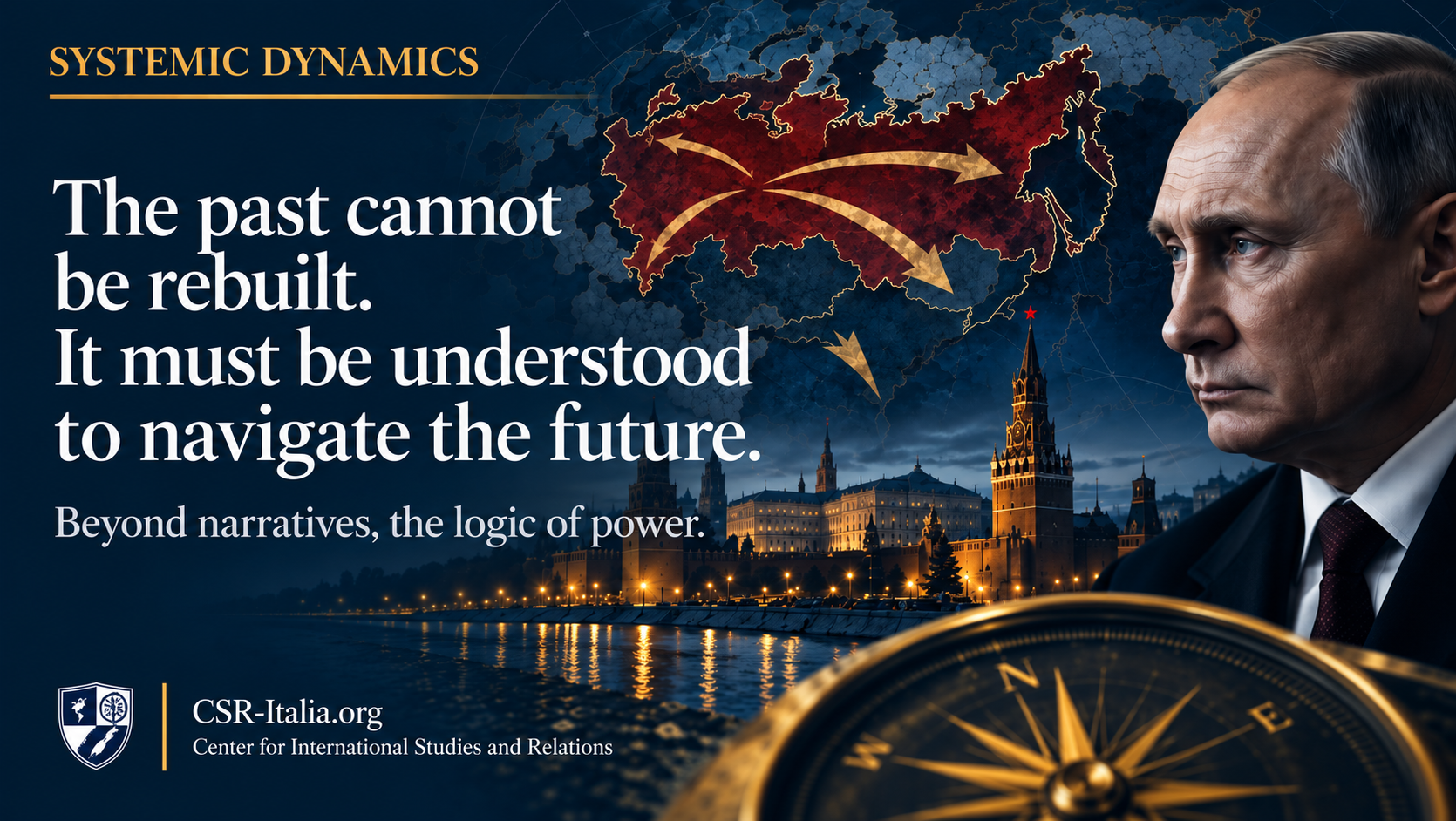
He wants to rebuild a Russian sphere of security
Abstract
The idea that the Russian strategy in Ukraine simply stems from Vladimir Putin’s desire to restore the Soviet Union is intuitive, but reductive.
The Russian project does not consist in rebuilding the Soviet system. Rather, it seeks to reconstitute a Russian space of security, influence and historical-civilizational continuity, while limiting the integration of territories considered strategically vital into Western architectures.
Ukraine is therefore not merely a theatre of war. It is the point where security, strategic depth, identity and the reshaping of the international order converge.
Four years after the start of the full-scale invasion, the conflict is increasingly less about Kyiv and Moscow alone and increasingly about the future architecture of European security.
Russian strategy in Ukraine is not about restoring the USSR
Much of the Western debate continues to interpret Putin’s actions as an attempt to rebuild the USSR. It is a simple and compelling interpretation, but an imprecise one.
The Russian project does not consist in restoring the Marxist-Leninist system or recreating the Soviet political and institutional structure. Its objective is more pragmatic and more traditional: to create a security sphere in which Moscow can exercise strategic primacy, preventing territories considered vital from becoming platforms for hostile influence, primarily Euro-Atlantic.
In short, neighbouring states may formally continue to exist, but they must not become hostile outposts.
This interpretation is consistent with the CSR approach, which examines the international system not only through events, but through the architectures that make them possible. Metodo CSR
The three pillars of the Russian project
1. The security sphere.
Moscow regards the post-Soviet space as an area of vital interest. Not necessarily as territory to be annexed in its entirety, but as a strategic buffer kept insulated from Western infrastructure and alliances. It is the logic of the buffer, rather than ideological expansion.
2. The Russkiy Mir.
The so-called “Russian World” extends beyond the borders of the Russian Federation. It is conceived as a space of cultural, linguistic, historical and religious continuity, but it also performs a political and strategic function.
In the Russian narrative, belonging to a shared historical-civilizational matrix helps define a space in which Moscow claims particular interests and responsibilities.
Within this logic, the protection of Russian-speaking populations or communities regarded as part of Russian civilisation becomes an instrument for the political legitimisation of Moscow’s intervention and influence beyond its borders.
The crucial point is that this conception does not necessarily require the formal annexation of all territories considered part of the Russian space: it can also take the form of a demand that such territories not be integrated into strategic architectures perceived as hostile.
3. Anti-hegemonic multipolarity.
Moscow is not merely seeking a regional sphere of its own. It also wants an international order in which the West no longer holds a monopoly over normative legitimacy. Russian multipolarity is, in essence, a demand for the great powers to return to managing spheres of influence relatively insulated from external interference.
Why Ukraine is the decisive node
Ukraine is where these three pillars overlap and become explosive.
Geopolitically, Ukraine affects Russia’s strategic depth to the west, access to the Black Sea and its projection towards Central Europe and the Mediterranean. A Ukraine permanently integrated into Euro-Atlantic structures would represent, from Moscow’s perspective, a permanent contraction of Russia’s strategic space.
At the identity level, the challenge is even more destabilising. If an East Slavic population, largely Russian-speaking and historically linked to Russia, chooses a distinct and Western-oriented political path, the myth of the “single people” underlying the Russkiy Mir begins to fracture.
Ukraine, therefore, is not merely a military problem for Moscow. It is a challenge to historical and political legitimacy.
The legal dimension: necessary clarity
Russia’s invasion of February 2022 constitutes, under positive international law, a violation of Ukraine’s territorial integrity and of the prohibition on the use of force established by the United Nations Charter. On this point, the legal position remains formally clear.
However, an exclusively legal reading of the conflict risks being insufficient today. The war did not emerge in a normative vacuum, but within a strategic context marked by great-power competition, the expansion of areas of mutual pressure and an increasingly selective application of international rules.
Within this framework, US strategic thinking on the need to exploit Russian vulnerabilities — explicitly set out, for example, in the 2019 RAND report — does not amount to a “legal cause” of the invasion, but it does show that the deterioration of relations with Moscow was already being conceptualised in terms of systemic pressure.
The point, therefore, is not to deny the illegality of Russia’s action. It is to recognise that the legal judgment alone does not exhaust the political and strategic problem.
This is also because the recent international environment, marked by coercive practices and a growing selective erosion of normative paradigms by major powers, makes it increasingly difficult to draw a clear line between formal legality, political legitimation and the use of force.
From this perspective, the Ukrainian case should be interpreted neither in purely moralistic terms nor through a purely relativistic lens. Russia’s invasion remains formally unlawful; what has become increasingly less straightforward is the broader context in which that illegality is judged, because that context is itself marked by a wider crisis of the international normative order.
The practical rationale behind Russian strategy in Ukraine
Beyond the rhetoric, Russian strategy in Ukraine responds to very concrete considerations:
1. ensuring strategic depth and buffer zones to the west.
2. maintaining access to the Black Sea and warm-water seas.
3. preserving economic, industrial and agricultural resources.
4. preventing the emergence of an East Slavic democratic model that could also prove attractive to Russian society itself.
5. sending a deterrent signal across the entire post-Soviet space.
This dimension is essential because it shifts the analysis from imperial nostalgia to strategic rationality.
Why this matters for Europe
Four years after the start of the full-scale invasion, the war has already transformed European security.
It has dismantled the assumption that economic interdependence alone would be sufficient to guarantee peace.
It has accelerated the remilitarisation of the continent.
And it has exposed a structural limitation of the European Union: its capacity for political and sanctions-based response is significant, but its effective strategic autonomy remains incomplete.
Europe must decide whether it intends to continue seeing itself primarily as a normative and economic space, or whether it will develop a genuine capacity for autonomous deterrence and power projection.
This choice can no longer be postponed.
From this perspective, the issue is directly connected to the Global System Assessment (GSA), namely the structural assessment of the pressures reshaping the European and international system.
The return of spheres of influence
The conflict in Ukraine is one of the clearest signs of the return of spheres of influence as an operative grammar of the international system.
For more than a decade, the idea prevailed that law, multilateral institutions and interdependence had superseded the logic of great-power politics. Events in recent years demonstrate otherwise.
For Europe, the problem is particularly acute. If the world is once again organising itself around security spheres and competition among major powers, the continent cannot afford to remain primarily an object of that competition.
It must become the subject of its own security.
Update — September 2026
The developments of 2026 do not alter the structural logic of Russian strategy in Ukraine described in this analysis, but they make its systemic dimension even more evident.
The conflict continues while, in parallel, diplomatic channels aimed at exploring a possible negotiated configuration remain active. Contacts between the United States and Russia, together with discussions involving Ukraine, show that the military and diplomatic dimensions are now operating simultaneously.
The central issue therefore concerns not only the terms of a possible ceasefire. It concerns the security configuration that would follow: Ukraine’s status, security guarantees, its relationship with NATO and the European Union, territorial control and the future balance between Russia and Europe.
It is precisely at this level that the concept of a Russian security sphere retains its explanatory power. Even a possible reduction in military intensity would not eliminate the structural issue that has accompanied the conflict: competition over Ukraine’s strategic alignment and, more broadly, over the architecture of European security.
Conclusions
Putin does not need to rebuild the USSR as a political and ideological system.
The Russian project instead seeks to reconstitute a sphere of security, influence and historical-civilizational continuity strong enough to prevent territories considered strategically vital from becoming platforms for hostile influence.
Russian strategy in Ukraine is the point at which this logic of security and influence has translated into open warfare, because strategic depth, identity, control of the regional space and the crisis of the post-Cold War European security architecture all converge there.
For this reason, the conflict concerns more than the future of Russia and Ukraine.
It concerns the configuration of the European security order that will emerge from the war, the future relationship between Russia and the West, and Europe’s capacity to become a subject — rather than merely a space — of strategic competition.
This contribution is part of the areas of strategic analysis developed by CSR on the relationship between security, power and the transformation of the international order.
Essential references
— NATO – fourth anniversary of Russia’s full-scale invasion of Ukraine
— In the 2023 Russian Foreign Policy Concept and the related doctrinal framework, Russia is represented as a Eurasian “civilisation-state”, while the Russkiy Mir assumes a dimension extending beyond the borders of the Federation.
— Within this framework, US strategic thinking on the need to exploit Russian vulnerabilities — explicitly set out, for example, in the RAND report Extending Russia: Competing from Advantageous Ground (2019) — does not amount to a “legal cause” of the invasion, but it does show that the deterioration of relations with Moscow was already being conceptualised in terms of systemic pressure.
In parallel, the NATO Ankara Summit Declaration of July 2026 defines Russia as a long-term threat to Euro-Atlantic security and stability.