


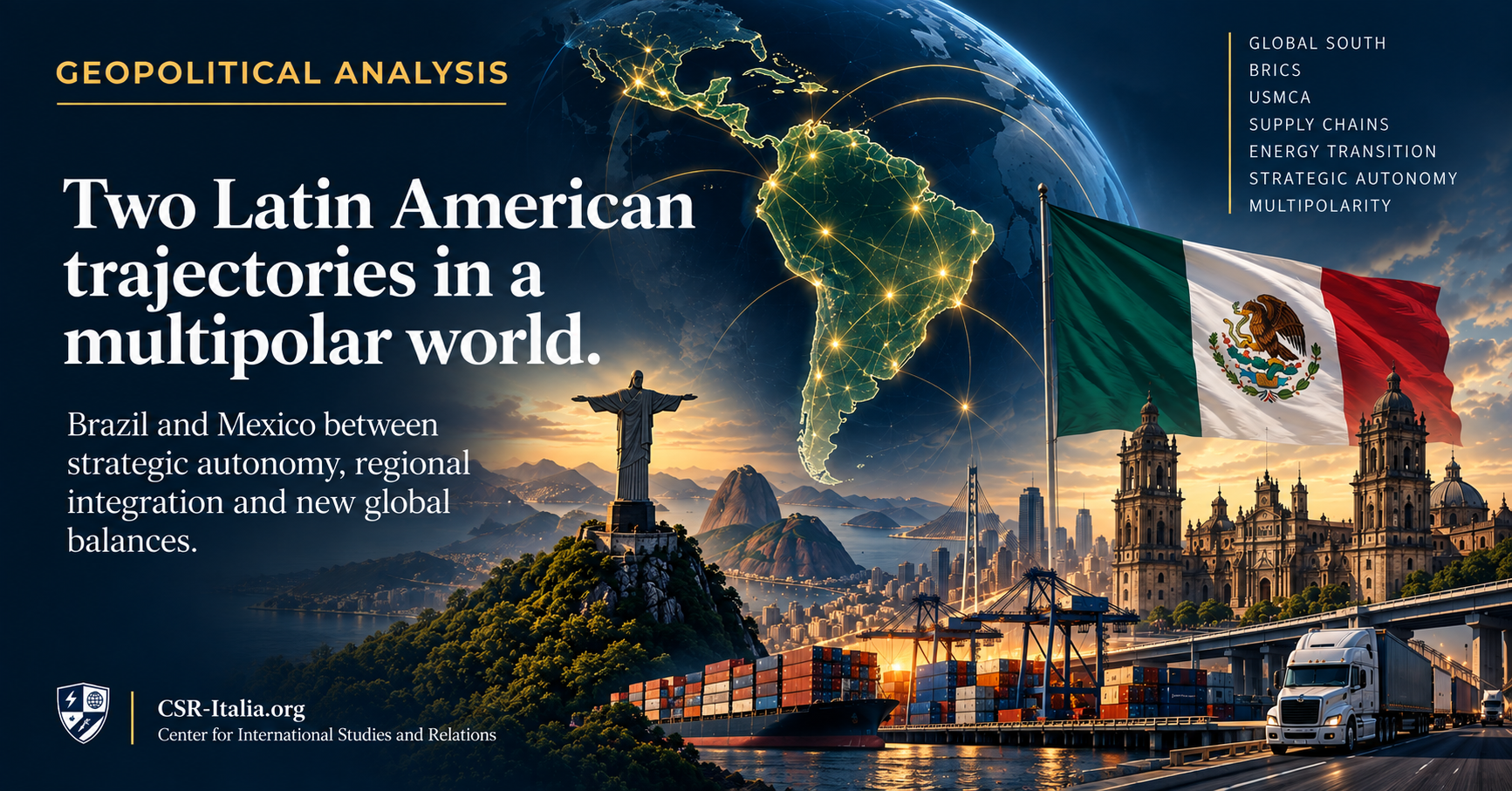
In an international system marked by the fragmentation of supply chains, competition between blocs and the pursuit of greater strategic autonomy, Brazil and Mexico are increasing Latin America’s systemic weight in different ways.
Brazil acts as a lever for reform within the Global South and the BRICS framework; Mexico as a hybrid platform between North American integration and strategic diversification.
Brazil: a lever for reform within the Global South and BRICS
A founding member of BRICS, Brazil chaired the group in 2025 and hosted the XVII Summit in Rio de Janeiro under the theme “Strengthening Global South Cooperation for a More Inclusive and Sustainable Governance”.
This is more than symbolic: it reflects Brasília’s attempt to strengthen the political weight of the Global South, promote a less concentrated model of international governance and develop instruments of economic and financial cooperation that provide alternatives to those dominated by the West.
Brazil’s positioning should be understood in terms of relative autonomy. Natural resources, advanced agriculture, critical minerals and leadership in the energy transition expand Brasília’s room for manoeuvre and consolidate its role as a mediator between the demands of the Global South, the reform of multilateral institutions and competition among major powers.
Mexico: a hybrid actor between North America and the Global South
Mexico is not a member of BRICS, but its participation as an observer at the 2025 Rio Summit, at Brazil’s invitation, reveals a more complex posture than its North American integration alone might suggest. It reflects an attempt to keep channels open with the Global South without calling into question its economic and strategic anchoring to the United States.
This structurally hybrid condition defines Mexico: deeply integrated into the North American production architecture through USMCA, advanced manufacturing and nearshoring, while at the same time seeking room for commercial, diplomatic and financial diversification towards other poles of the international system. Its position is not one of full autonomy, but rather of continuous balancing between functional dependence and selective openings.
Nearshoring, the 2026 USMCA Review and Strategic Competition
The USMCA review formally began on 1 July 2026, as provided for under Article 34.7 of the agreement, which requires the three governments to convene the Free Trade Commission to decide whether to extend the agreement until 2042, subject it to annual reviews, or allow it to expire in 2036.
Unlike what a “clean” extension would have implied, the process had effectively begun on a bilateral US–Mexico basis as early as March 2026, with a first negotiating round concluded at the end of May 2026 on automotive rules of origin, steel and aluminium, and economic security.
At the time of writing, Washington had not committed to a clean extension, making it likely that negotiations would continue beyond the summer, focusing precisely on the issues most directly affecting Mexico and Canada.
Washington aims to strengthen the North American production architecture, increase local content and limit the entry of inputs from economies considered “non-market”.
The issue is not merely commercial: it concerns the ability of the United States to preserve the centrality of the North American production architecture and, more broadly, to limit an excessive dispersion of the region’s strategic space in a context of growing competition with China and BRICS.
Within this framework, Mexico does not strengthen BRICS in the same way as Brazil. Rather, it contributes to making Latin America a hinge space: a region that does not passively absorb competition between blocs, but processes and reshapes it, extracting negotiating leverage from it.
Brazil and Mexico: Latin America as a Hinge Space
The asymmetry between the two trajectories does not weaken the region’s strategic weight; on the contrary, it increases it. Brazil operates primarily through the political representation of the Global South and the reform of international governance; Mexico through its role as a productive and diplomatic platform between North America and the multipolar world.
Together, they demonstrate that Latin America is no longer merely a peripheral region, but one of the laboratories in which supply chains, standards, interdependencies and forms of autonomy are being redefined.
For Europe and Italy, the issue is not simply one of identifying economic opportunities. It is about understanding how Brazil and Mexico are redefining the margins of regional autonomy within a system that is more competitive, less linear and more openly organised around blocs, supply chains and spheres of influence.
In this context, sustainability, supply-chain resilience, regulatory standards and the energy transition are not separate from geopolitics: they are becoming integral components of strategic competition.
Conclusions
Brazil and Mexico do not form a homogeneous axis. They represent two different ways in which Latin America is increasing its systemic weight.
Brazil strengthens the Global South pole and the capacity of BRICS to present itself as a platform for reform of the international order. Mexico illustrates how a major economy in the region can remain deeply integrated into the North American architecture while seeking opportunities for diversification within the emerging multipolar context.
Understanding these two trajectories helps us view Latin America not as a marginal region, but as one of the arenas in which the dynamics of multipolar reconfiguration are now being tested in concrete terms.
Update (July 2026):
The effective launch of the USMCA review on a bilateral rather than trilateral basis confirms rather than contradicts the argument of this article: Mexico remains a hybrid actor that negotiates its North American integration piece by piece, without any automatic renewal mechanism. The outcome of the negotiations (full extension, renegotiation or a transition to annual reviews) will need to be monitored in the coming months.
Update — September 2026
The USMCA Joint Review formally took place on 1 July 2026 in a trilateral setting, but the United States did not agree to renew the agreement in its current form. USMCA remains in force, while negotiations have continued primarily through the bilateral US–Mexico channel. Following the first two rounds in May and June, a third round was held in Mexico City in July, focusing, among other issues, on economic security, steel and aluminium, the automotive sector, labour and agriculture; the parties subsequently planned a fourth round in Washington in September 2026. United States Trade Representative.
This evolution confirms the configuration described in the article: Mexico remains deeply integrated into the North American production architecture, but the concrete form of that integration is subject to continuous negotiation. The absence of an automatic USMCA renewal therefore intensifies, rather than eliminates, the tension between functional dependence on the North American system and the pursuit of selective margins of autonomy.
Further Reading
For a broader perspective on the case, the following methodological and documentary references are recommended:
Global System Assessment (GSA) – Global Systemic State Dashboard (CSR Italia)
CSR Method and Decision-Making Architectures (CSR Italia)
Final Declaration of the XVII BRICS Summit – Rio de Janeiro 2025 (official text)
Rio de Janeiro Declaration – Strengthening Global South Cooperation
USMCA Joint Review 2026 – USTR Announcement and Preparatory Work
USMCA Review 2026 – CSIS Analysis
Nearshoring and FDI Confidence Index 2026 (Kearney)