
 English

Technology and Energy
Strategic assessments of critical technologies, energy systems, strategic resources, and power infrastructures. Analysis of the interdependence linking technological innovation, energy security, and state sovereignty.
-
Yemen and the Red Sea: how much can Saudi Arabia compensate if Hormuz slows down?
La crisi in Yemen riporta l’attenzione su Bab al-Mandab, ma il rischio petrolifero dipende anche da quanto greggio l’Arabia Saudita può spostare dal Golfo al Mar Rosso con l’oleodotto Est-Ovest quando Hormuz rallenta. Precedenti, segnali da osservare e implicazioni per l’Europa.
-
Global Water Crisis: The Distributed Chokepoint of the Global System
Water Scarcity, Food Security, Energy, Supply Chains, and Emerging Geopolitical Pressures
Water is no longer merely an environmental resource. It has become a strategic infrastructure of the global system. Food production, energy generation, industrial processes, public health, urban stability, supply chain continuity and, ultimately, the capacity of states to govern all depend upon it.
When water systems become unstable, the result is not simply an environmental crisis. It is a reduction in the overall resilience of economic, social and political systems.
The global water crisis should therefore be understood as a distributed systemic pressure. Unlike maritime chokepoints such as Hormuz or Suez, there is no single strategic bottleneck. Water functions instead as a diffuse chokepoint, simultaneously compressing agriculture, energy, industry, urban systems, migration, and... -
Palantir and the New Sovereignty of Software
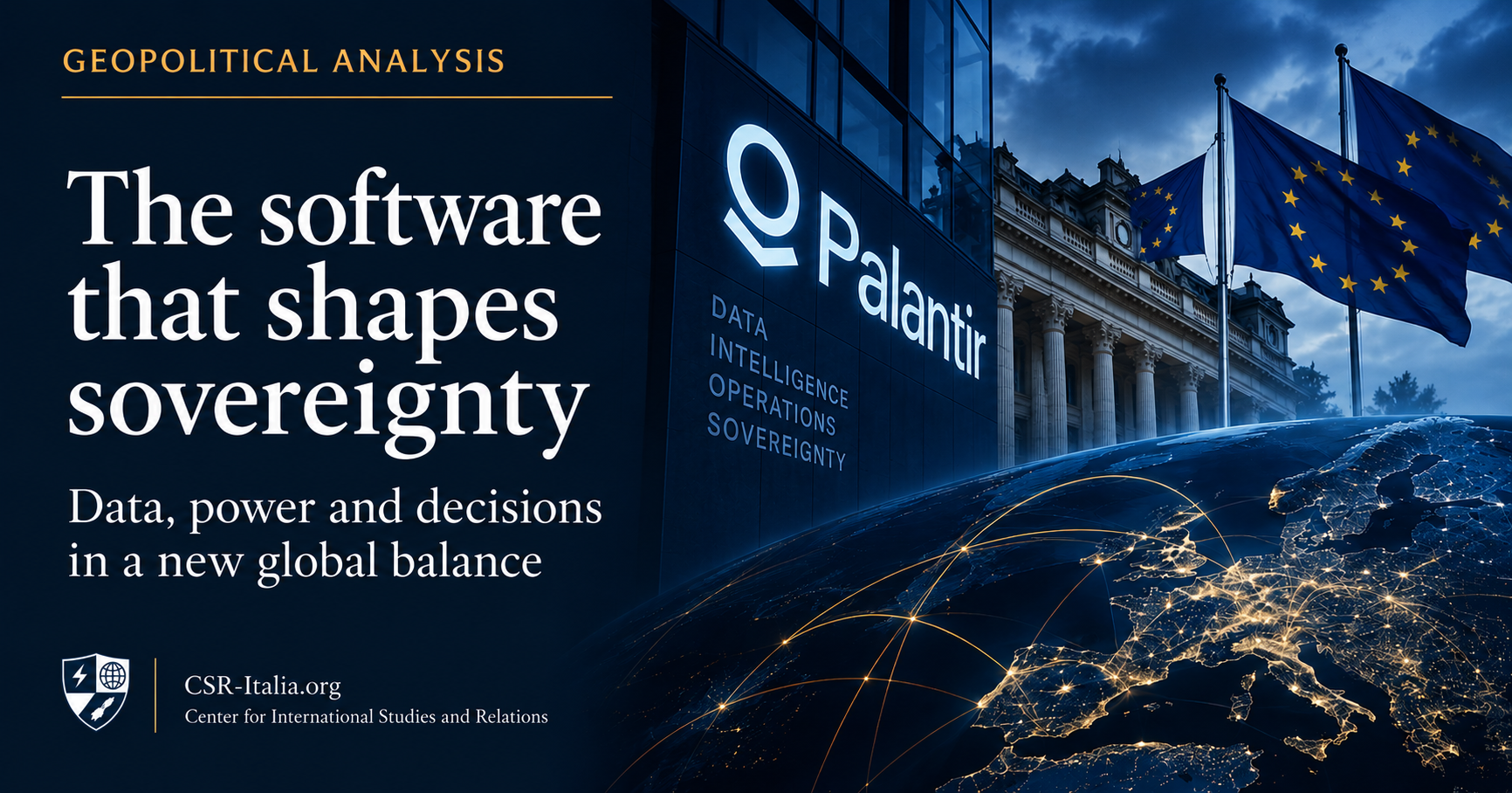
Palantir is no longer merely a technology company. Its case highlights the increasing centrality of private providers within the decision-making architectures of states and alliances. The issue is not only privacy, but the emergence of architectural, functional, and cognitive dependence on external proprietary stacks.
-
Technology and Method
Digital tools, imagery, and open-source data have greatly expanded our capacity to observe. Without a robust methodology, however, more information does not necessarily lead to greater understanding.
-
Critical Minerals and Structural Power
How the Concentration of Chokepoints Transforms Commercial Dependence into Strategic Vulnerability: A Focus on China, Europe, and Italy
Public debate on critical raw materials continues to be dominated by a simplified narrative centred on resource scarcity, rising demand, and the need to diversify supply sources. This interpretation, however, captures only part of the picture.
The real challenge lies not simply in the physical availability of critical materials, but in the concentration of the industrial nodes that enable their extraction, processing, refining, and operational access.
Figure 1 — Concentration of Critical Raw Materials Production
The chart illustrates how, for several strategic materials, global production is highly...