


**How Bottleneck Concentration Turns Trade Dependence into Strategic Vulnerability: Focus on China, Europe, and Italy**
Public debate on critical raw materials is still dominated by a reductive reading, focused on resource scarcity, rising demand, and the need to diversify supply. This is a partial interpretation.
The real issue does not lie solely in the physical availability of materials, but in the concentration of industrial nodes that enable their extraction, transformation, refining, and operational access.
Figure 1 — Concentration of critical raw materials production
The chart highlights how, for several strategic materials, global production is highly concentrated in a limited number of countries. This vulnerability is further amplified in refining and processing segments, where bottlenecks are even more concentrated.
(Source: Bloomberg based on OECD data (2025). Note: *Precious metals (gold, platinum, iridium, osmium, palladium, rhodium, and ruthenium). **Germanium, vanadium, gallium, hafnium, indium, niobium, and rhenium. CSR analytical elaboration based on IEA and USGS sources).
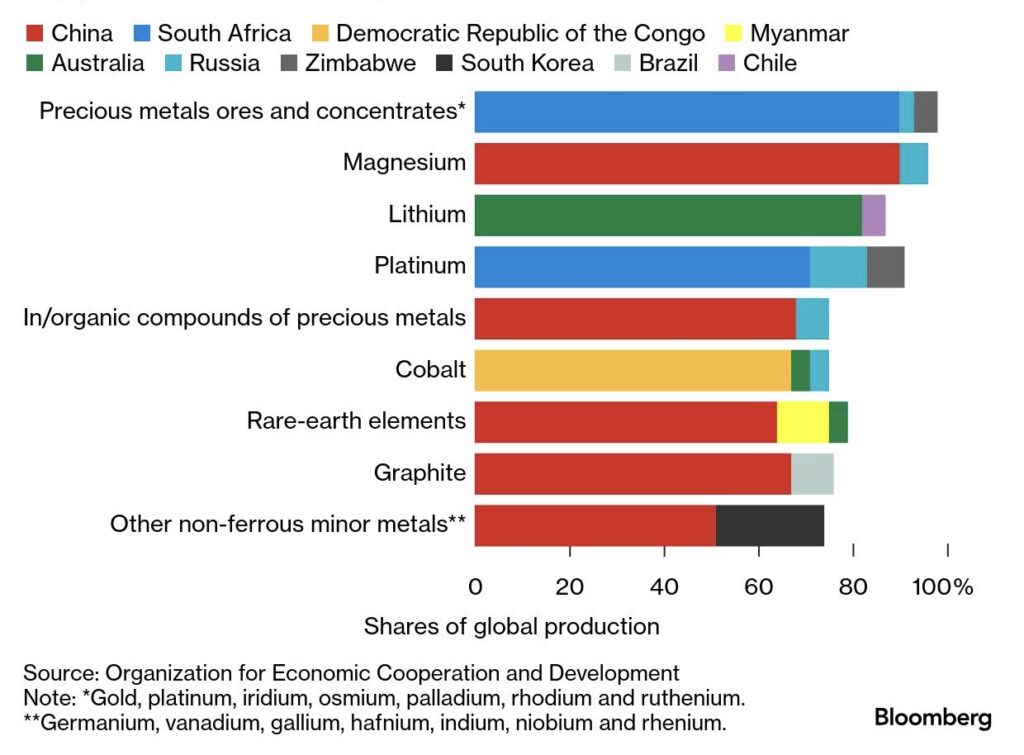
The graph immediately shows a strategically relevant reality: for many critical raw materials, global production remains highly concentrated in a small number of countries.
It is not just an economic figure. It is an indicator of structural power.
When a few actors hold dominant shares of supply, the market loses its neutrality and commercial dependence can turn into systemic vulnerability.
But the decisive point emerges even more clearly if we look at the intermediate segments of the supply chain.
According to the IEA, the average share held by the top three refining countries for the main energy minerals has risen from about 82% in 2020 to 86% in 2024. Rather than a mere concentration of the “top three”, the figure signals the strengthening of a few dominant refining hubs: Indonesia in nickel and especially China in cobalt, graphite, rare earths, and, to a large extent, lithium.
Projections to 2035 indicate only slow diversification, with an average level still around 82%. In other words: even where extraction is distributed a little more widely, the real bottlenecks remain firmly concentrated in refining and processing.
This is where the issue of critical minerals ceases to be a mere industrial dossier and becomes a dossier of economic security. Control of the node often counts more than control of the resource in abstract terms.
Refining, chemical processing, logistics, continuity of supply, industrial standards and permitting capacity are today decisive components of the competition between powers.
A total blockade of exports is not necessary for coercive dynamics to emerge: often it is enough to introduce friction, slow down approvals, restrict licenses, increase uncertainty, or make access more expensive.
For a long time, Western economies have considered global supply chains as tools of efficiency.
The priority was to optimize costs, time, and production specialization. This logic generated economic benefits, but also built deep dependencies in the segments that are least replaceable.
Today, the supply chain is no longer just an economic structure: it is a real infrastructure of power. Those who control the crucial intermediate stages of the value chain can influence the industrial competitiveness of others and, over time, even their freedom of strategic choice.
In this context, China’s position should be viewed with cold analytical scrutiny. Over time, Beijing has built a dominant presence in numerous key segments of refining, and the IEA indicates that China remains the leading refiner for 19 of the 20 minerals monitored, with an average share of around 70%.
This position not only produces commercial advantage: it also produces systemic pressure capabilities.
At the same time, it is important to avoid caricatured readings. The Chinese leverage is not used only in an offensive way, but also as a tool of response and strategic compensation for the tightening of trade and technological competition.
The recent picture confirms this: according to the USGS, in 2025 China tightened export controls on several rare earths, further expanding them in October before suspending some of them for a year in November; the IEA also reports the tightening of restrictions on gallium, germanium, antimony and other critical materials in the context of growing trade tensions.
Update (July 2026): The suspension of the most recent part of the controls on rare earths, ordered in November 2025, was confirmed by China until November 10, 2026, while the controls introduced on April 4, 2025 remain fully in effect. From July 1, 2026, a new package of measures came into effect that further strengthens state control over the entire chain of strategic minerals: an internal reporting system (with incentives for those who identify non-compliant exports) and broader powers granted to the Ministry of Commerce to investigate foreign governments, companies, or organizations deemed responsible for harming Chinese industrial interests. The picture confirms, with an additional tightening of regulations, the central thesis of the article: control of the nodes of the supply chain remains the true lever of power, more than the availability of the resource itself.
For Europe, all this represents a test of strategic credibility.
It is not enough to call for technological autonomy, industrial policy or a green transition if the material foundations of that project remain exposed to decisions made elsewhere.
For years the European mistake has been to confuse access with control: being able to buy is not the same as holding a position, importing is not the same as governing, and today's commercial availability does not guarantee tomorrow's industrial security.
For Italy, the problem is even more pronounced. The country is not a mining power, but it remains a large manufacturing economy.
And this is precisely its exposure. Automotive, components, industrial electronics, storage, networks, defense, and advanced mechanics increasingly depend on critical inputs whose governance lies outside the country.
Vulnerability, therefore, does not translate only into higher prices. It takes the form of a cumulative risk: costs, delays, loss of competitiveness, less predictability of investments and narrowing of the national strategic margin.
This dynamic becomes even more significant at a time when export restrictions on industrial raw materials have increased by more than five times since 2009, with a sharp acceleration in 2023.
The conclusion is simple but politically demanding. Critical minerals are not just a question of scarcity. They are a question of structural command.
The graph shows the concentration of production; IEA data show that the concentration remains even higher in the refining segments; the OECD report confirms that the use of trade restrictions is increasing.
Together, these elements outline a map of contemporary systemic vulnerability.
The question for Italy and for Europe is no longer just how to reduce a dependency. The question is more difficult: how to transform a structural vulnerability into industrial capacity, strategic coordination, and decision-making autonomy?
This article is part of the broader CSR analysis on
The access control to the global system
Further reading: the updated global systemic state in the GSA Dashboard.
Essential sources:
IEA, Global Critical Minerals Outlook 2025
OECD, Export restrictions on critical raw materials rise sharply amid growing demand (2025)
USGS, Mineral Commodity Summaries 2026; Rare Earths / Heavy Rare Earths sheets