


The crisis in Yemen is drawing attention back to Bab al-Mandab. To understand the risk to Saudi exports, we also need to look at how much crude Saudi Arabia can move from the Gulf to the Red Sea when transit through Hormuz becomes more difficult.
Saudi Arabia has two routes for exporting its crude. Tankers leaving the Gulf terminals pass through the Strait of Hormuz. Part of the crude can instead reach Yanbu, on the Red Sea coast, through the East-West pipeline. From there it can continue to the Mediterranean through the Suez system, which includes the canal and the Egyptian SUMED pipeline.
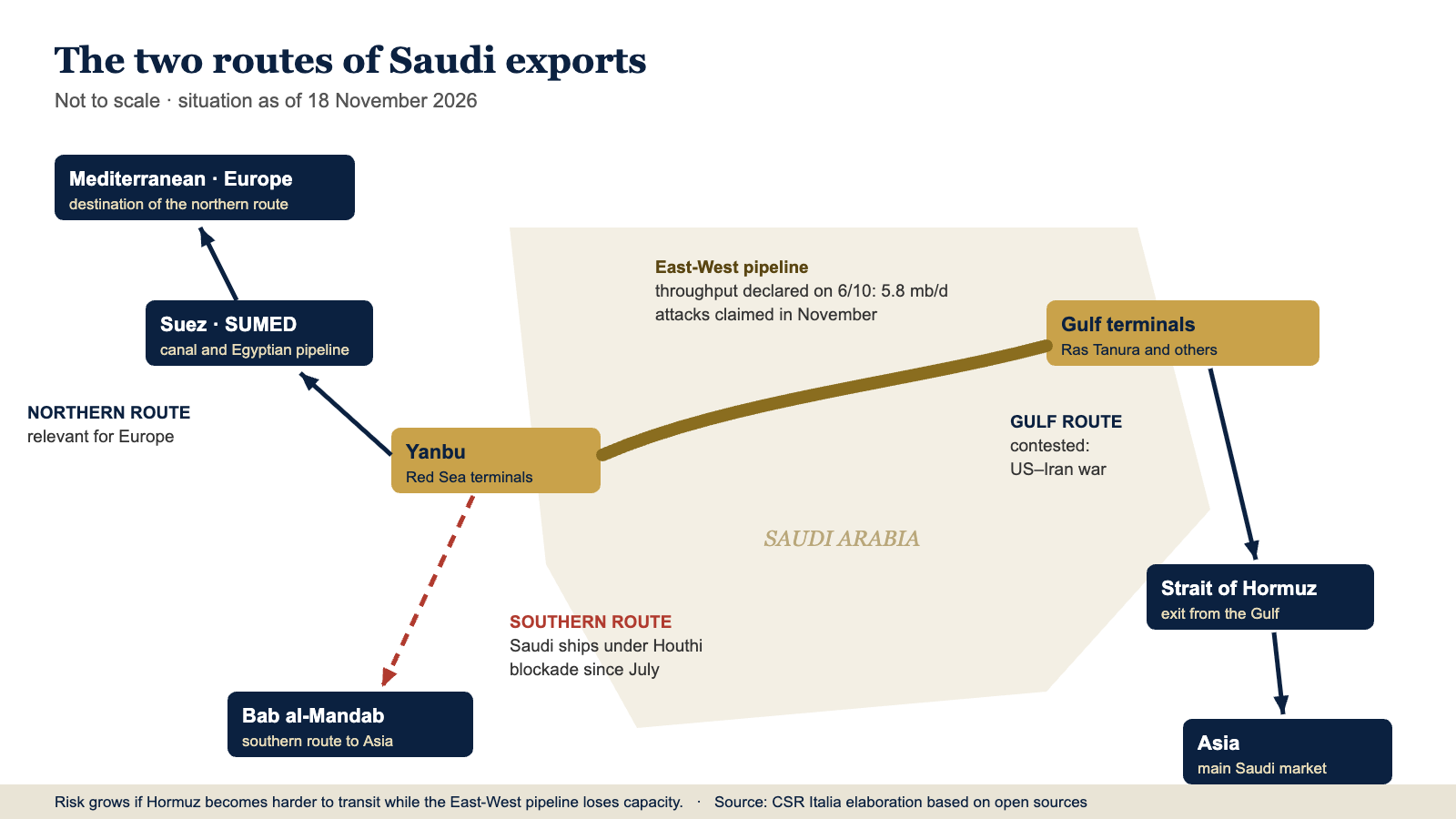
This second route gives Riyadh an alternative. Its value depends on how much capacity is actually available when needed and on the ability to deliver the crude to destination markets. The risk grows when both routes lose capacity at the same time, even if they remain partly operational.
Compensation capacity can change within a few weeks
In September, when Red Sea loadings stopped temporarily after an attack on the pipeline, Saudi Arabia increased shipments from the Gulf. That precedent shows that the system can offset a loss on one route when the other has spare margin.
In November, new claims of attacks on Saudi infrastructure and tensions in Hormuz raise a different question. Would compensation still work if both routes were under pressure? As of 18 November, the available information does not show whether the attacks have reduced Saudi Arabia’s actual export capacity, nor how much margin remains.
When a fall in Saudi exports becomes a crisis signal
A fall in loadings can result from shipments moving to other terminals, from weaker demand or from an operational problem. This is why Gulf and Red Sea shipments need to be watched together. A persistent fall in the national total deserves attention. To attribute it to a loss of capacity, there must also be evidence of the constraint that is limiting exports.
Over the next 30–90 days, the most plausible scenario is prolonged pressure with limited operational effects. A significant reduction in the availability of Saudi crude is less likely and would have broader consequences. The assessment would change if persistent difficulties in Hormuz and a confirmed reduction in capacity on the Red Sea route emerged at the same time.
What to watch from Europe
For Saudi crude heading to the Mediterranean from Yanbu, the northbound link through Suez and SUMED is particularly important. Watching only transits through Bab al-Mandab would therefore give an incomplete picture of Europe’s exposure. What also matters is the volume loaded on the Red Sea and the ability to deliver it to European markets without interruption.
The evidence available as of 18 November does not point to an imminent energy emergency for Europe. The strategic question is how much compensation capacity Saudi exports would retain if the difficulties on the two routes overlapped.
Further Readings
Restricted briefing
- CSR briefing «Yemen: Houthi offensive and residual capacity of the Saudi export system» (18 November 2026). Restricted access: request the password via Contact.
Related CSR analyses
- Iran in the international system: pressure, deterrence and systemic propagation. (Strategic Node)
- Middle East strategic analysis - Iran core
- Security of Flows and Strategic Chokepoints: The Acute Risk at Hormuz and Beyond
External sources
- ISPI, «Yemen, doppia stretta», 17 November 2026
- IEA, Oil Market Report – November 2026, 13 November 2026
- UKMTO, VRA Weekly Overview, 13 November 2026
- JMIC, Advisory Update 113, 12 November 2026
- Kpler, «Yanbu pipeline attack ripples across crude, freight and gas markets», 17 September 2026
- Reuters via Al-Monitor, withdrawal of government forces from Bab al-Mandab, 15 November 2026