

Ray Dalio World War: The Signal from the Financial Elites
Ray Dalio World War | Cognitive Signals and the Transformation of the Global System
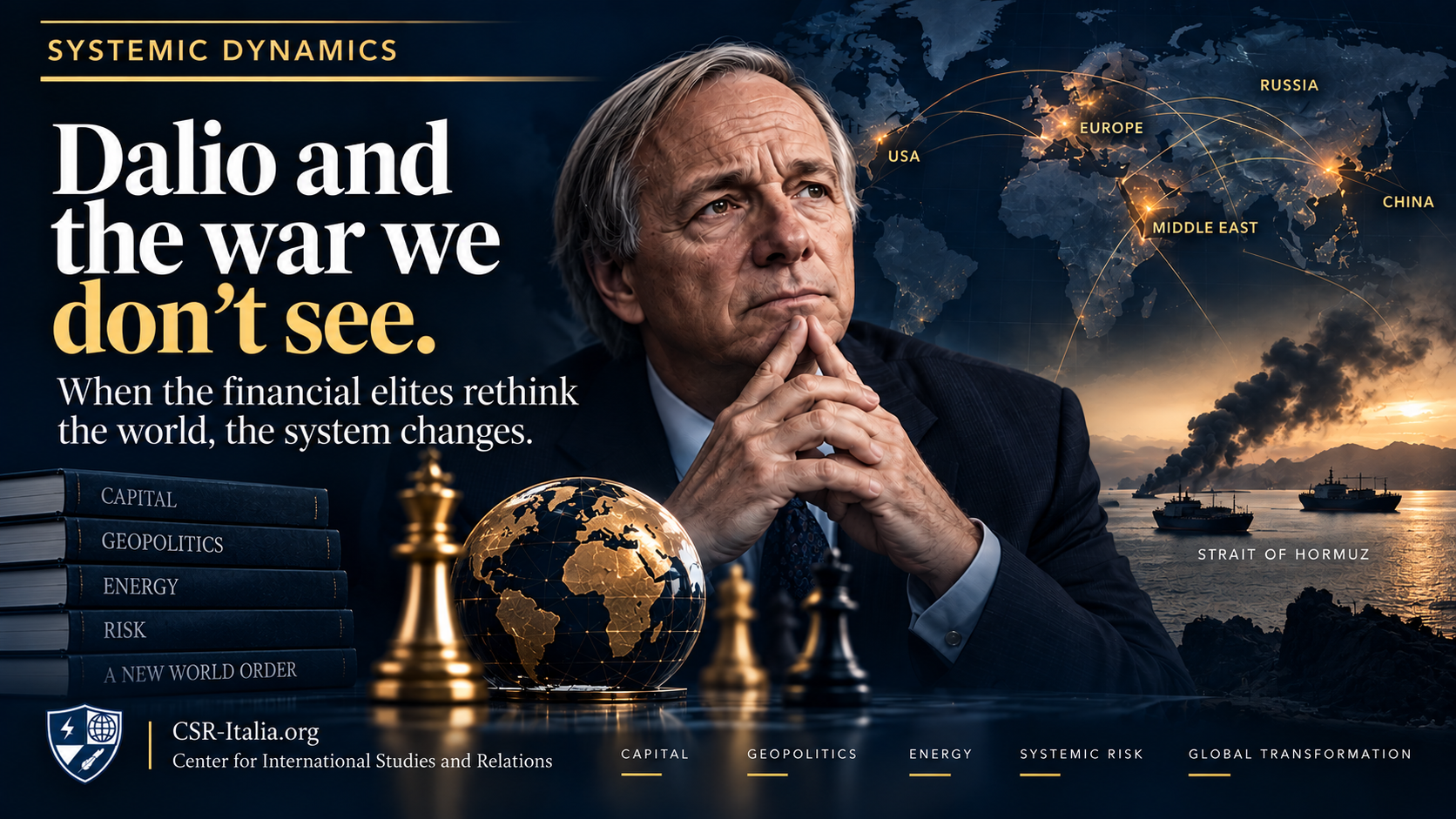
Dalio and the war we don’t see is not an article predicting a world war. It is an analysis of how a central figure within the financial elites is signalling a transformation of the global system.
Ray Dalio is not predicting a world war. He is signalling that the global system has already entered a phase of structural conflict.
When a figure operating at the heart of the global financial elites uses expressions such as “world war”, the key point is not the prediction itself, but the signal being transmitted: a shift in risk perception within decision-making circles.
This type of signal operates within the cognitive domain of the system, often anticipating shifts that only emerge later in the financial, energy and geopolitical domains.
Ray Dalio World War: A Signal of Systemic Transition
The idea of a new world war is not new. What has changed is who has started saying it out loud.
Ray Dalio, founder of Bridgewater Associates and one of the most influential macro investors in history, has written that “we are in the early stages of a world war that isn’t going to end anytime soon”. The point is not to determine whether this diagnosis is literally correct, but to recognise that it comes from one of the most sophisticated actors in the global financial system.
This does not imply that the scenario he describes is the most likely one. It means that it has become conceivable to those who influence the system.
This is not a think-tank forecast. It is an indicator of cognitive transition coming from someone who manages hundreds of billions.
In his contribution to TIME and in a parallel LinkedIn post, Dalio connects the crisis in the Strait of Hormuz with the other active fronts — Russia-Ukraine, Israel-Gaza-Lebanon-Syria, Yemen — and with the broader confrontation involving China, Russia and Iran.
These are not isolated conflicts, but an interlocking combination of “shooting wars” (armed conflicts) and “non-shooting wars” (trade, technology, capital and influence wars) that constitutes an atypical form of systemic warfare: without a formal declaration and without a clear prospect of resolution.
“Virtually nobody is talking about the fact that we are in the early stages of a world war that isn’t going to end anytime soon”, Dalio writes. He adds that markets continue to price in a rapid return to normality, underestimating the duration and depth of the process underway.
The real value lies not in the diagnosis, but in who is making it.
Financial elites do not produce analysis simply to describe the world: they produce it to position themselves in relation to systemic risk.
When an investor of Dalio’s stature abandons the language of “manageable crises” and openly speaks of a prolonged world war, he is signalling a profound shift in risk perception.
It is no longer “geopolitics as a temporary disruption”.
It is “geopolitics as the new structural environment”.
This shift is decisive because it changes the behaviour of those who allocate capital.
It changes portfolio allocation towards gold, commodities, defence and real assets.
It changes risk tolerance and investment time horizons.
It changes demand for hedging against scenarios of systemic fragmentation.
When the interpretation of reality changes among those who control the flow of global capital, the system itself begins to behave differently.
Hormuz is not the end point. It is the multiplier.
Dalio is right to identify the Strait of Hormuz as a critical node.
The control of energy flows, the ability to project threats and the impact on prices, inflation and supply chains make it one of the most sensitive chokepoints in the global system.
But reducing it to a simple “test for the United States” would be an oversimplification.
The Strait does not need to be completely closed to generate systemic damage.
It is enough to make its flows unstable and costly.
In a phase of multidomain competition, prolonged uncertainty is often more effective than a single shock.
Yet even on this point, Dalio invites us to look beyond the immediate event.
The Iranian crisis is only one theatre within a broader dynamic in which actors putting pressure on the existing order operate simultaneously across multiple domains, without necessarily forming a monolithic bloc.
Update – July 2026
The Hormuz crisis referenced by Dalio ended with a memorandum of understanding on 14 June 2026, after 107 days of conflict and a period of naval blockade (11–13 April). In the meantime, Dalio himself had broadened his analysis: in a February 2026 intervention, preceding the one discussed here, he had already warned that the world was “on the brink” of a “capital war” — a war fought with the instruments of capital (currency controls, the use of the dollar as leverage) rather than primarily with military weapons — while advising investors to hold gold as a hedge (up to 15% of their portfolios).
Update — September 2026: from “world war” to competition over the international order
Subsequent developments reinforce the interpretative framework proposed in this article, while providing a clearer definition of its nature. The key issue is not so much an approach towards a world war in the twentieth-century sense of the term, but the growing overlap between geopolitical conflict, financial competition and the transformation of the international order.
In June 2026, following a trip to Asia and meetings with political decision-makers in the region, Ray Dalio further developed this interpretation, arguing that the US handling of the Hormuz crisis had contributed to changing international perceptions of the United States’ ability and willingness to bear the costs required to sustain the existing order. In his interpretation, changes in perceptions of US reliability tend to affect alliances and, more broadly, the configuration of the international order.
At the same time, the concept of “capital war” invoked by Dalio is acquiring broader relevance in the financial debate. The growing politicisation of capital flows, foreign-exchange reserves, sovereign securities and cross-border investment shows how financial instruments can become part of strategic competition between states, alongside trade, technology, energy and military capabilities.
This evolution reinforces the central argument of the article. The relevant signal is not that Dalio’s prediction of a “world war” must necessarily materialise. It is that interpretative categories once regarded as extreme — prolonged conflict, fragmentation of the international order, capital war, and declining confidence in systemic guarantees — are progressively entering the frameworks through which political and financial decision-makers interpret the system.
The shift to watch therefore remains cognitive before it becomes military: when what systemically relevant actors consider plausible changes, so too do the strategies through which they allocate capital, build alliances and prepare for risk.
It is not (yet) a classical world war. It is something more insidious.
The narrative of “two blocs” has its rhetorical usefulness, but reality is more fluid: diverging interests, different risk thresholds, and alliances that are often tactical rather than expressions of permanent strategic alignment.
The system is not yet in a declared total war.
It is in a distributed, multidomain, and for the most part undeclared systemic competition — a configuration that can be read as an advanced phase of systemic friction.
Precisely for this reason, Dalio’s reading is valuable: it describes a transition in which the old order based on shared rules is eroding without a new stable one having yet emerged.
The change that really matters
Dalio’s intervention is not an apocalyptic prophecy. It is an indicator of transformation in the way elites interpret the system.
When major institutional investors stop reading the current phase as a sequence of temporary crises and begin to incorporate the possibility of a prolonged conflict into their baseline scenarios, the variables that matter begin to change: long-term strategies, risk management, the relationship between debt and growth, and the allocation of capital.
When the behaviour of capital changes, the material reality of the system changes as well.
Conclusions
We are not necessarily on the threshold of a world war in the twentieth-century sense of the term.
But we are certainly beyond an interpretive point of no return: the point at which the system could still be read as fundamentally stable, with only episodic turbulence.
Wars begin when facts on the ground change.
Global systems change when the way elites read them, price them and, consequently, finance them changes.
To understand the theoretical framework within which these signals can be interpreted, see also:
Cognitive Power as a Strategic Infrastructure
On the level of influence networks, opacity, and the systemic vulnerabilities of elites, this article also connects to:
The fragilities of global power networks.
For a financial articulation of the same systemic transformation, see also:
BlackRock does not save Trump
Trump in the global financial system: politics, markets, and elites
Further reading: the updated global systemic state in the GSA Dashboard.