


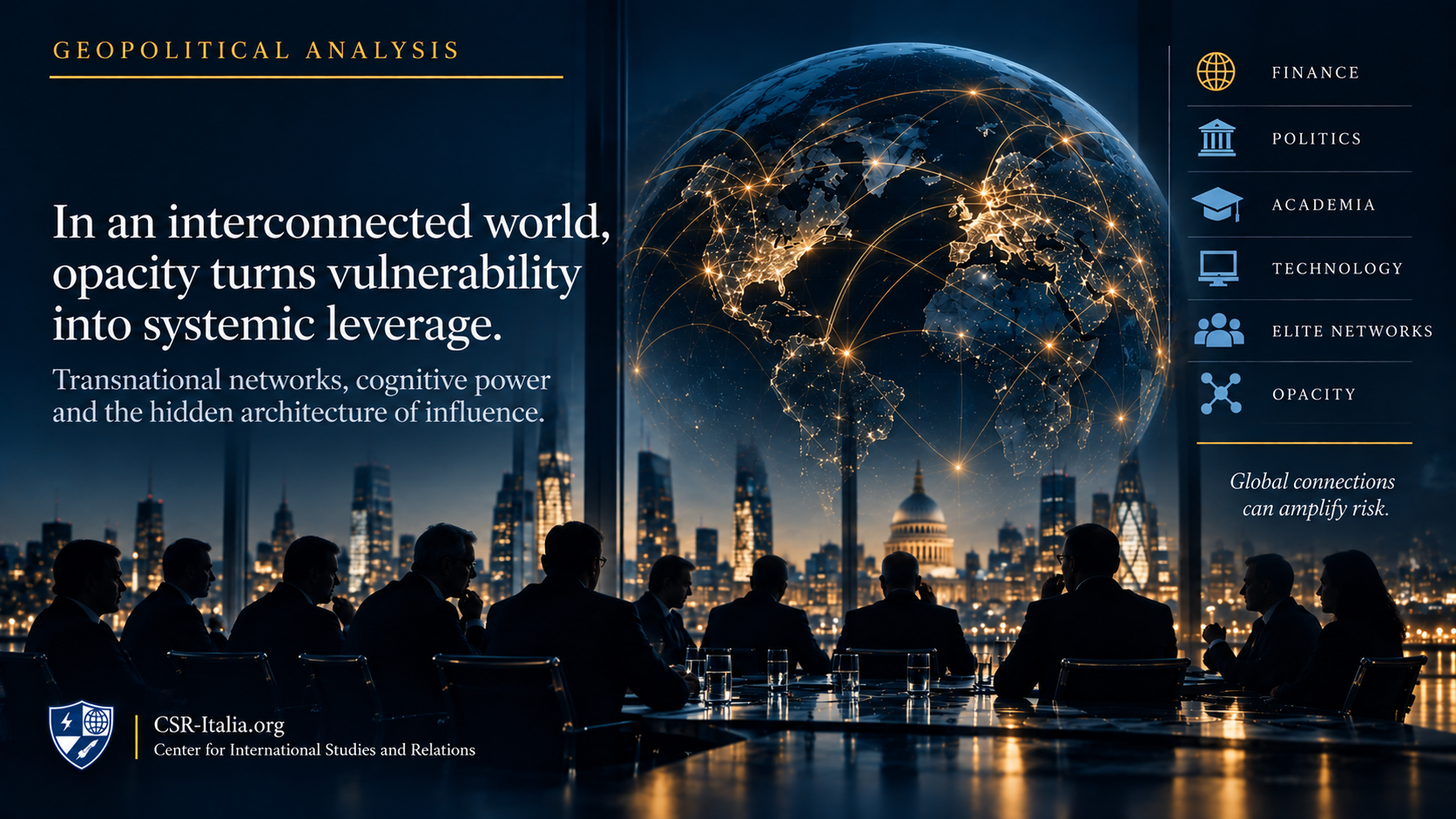
Power Networks | Opacity, Interconnection and Cognitive Power in Transnational Networks
Thesis
Global power networks display structural vulnerabilities arising from the combination of financial opacity, jurisdictional fragmentation and the concentration of social capital. These vulnerabilities are not only material or reputational: they are cognitive.
Mechanism
When finance, politics, academia and technology converge within restricted and opaque environments, individual vulnerability can become a source of systemic leverage, affecting the symbolic and decision-making stability of the entire network.
Scope
The analysis does not focus on individual judicial cases, but examines the structural conditions that make opaque forms of influence possible within global power networks.
When interconnection generates fragility
Globalisation has not only expanded markets. It has also densified networks.
Contemporary elites operate in environments characterised by transnational mobility, direct access to decision-making centres, and integration across economic, political, and scientific spheres. This relational density produces operational efficiency, but also systemic fragility.
In highly connected systems, a vulnerable node does not remain isolated: it transmits reputational, symbolic, and decision-making effects across the entire ecosystem.
Elite Networks and Informational Asymmetry
High concentration of social capital
Privileged access to public decision-makers, investors, academic institutions, and research centres consolidates networks with strong relational centrality.
Low operative transparency
Multilayered corporate structures, trusts, foundations, and offshore jurisdictions reduce the traceability of flows and responsibilities.
Informative asymmetry
Insiders possess information and connections that are not accessible within the public sphere, creating a structural imbalance between the network and the external environment.
In this context, individual vulnerability — reputational, financial, or behavioural — can become a source of indirect leverage. There is no need to posit a centralised direction: it is sufficient to observe the dynamics of complex systems.
Jurisdictional Opacity as a Risk Multiplier
Global governance is structurally fragmented. Differences between legal systems, regulatory arbitrage, and overlapping jurisdictions make responsibility diffuse and, at times, diluted.
This fragmentation does not automatically produce unlawful conduct, but it reduces the system’s capacity to coordinate accountability. When an actor operates simultaneously across multiple jurisdictions, the line of responsibility becomes less clear.
It is a mechanism analogous to global supply chains: each segment responds to different rules, and overall responsibility is distributed along the sequence. As long as the system functions, that complexity remains invisible.
When a vulnerability emerges in a highly central node, interdependence suddenly becomes visible. The perception of technical neutrality gives way to the political dimension of responsibility.
At that point, the vulnerability is no longer merely individual: it becomes systemic.
Node Vulnerability and the Destabilisation of Cognitive Infrastructure
As outlined in the foundational text “Cognitive Power as a Strategic Infrastructure”, contemporary power does not operate primarily through direct coercion, but through the preventive normalisation of available options.
Elite networks are not merely relational structures: they constitute active nodes within this cognitive infrastructure. They contribute to defining what appears legitimate, responsible, and technically inevitable within the decision-making space.
The node as cognitive point of stress
When a highly central node displays a vulnerability, the effect is not merely reputational. It becomes an event of cognitive disruption.
The field of what can be said expands. Relationships that had previously been normalised become open to questioning. Technical neutrality is subjected to scrutiny.
The system does not lose only relational stability: it temporarily loses its capacity to normalise options in advance.
Restructuring the field of the possible
Cognitive power does not impose: it normalises. Vulnerability disrupts that normalisation.
What had appeared inevitable or technically neutral becomes open to discussion. It is not the event in itself that destabilises the network, but its capacity to call into question the epistemic field that had sustained it.
Feedback and Reconfiguration
In complex systems, cognitive shock generates feedback. The system may either reinforce its closure mechanisms or reorganise itself around more rigorous standards. In both cases, the cognitive infrastructure is recalibrated.
Apparent Stability and Latent Fragility
Highly interconnected networks appear resilient. The removal of a single node does not automatically produce the collapse of the entire system. However, the exposure of a vulnerability can fracture the symbolic coherence that sustains the network.
In a global system marked by high relational density, stability depends on the capacity to control not only material chains, but also the field of the thinkable.
Conclusions
This dynamic confirms what is outlined in the theoretical framework of cognitive power adopted by CSR. Systemic stability does not depend solely on control over material chains, but on the capacity to pre-structure what appears realistic and legitimate.
When a central node is exposed, it is not only a relationship that begins to fracture: the cognitive infrastructure that had sustained it is also exposed. It is in that exposure that the deeper fragilities of highly interconnected systems emerge.
The strategic issue does not concern the individual event. It concerns the model. In the absence of systemic transparency and cognitive autonomy, interconnection can turn from a factor of strength into a generator of vulnerability.
For a financial and operational reading of these dynamics, see also BlackRock is not saving Trump. Is hedging Trump
To examine how a shift in risk perception within financial elites can become a signal of systemic reconfiguration, see also Dalio and the War We Don’t See.
Further reading: the updated global systemic state in the GSA Dashboard.