


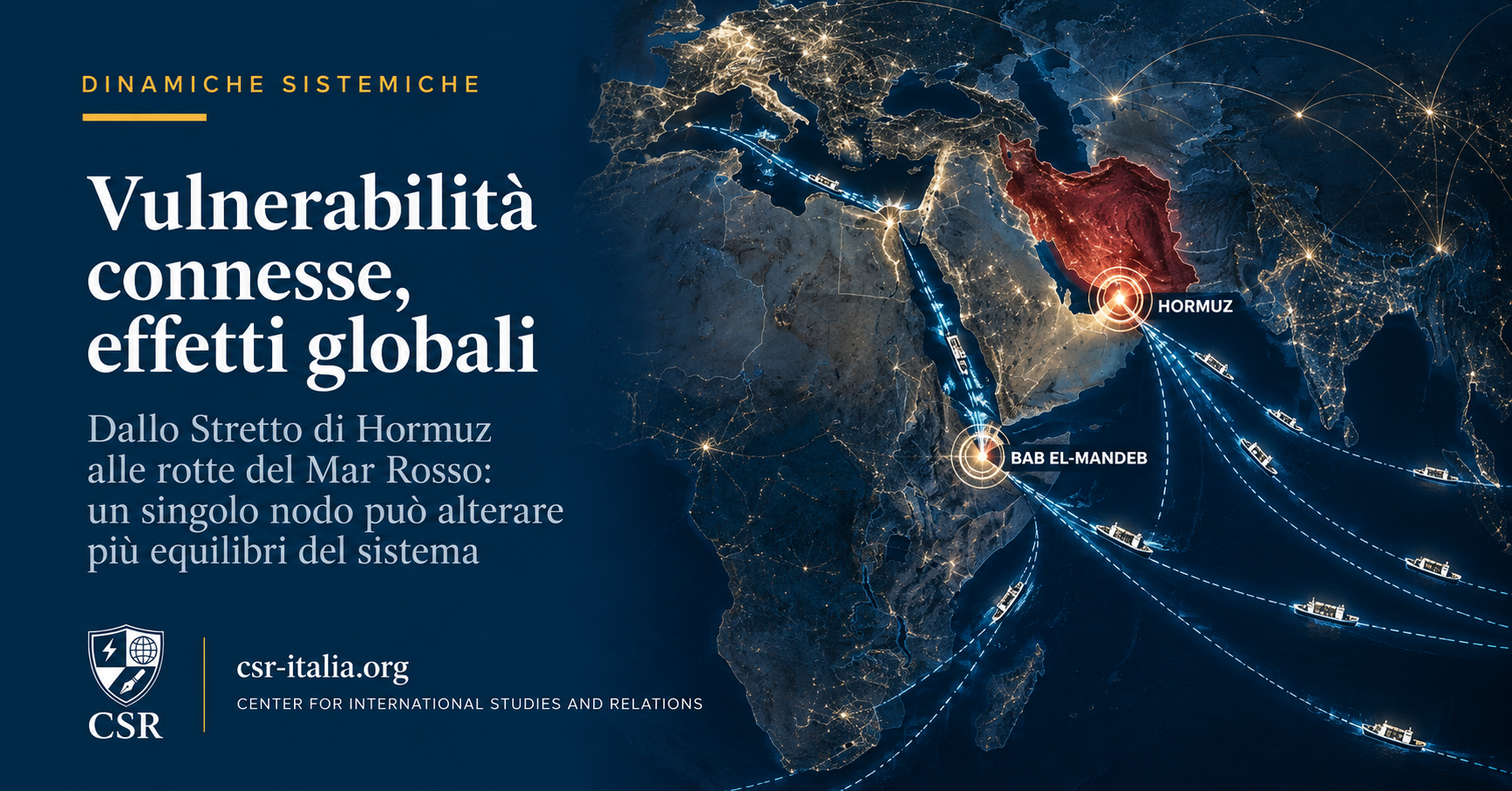
In the contemporary international system, some chokepoints no longer represent merely critical points along trade and energy routes, but nodes through which localized pressure can propagate across domains and macro-regions.
When a crisis erupts in a node of high strategic density, the most common mistake is to continue reading it as a local event.
Attention focuses on the initial theatre, the actors directly involved, and the most visible military sequence.
But not all crises remain where they begin. Some, precisely because of the point at which they ignite, quickly begin to transmit pressure beyond their immediate perimeter.
In the current Gulf context, marked by reduced transit flows and renewed energy volatility, this mechanism of propagation emerges with particular clarity.
Strategic chokepoints are not merely geographical passages.
They are points of condensation between security, energy, trade, finance, logistics, and political stability.
When they enter into crisis, it is not only the regional context that deteriorates: a mechanism of propagation is activated that can affect multiple domains simultaneously and transfer pressure towards other macro-areas of the international system.
In this sense, the Gulf crisis should not be observed merely as a sequence of attacks, retaliations, or military postures. It should be read as a concrete case of systemic propagation. To understand it, the point is not to add yet another account of events, but to grasp how a localised tension ceases to remain local.
For CSR, this reading does not arise from chronicle but from method. As explained in [MST Methodological Foundations], the international system is not observed as the sum of isolated episodes, but as a dynamic configuration of pressures that accumulate across the different domains of geopolitical macro-areas and interact with one another.
The analytical value therefore lies not in the individual event, but in the ability to identify when a pressure begins to transfer, amplify, and converge on a wider scale.
Three levels of Systemic Propagation
Intra-domain: pressure spreads within the same functional space.
Inter-domain: pressure passes from one domain to another.
Inter-macro-area: pressure is transferred towards other geopolitical areas.
The Point of Origin of the Pressure
Every systemic propagation has a point of origin. In the current case, that point is the Gulf, and in particular the strategic space revolving around the Strait of Hormuz.
On this point, CSR has already drawn attention in the article [Hormuz Is Not Just a Strait], where the passage is correctly defined not as a simple maritime route, but as one of the main chokepoints of the global economy.
But the decisive point here is another. A chokepoint matters not only for what passes through it. It matters for what happens to the system when that transit becomes unstable.
Vulnerability does not arise only from absolute closure. It already emerges when uncertainty, operational risk, insurance costs, planning difficulties, and the perception of insecurity increase along an essential route.
The crisis thus generates a primary pressure in the maritime-energy domain.
This is the first form of tension: not yet fully systemic in the strict sense, but already capable of producing effects that extend beyond the theatre of origin.
The Intra-domain Propagation
The first level of propagation occurs within the same functional space.
A tension arising in a maritime chokepoint does not remain confined to a single stretch of sea.
It is transferred to the entire logistical chain that depends on that corridor.
In this phase, pressure manifests itself through interconnected effects: reduced traffic fluidity, rising insurance premiums, longer transit times, increased transport costs, energy price volatility, and procurement difficulties.
The system thus begins to lose elasticity. Not because it is totally interrupted, but because it becomes more costly, more fragile, and less predictable.
This passage is essential. A crisis does not always expand through a sudden leap. Much more often, it spreads through cumulative friction.
Each segment of the chain absorbs a share of pressure and transmits it to the next. In this way, a local tension is transformed into distributed vulnerability.
The Inter-domains Propagation
A crisis becomes truly systemic when pressure leaves the domain in which it originated and begins to transfer into other domains.
In the Gulf case, the pressure generated in the maritime-energy domain does not remain confined to navigational security or to the price of commodities.
It rapidly shifts into the economic domain, because it alters costs, expectations, margins, and industrial planning. It then moves into the cognitive and informational domain, because every prolonged crisis expands the space for perceptual manipulation, narrative saturation, and strategic uncertainty.
It may also affect the cyber and technological domain, because contemporary conflicts increasingly target not only physical infrastructure or military platforms, but also civilian networks, digital ecosystems, and critical architectures.
It is at this point that the crisis changes in nature. It is no longer merely a crisis in the Gulf. It becomes a mechanism for the transmission of pressure across different domains. And the more interdependent these domains are, the faster propagation accelerates.
Propagation Across Macro-Areas
The third step concerns the geopolitical space.
Pressures do not stop at the boundaries of the macro-area in which they originate. When they pass through interconnected domains, they begin to produce effects also on macro-areas other than the one of origin.
In the case under examination, the Gulf does not remain an isolated theatre.
Tension affects the Red Sea, impacts broader trade routes, increases the relevance of the Eastern Mediterranean, and falls back on Europe in the form of energy, logistical, industrial, and informational pressure.
It does not necessarily amount to a linear expansion of the conflict in military terms.
Rather, it takes the form of a subtler, and often more dangerous, extension of systemic pressure.
This is precisely the point that a purely event-driven reading tends to miss.
The international system does not destabilize only when a war widens formally.
It can also destabilize when the pressure generated in one macro-area begins to transfer continuously toward other areas that depend on the same infrastructure, the same flows or the same market equilibria.
For Europe, and therefore for Italy, the issue does not concern only the price of energy. It concerns the sum of energy, logistics, insurance, supply-chain continuity, the vulnerability of critical infrastructure and the degradation of the information environment.
It is this convergence that turns a regional crisis into systemic pressure.
Update note: the Gulf case used in this article as an example of propagation did not close in June. After the memorandum of 14 June 2026, the cycle reignited in late July — the Houthi blockade of the Bab el-Mandeb (20 July), the attacks on Saudi facilities, Saudi Arabia's entry into the conflict (29 July) — offering further, clear evidence of the mechanism described here: a tension that appears locally recomposed can reactivate and transmit across domains and macro-areas. The propagation mechanism remains valid regardless of the outcome of the individual case.
Update note — September 2026:
the Gulf case used in this article as an example of systemic propagation did not end with the renewed escalation in late July.
Developments in September further confirmed the mechanism described: the persistent degradation of transit through strategic chokepoints such as Hormuz and Bab el-Mandeb, together with adjustments to Saudi energy routes, shows how a localized disruption can spread across different infrastructures, domains and strategic corridors.
The analytical point is not the sequence of individual events, but the capacity of pressure to persist, migrate and recombine within the system. The propagation mechanism therefore remains valid regardless of how the individual episode evolves.
Why this Matters for the CSR Method
The value of a case like this does not lie only in its contingent impact. It lies in the fact that it shows, in a readable way, how multidomain systemic pressure operates.
As clarified in the
Architecture of the MST Framework,
CSR observes the main geopolitical macro-areas through six invariant structural domains:
security and military postures;
energy and infrastructural architectures;
financial and monetary circuits;
normative and regulatory standards;
the cognitive and informational domain;
technological-industrial ecosystems.
Regional assessments are then integrated into the [Global System Assessment], which measures the overall state of the system resulting from the interaction among macro-areas.
This means that a crisis is not interpreted solely in terms of what happens in its initial theatre. It is observed in terms of how it generates pressure across domains, how that pressure is transferred to other domains, and how, ultimately, it produces spillover effects across macro-areas.
From this point of view, the Gulf case is exemplary. Not because it is the only relevant crisis, but because it makes a general mechanism visible: a local tension can acquire systemic relevance when it passes through infrastructures, networks, and perceptions that connect multiple geopolitical spaces to one another.
The Real Strategic Implication
The most important lesson is not that the world has suddenly become fragile. It is that its fragility was already there, but remained partly hidden until the points of pressure were activated.
Chokepoints, energy networks, supply chains, digital architectures, and the cognitive environment are not separate layers. They are the elements through which the system holds, adapts, or deteriorates.
When a crisis enters these nodes, the distinction between “regional” and “global” begins to lose precision. Not because everything everywhere becomes open conflict, but because pressure is distributed in a reticular way and affects spaces far wider than those in which it originated.
For this reason, the strategic question is not only whether a war will expand. The real question is whether the tension it has generated is already beginning to propagate across domains and macro-areas with sufficient persistence to alter the configuration of the system.
CSR editorial Closing
The Gulf crisis is not relevant only because of what happens in the Gulf. It is relevant because it clearly shows a more general principle: in the contemporary international system, tensions do not remain fixed in the place where they emerge. They are transmitted.
They are transmitted along maritime routes.
They are transmitted through energy.
They are transmitted through logistical costs, digital infrastructures, markets, supply chains, and the cognitive environment.
And when this transmission affects multiple macro-areas, the problem is no longer the single crisis: it is the systemic configuration that derives from it.
It is precisely at this point that the CSR method finds its operational meaning.
Not limiting itself to describing the event.
Reading the pressure.
Measuring its propagation.
Understanding when a local crisis has already begun to become something more.
For a fuller understanding of the methodological framework, see:
Official CSR Methodological Framework
For an analysis specifically dedicated to the role of Hormuz as a global chokepoint, see:
For an overall reading of the state of the system, please refer to the:
For requests concerning dedicated briefings or restricted assessments: