

June 2026 | CSR Italia | Strategic Nodes Dossier | Energy Vulnerability | Global Maritime Chokepoints
Update Note — US–Iran MoU, 14–15 June 2026
On 14–15 June 2026—following the completion of this analytical cycle—the United States and Iran signed a Memorandum of Understanding (MoU) on the reopening of the Strait of Hormuz and the launch of renewed nuclear negotiations. The agreement was signed virtually by Trump and Vance for the United States and Speaker Ghalibaf for Iran, with Pakistan acting as mediator and a formal ceremony held in Switzerland. The document, approximately one and a half pages in length, was intentionally drafted in broad and general terms.
The MoU's main provisions include the reopening of the Strait of Hormuz upon signature, the end of the US naval blockade of Iranian ports, the return of IAEA inspectors, and the launch of a sixty-day nuclear negotiation process. Market reactions were immediate: oil prices fell by approximately four dollars per barrel, while the Nasdaq recorded gains.
The MoU does not, however, resolve the immediate operational challenges. Mine-clearing operations are expected to require forty to fifty days before insurers and shipping companies regain sufficient confidence to resume normal transit (estimates indicate up to one thousand Iranian naval mines). Hundreds of vessels remain delayed, with only three VLCCs having transited the Strait on 15 June. The Houthis have provided no independent stand-down guarantees and may continue to operate autonomously from Tehran. Implementation also remains contested: Tehran links the start of negotiations to the release of frozen assets, while Washington rejects this interpretation. Under the most optimistic scenario, approximately 50% of pre-war traffic could recover during the first month, while a full restoration of maritime flows is not expected before the end of 2026, if not later.
This assessment reflects the situation as of 17 June 2026 and does not yet incorporate the effects of the MoU into its structural evaluation. An updated assessment will be published within two to three weeks, once the post-signature operational environment has reached a sufficient level of stability.
Maritime Chokepoints as Systemic Leverage
Maritime chokepoints are the strategic bottlenecks of international trade: mandatory geographic corridors through which energy, goods, and global supply chains flow. Their strategic significance lies in the fact that they cannot be replaced in the short term. Whoever controls them—or places them under sustained pressure—exerts leverage over the global economic system.
This assessment covers seven maritime chokepoints experiencing either structural disruption or latent vulnerability during the period from November 2023 to June 2026. It integrates multiple categories of open-source evidence: documented flows and actor architecture (structural OSINT), geographic and infrastructure analysis (open GEOINT), digital and cyber vulnerabilities (open CYBINT), public narratives and influence operations (SOCMINT and COGINT), and observable physical indicators (MASINT-Light).
Data source: U.S. Energy Information Administration (EIA) analysis, based on Vortexa tanker tracking; World Bank; and Panama Canal Authority data, using EIA conversion factors and calculations
Notes: 1H25=first half of 2025
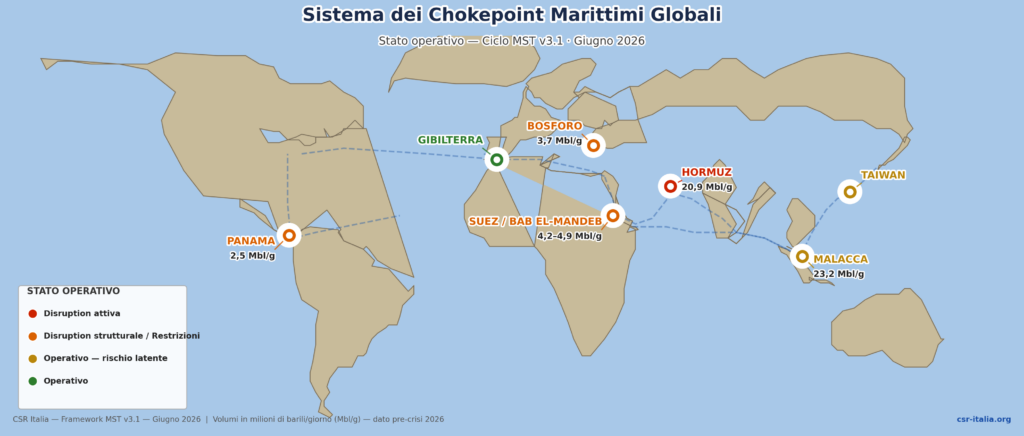
The Seven Chokepoints Covered by the Assessment
Strait of Hormuz — Active Disruption
Formally closed since 4 March 2026. Handles approximately 21% of global energy flows. The primary node of the current crisis and the focal point of the US–Iran military escalation in June 2026.
Suez Canal and Bab el-Mandeb — Structural Disruption
Maritime traffic has declined by 48% compared with 2022 as a result of the Houthi campaign ongoing since November 2023. These routes account for approximately 12% of global trade and constitute the principal Europe–Asia gateway for LNG flows to the European Union.
Strait of Malacca — Operational, Increasing Latent Vulnerability
The world's busiest maritime chokepoint, with approximately 23.2 million barrels per day transiting through it. Indo-Pacific energy dependence makes it a structural multiplier of crises affecting other strategic nodes.
Panama Canal — Structural Restrictions
Persistent drought conditions since 2023 have reduced transit capacity. The Canal handles approximately 2.5% of global trade, with particular importance for LNG, grain, and US–Europe container traffic.
Taiwan Strait — Operational, High-Impact Latent Risk
Physically open. The Chinese Navy's capacity to impose maritime interdiction continues to expand. The principal latent risk concerns global technology supply chains, with potentially catastrophic implications for semiconductors and the digital industry.
Bosphorus and Dardanelles — Operational with Restrictions
The Montreux Convention continues to be enforced under active restrictions. These waterways control access to the Black Sea and the flow of Ukrainian grain exports. NATO and Russian naval forces remain under heightened tension.
Strait of Gibraltar — Operational
Atlantic–Mediterranean gateway. Currently assessed as having low vulnerability, while remaining under continuous monitoring.
Operational Situation as of June 2026
Security and Military Dimension
Between 6 and 8 June 2026, direct military strikes were exchanged between the United States and Iran in the vicinity of key maritime chokepoints—the first direct military escalation of this magnitude since April 2026. The Strait of Hormuz has remained formally closed since 4 March 2026: the closure is no longer a deterrent measure but a structural operational reality. The Houthi campaign in the Red Sea—ongoing since November 2023—has reduced Suez traffic by 48% compared with 2022. In the South China Sea and the Taiwan Strait, the Chinese Navy's maritime interdiction capabilities continue to expand, maintaining a high-impact latent risk.
Energy
The shutdown of the Strait of Hormuz has removed approximately 11.3 million barrels per day from global markets (EIA STEO, May 2026). Around two thousand vessels remain stranded in the Persian Gulf. Brent crude has exceeded USD 105–107 per barrel. The International Energy Agency (IEA) has released 400 million barrels from strategic reserves—a temporary measure expected to provide relief for three to four months rather than a structural solution. Rerouting via the Cape of Good Hope has increased transit times by 50–70%, generating cascading effects on freight rates and global insurance premiums. LNG flows to Europe—already diverted away from the Suez route—are facing additional pressure.
Technology and Cyber
The Center for Strategic and International Studies (CSIS) has classified the GPS spoofing campaign in the Gulf as a Tier-1 threat: more than one thousand commercial vessels have experienced manipulation of positioning signals in the Strait of Hormuz. More than sixty cyber groups are currently active in the area, including fifty-three aligned with Iran. Targets include critical energy infrastructure, water systems, and supply chains. The structural shift lies in the transition from isolated cyber incidents to a sustained campaign using GPS and AIS as hybrid military-cognitive vectors: vessels become digitally invisible or falsely repositioned, amplifying market uncertainty and influencing decision-making even beyond the immediate physical effects.
Finance
War-risk insurance premiums have risen to five to ten times their pre-2022 baseline (Lloyd's List, Argus Media, June 2026). Freight rates—both for container shipping and oil tankers—have experienced structural spikes that are progressively transmitted to consumer prices. Global financial markets remain operational, with central banks maintaining effective policy instruments, but the risk of further deterioration linked to the duration of the crisis remains elevated.
Cognitive Dimension and Public Narratives
The dominant global narrative has shifted from viewing the situation as a "regional risk" to recognizing it as a "structural vulnerability of the global logistics and energy system." This perception is now widespread and persistent across the media, industry, and international institutions. AIS manipulation has become a hybrid vector: uncertainty regarding the actual position of vessels amplifies the market and decision-making impact of the disruption, even in the absence of additional physical incidents. Iranian and Western media continue to frame events in fundamentally opposing ways, making the emergence of an international consensus on an appropriate response increasingly difficult.
Regulatory and Diplomatic Dimension
US–Iran negotiations were suspended by Tehran in June 2026. The UN Security Council remains deadlocked, with the Russian-Chinese veto preventing the adoption of the resolution proposed by Bahrain and the Gulf Cooperation Council (GCC) in April 2026. Hezbollah rejected a ceasefire in Lebanon on 4 June, while Iran explicitly linked the resumption of military strikes to developments in Lebanon. The result is a diplomatic stalemate across all fronts, preventing any meaningful multilateral structural solution in the short term.
Systemic Convergence — Why This Crisis Is Different
The most significant analytical characteristic of the Global Maritime Chokepoint System is not the severity of any single crisis—it is their convergence. Five of the six domains assessed display a positive structural correlation: pressure in one domain amplifies pressure across the others.
The military closure of the Strait of Hormuz generates an immediate energy shock—through higher oil prices, supply shut-ins, and shipping disruptions—which is transmitted to global markets in real time. Uncertainty over maritime transit immediately drives up war-risk insurance premiums, increasing the cost of capital and constraining commercial activity. Oil prices above USD 105 per barrel generate cost-driven inflation, creating persistent pressure on financial markets.
The GPS spoofing campaign affecting more than one thousand vessels represents a hybrid military-cognitive vector: uncertainty over vessel positioning amplifies the market and decision-making impact of the physical disruption, even in the absence of additional incidents. With more than sixty active cyber groups and critical energy infrastructure under continuous targeting, the technological domain has evolved into an autonomous axis of convergence that overlaps with—and reinforces—the other domains.
The mandatory rerouting of shipping around the Cape of Good Hope—adding ten to fourteen days compared with the Suez route—places additional strain on global shipping capacity and amplifies pressure across all remaining strategic nodes. These are not parallel crises; they represent a system experiencing simultaneous disruption. The Global Maritime Chokepoint crisis is not the sum of five sector-specific crises—it is a systemic configuration in which security, energy, finance, technology, and public perception reinforce one another. The resulting multiplier effect is greater than the sum of its individual components.
Geographic Impact — Documented Effects Across Macro-Areas
Middle East
Direct impact: the Strait of Hormuz lies within the core geographic area. Systemic disruption is active across all sectors. The region simultaneously functions as a major energy source and a critical transit node. All six analytical domains are directly affected: security, energy, finance, regulatory, cognitive, and technological. Pressure transmission is direct and structural.
Europe
Europe remains heavily dependent on the Suez Canal and Bab el-Mandeb for Asian container traffic, energy imports, and LNG supplies. Mandatory rerouting has increased logistics costs by approximately 30–40%. Documented pressure is affecting German, Italian, and Dutch manufacturing supply chains. Pressure transmission is indirect but structural, particularly across the energy, finance, and industrial supply chain domains.
Indo-Pacific
The Strait of Malacca remains the world's busiest maritime chokepoint, carrying approximately 23.2 million barrels per day. The Taiwan Strait presents a high-impact latent vulnerability for global semiconductor supply chains. Sino-American tensions continue to intensify within the broader context of the global crisis. Pressure transmission is indirect but structural across the security, energy, and technology supply chain domains.
South Asia
India and Pakistan remain heavily dependent on the Strait of Hormuz for Gulf oil imports. The Strait of Malacca is also a critical route for both energy supplies and manufacturing trade. Documented pressure has emerged on food security through fertilizer supply chains transiting via Hormuz and the Suez Canal. Pressure transmission is indirect and structural across the energy, finance, and food security domains.
Africa
Shipping routes around the Cape of Good Hope have become increasingly congested as traffic is diverted from the Suez Canal, raising import costs for African economies dependent on maritime trade. Documented impacts affect fertilizer imports and food supplies, as the Suez Canal remains the principal gateway for Ukrainian grain exports. Pressure transmission is indirect and moderate across the finance, energy, and food security domains.
Americas
The Panama Canal continues to experience structural restrictions affecting LNG shipments, grain exports, and US container traffic. LNG exports to Europe—an important alternative to Russian gas—depend in part on Panama routes that are now subject to disruption. The impact concerns approximately 2.5% of global trade, concentrated in high-value commodities. Pressure transmission is indirect and moderate across the energy, finance, and trade domains.
Finding — The Global Maritime Chokepoint System transmits structural pressure across all major geographic regions assessed. No macro-area remains isolated from the effects of this systemic crisis.
The Thesis: Logistics as the New Frontier of Global Power
The Global Maritime Chokepoint crisis has made empirically visible a proposition that classical geopolitics largely underestimated: in twenty-first-century global competition, those who control the transit node wield greater strategic leverage than those who merely possess the resource itself. Owning a resource without the ability to move it represents a form of vulnerability. By contrast, whoever controls the transit node can simultaneously influence both producers and consumers that depend on that route.
This proposition is not theoretical—it is empirically observable in the structure of the current crisis. Iran, an energy-producing country, has been able to interrupt the transit of other countries' oil more effectively than it has been able to export its own. The Houthis—a non-state actor with no significant energy resources of their own—have reduced Suez traffic by 48% simply by exerting control over a narrow maritime corridor. Oil prices no longer reflect the scarcity of the resource itself, but rather the ability—or inability—to move it.
The 14–15 June MoU as Empirical Evidence
The US–Iran Memorandum of Understanding signed on 14–15 June 2026 paradoxically provides the clearest demonstration of this logistical proposition. The agreement was not negotiated around the volume of Iranian oil exports or the price of crude. Instead, it was negotiated around a single geographic location: the reopening of the Strait of Hormuz.
In exchange for reopening Hormuz, Iran secured significant diplomatic concessions, including the end of the naval blockade and the return of IAEA inspectors. Control over the transit route proved diplomatically as valuable as—or even more valuable than—ownership of the underlying resource. Energy markets reacted immediately to the signing of the agreement, well before any physical increase in maritime flows occurred: prices reflected the accessibility of the route rather than the availability of the resource. Crude oil prices fell by approximately four dollars per barrel immediately after the signing, before a single additional tanker had crossed the Strait. Meanwhile, the GPS spoofing campaign targeting more than one thousand vessels demonstrated that the cognitive dimension of transit control multiplies the leverage of physical control: logistics has become a domain of information as much as transportation.
Overral assessment- Systemic Risk
The Global Maritime Chokepoint System is assessed as being under **critical structural pressure** as of June 2026. This is not a temporary disruption but a configuration of systemic vulnerability that has developed over more than two years, rooted in deep geopolitical, infrastructural, and technological dynamics.
The risk to the continuity of global energy flows is **critical** in the short term (0–6 months): the Strait of Hormuz remains closed, Suez traffic is still reduced by 48%, and the IEA's emergency reserves are expected to provide relief for only three to four months. The risk of military escalation remains **high** in the short to medium term, with documented direct US–Iran strikes and Houthi operations continuing independently of Tehran. The technological and cyber risk remains **persistent**, driven by a sustained GPS spoofing campaign and the activity of more than sixty cyber groups. The risk of regulatory fragmentation is **high** over the medium term (6–18 months), as the UN Security Council remains deadlocked, negotiations have been suspended, and effective multilateral governance is absent. The risk of financial contagion is assessed as **moderate to high**, with war-risk insurance premiums at five to ten times their pre-2022 baseline, freight rates experiencing structural spikes, and supply chain inflation continuing to affect global markets.
The post-MoU outlook points to a **partial de-escalation**. The Strait of Hormuz is entering a gradual operational reopening, but mine-clearing operations are expected to require forty to fifty days, the Houthis continue to operate independently, and the outcome of the renewed nuclear negotiations remains uncertain. The timeframe for operational stabilization is currently estimated at one to three months
Implications for Decision-Makers and Operators
The Global Maritime Chokepoint crisis requires a fundamental shift in the way geopolitical risk is assessed.
Supply Chains and Logistics
Organizations should assess their dependence on individual maritime routes and develop structural alternatives rather than relying solely on contingency planning. The rerouting of shipping around the Cape of Good Hope should no longer be regarded as a temporary adjustment but as a factor to be incorporated into long-term operational models.
Energy Exposure
Oil price volatility is expected to remain structural until the Strait of Hormuz is fully reopened and insurance markets return to normal conditions. Hedging strategies and supplier diversification therefore remain strategic priorities even after the signing of the MoU.
Cybersecurity and Technological Resilience
The GPS and AIS spoofing campaign represents a structural threat that is likely to continue regardless of the outcome of the MoU. Navigation systems and critical infrastructures require technological redundancy and resilient operational architectures.
Diplomatic Monitoring
The sixty-day post-MoU nuclear negotiation process constitutes the key indicator of regional stabilization. Failure of the negotiations would reopen escalation scenarios with immediate consequences for the world's principal maritime chokepoints. The risk has not disappeared—it has been temporarily suspended.
Strategic Positioning
Control over global logistics infrastructure has become a geopolitical axis of competition equal to—or even greater than—the control of natural resources. Strategic planning and positioning should increasingly incorporate this dimension.
Conclusive Notes
The US–Iran Memorandum of Understanding of 14–15 June 2026 reduces the likelihood of immediate military escalation but does not resolve any of the structural vulnerabilities documented in this assessment. Pressure across all six analytical domains remains active. The implementation phase of the MoU—including mine-clearing operations, the gradual reopening of maritime traffic, and the nuclear negotiation process—constitutes a period of risk in its own right and requires continuous monitoring.
Further Reading
→ Architecture of the MST Method
→ The MST Strategic Nodes
→ Global System Assessment (GSA)
→ Risk Assessment
–> World Oil Transit Chokepoints — EIA