


Cycle: 14 October 2026 | Arctic / High North Macro-area | MST Framework v3.2 | CSR Italia
How to read the Strategic Analysis of the Arctic / High North Macro-Area
MST Score:
A score on a 1–5 scale that summarises the overall level of structural pressure within the macro-area. It is derived from the combination of the net pressure of each domain and the inter-domain amplification factor. Higher values indicate systems under persistent, multi-domain pressure.
Adaptive capacity (ICA):
Measures the structural resilience of the macro-area: its ability to absorb, manage and contain the pressures observed. A higher value indicates a greater capacity to maintain systemic equilibrium. Scale 1–5. When the ICA is higher than the pressure in a domain, that domain's net pressure is reduced.
Latent Accumulation:
The second of five tiers of the MST scale (2.0–3.0). Pressures are present and growing, but still absorbed by the system without persistent structural friction.
Systemic Friction:
The third tier (3.0–4.0). Multi-domain structural pressure in which tensions between actors, resources and governance capacities generate constant friction that erodes stability margins, without yet producing full mutual amplification across domains.
Domain Breakdown Threshold:
An internal flag activated when the net pressure of a single domain exceeds 4.8. It does not alter the overall configuration, but indicates a domain in a state of critical compression that requires intensified monitoring.
–> How to Read an MST Assessment
Executive Summary
The MST cycle as of 14 October 2026 confirms the Systemic Friction tier for the Arctic / High North, with a Macro Score of 3.03 out of 5, unchanged from June. No valid structural change is recorded: the cycle is Evidence of No Structural Change and all six domains remain at the values of the 10 June baseline, when the macro-area crossed the 3.0 threshold for the first time.
This outcome does not mean nothing new happened. On 22 September the United States, Denmark and Greenland signed a security agreement opening two new US defence areas on the island; on 23 July the EU adopted the 21st sanctions package, which also targets Russian LNG; between August and September NATO tested uncrewed maritime systems for the Arctic. These facts are too recent or have no measurable effects yet: they are recorded but not validated.
The macro-area remains in the lower part of the tier, with high adaptive capacity (ICA 3.7) that exceeds the structural pressure of every domain.
MST Score: 3.03 / 5
1.0 – 2.0
Sustainable Pressure
2.0 – 3.0
Latent Accumulation
3.0 – 4.0
▲
Systemic Friction
4.0 – 4.5
Critical Convergence
4.5 – 5.0
Systemic Breakdown
Macro-area configuration: Systemic friction
Adaptive capacity: High (ICA: 3.7)
Dominant node: Technological-Industrial (DN 3.3)
Dominant dynamic: Multipolar military repositioning and competition for Arctic routes, resources and capabilities
Valid changes in the cycle: 0 — Evidence of No Structural Change
Position within the MST Scale
With an MST Score of 3.03, the Arctic / High North falls within the Systemic Friction tier (3.0–4.0), the third in the framework, just above the entry threshold.
The value reflects widespread but still contained structural pressure: the six domains have pressures between 3.1 (Regulatory) and 3.6 (Technological-Industrial). The macro-area's adaptive capacity, assessed as High at 3.7 on a 1–5 scale, exceeds the pressure of every domain: under the framework's rule, in this case each domain's net pressure is reduced by 0.3. The inter-domain amplification factor is zero.
The shift into Systemic Friction recorded in June therefore does not stem from a weakening of adaptive capacity, but from the simultaneous rise in pressure in five of the six domains. No domain is close to the Domain Breakdown Threshold: the highest net pressure is 3.3, in the Technological-Industrial domain.
The macro-area therefore maintains a configuration of: Systemic Friction
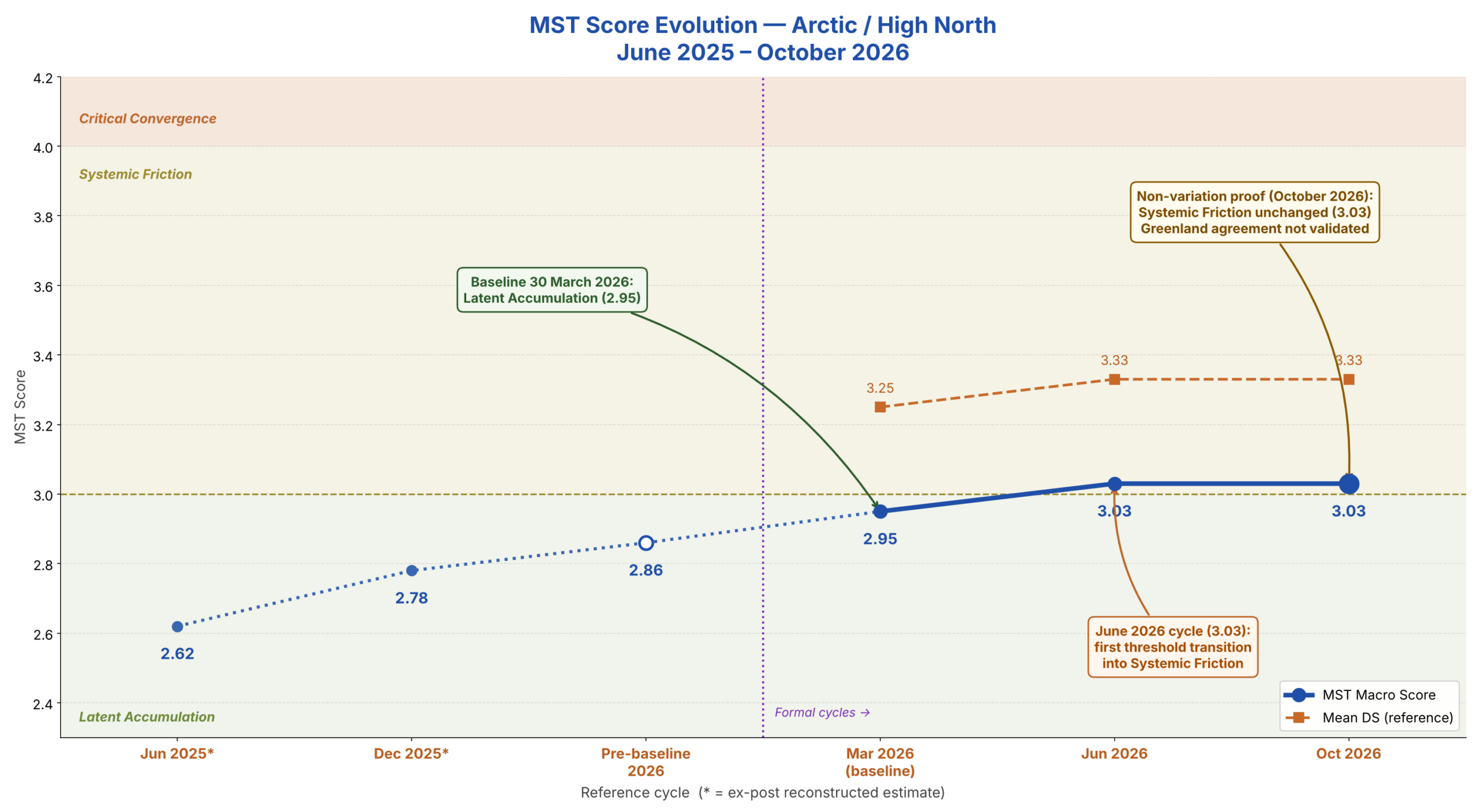
Evolution of the MST Macro Score — Arctic / High North, June 2025 – October 2026. The 2025 values are ex-post reconstructed estimates.
Legend — MST Evolution · Arctic / High North · 2025–2026
●━━● Macro Score MST
Composite value of the cycle (mean DN + FC). Solid line = formal MST v3.1 cycles; dotted line = ex-post reconstructed estimates and the pre-baseline measurement (hollow circle).
■ – – ■ Mean DS (reference)
Mean of the Domain Scores of the six domains, shown for the formal cycles. A supporting value, not equivalent to the Macro Score.
Coloured bands MST scale
Latent Accumulation (2.0–3.0), Systemic Friction (3.0–4.0), Critical Convergence (4.0–4.5). The dashed line marks the 3.0 threshold.
⋮ ⋮ ⋮ Formal cycles
Time separator: on the left, estimates and measurements prior to the 30 March 2026 baseline; on the right, the formal MST v3.1 cycles.
▶ NOTES — significant structural changes
June 2025 → December 2025* (+0.16):
Ex-post reconstructed estimate, in Latent Accumulation.
December 2025 → 30 March 2026 baseline (+0.17):
Pre-baseline measurement of 2.86 and formal baseline of 30 March 2026 at 2.95, still in Latent Accumulation.
March → June 2026 (+0.08) [FORMAL CYCLE]:
Formal cycle of 10 June 2026. Nine valid changes across six domains: Security +0.2, Technological-Industrial +0.2, Finance, Regulatory and Cognitive +0.1, Energy −0.2; ICA from 3.6 to 3.7. Macro Score 3.03: first transition into Systemic Friction.
June → October 2026 (0.00) [FORMAL CYCLE]:
Formal cycle of 14 October 2026. Evidence of No Structural Change: no valid change. Macro Score 3.03, ICA and FC unchanged.*
* The 2025 values are ex-post reconstructed estimates, in the absence of formal cycles for that period.
Valid Structural Adjustments in the Current Cycle
In the cycle as of 14 October 2026 no valid structural change is recorded against the 10 June 2026 baseline. The cycle constitutes Evidence of No Structural Change: for every domain, structural pressure remains at its June level.
Four pieces of evidence warrant explicit documentation of their classification, as they are relevant but not structurally qualifying:
Greenland security agreement: NOT VALIDATED — CONTINUITY
On 22 September the United States, Denmark and Greenland signed an agreement providing for two new US defence areas at Narsarsuaq and Mestersvig, expanded operations at Pituffik base, US underwater access to territorial waters and the exclusion of bases and investors from non-NATO countries. It follows the Greenland crisis that peaked in January 2026. It is a new and significant fact, but at the cycle date 22 days had passed since signature, below the 30-day persistence threshold, and sources do not indicate its entry into force: the Regulatory and Security domains remain unchanged.
EU sanctions and Arctic LNG 2: NOT VALIDATED — CONTINUITY
On 23 July the EU adopted its 21st sanctions package, which also targets the Russian fleet and LNG. Arctic LNG 2 exports nevertheless continued: from the first seasonal cargoes at the end of June along the Northern Sea Route, by 25 August there had been 31 cargoes and 2.3 million tonnes in 2026 to China's Beihai terminal, with a fleet of at least 18 LNG carriers (Reuters data). The effect of the sanctions on flows has not been demonstrated and the data are not directly comparable with those of June: the Energy domain remains unchanged.
Uncrewed maritime systems: NOT VALIDATED — CONTINUITY
Between 31 August and 25 September NATO's REPMUS 2026 exercise tested uncrewed maritime systems and the Task Force X Arctic architecture, with a Norwegian trial planned for the end of the year. A trial lasting less than 30 days is not equivalent to a permanent operational capability: the Technological-Industrial domain remains unchanged.
Military activity in the High North: CONTINUITY
From 26 August to 4 September the United Kingdom, Norway and the United States conducted Operation Atlantic City at Jan Mayen, within the framework of Arctic Sentry: an exercise of about ten days, with no new permanent posture. On 10 September Reuters revealed, citing two Western officials, a Russian exercise simulating the disabling of undersea cables between Svalbard and Norway, interrupted by British, Norwegian and US forces: it dates back, however, to spring 2026, before the baseline, and is documented by a single source. The Security domain remains unchanged.
Strategic picture by Domain
In October 2026 the Arctic / High North is in a configuration that combines three dimensions of simultaneous structural pressure, each with its own trajectory and with potential for mutual amplification.
The first dimension is military: between 2025 and 2026 the High North shifted from a theatre of periodic exercises to a space of structural confrontation, with permanent NATO operations, Nordic integration into the Alliance's command and the strengthening of Russia's posture along the northern axis.
The second is energy and sanctions: Western restrictions on Russian Arctic LNG and the slowdown of the Northern Sea Route limit Russia's ability to monetise Arctic resources, without reducing its ambitions.
The third is technological: competition for Arctic navigation and surveillance capabilities involves the United States, Canada, the Nordic countries and China, turning the Arctic into a multipolar theatre.
Security
The Security domain (DS 3.4, DN 3.1) rose by 0.2 in the June cycle. NATO's Arctic Sentry operation, launched in February 2026, introduced continuous air and naval patrols in the High North; Finland and Sweden were integrated into JFC Norfolk command (December 2025) and the United Kingdom doubled its Royal Marines in Norway. On the Russian side, the strengthening of air defences along the northern coast and the Northern Fleet's submarine force continue to press on the GIUK gap between Greenland, Iceland and the United Kingdom.
In the October cycle activity continued without a change in posture: the start of NATO's Forward Land Forces in Finland (6 June) predates the baseline, Operation Atlantic City at Jan Mayen lasted about ten days and the Russian exercise on the Svalbard cables dates back to the spring. The domain is unchanged.
Energy
The Energy domain (DS 3.3, DN 3.0) was the only one to fall in the June cycle (−0.2): in 2025 cargo traffic on the Northern Sea Route had fallen by 2.3%, to 37 million tonnes against a Russian target of 80, and sanctions on Arctic LNG 2 had reduced the available fleet and export capacity.
In the October cycle the picture is more nuanced: Arctic LNG 2 exports to China continued with at least 18 LNG carriers, while the EU's 21st package added new restrictions. According to NSIDC and the Met Office, the Arctic summer was cold and stormy, with average September sea-ice extent of 4.81 or 5.34 million km² depending on the dataset: non-comparable measures, from which no change in navigability can be inferred. The domain is unchanged.
Finance
The Finance domain (DS 3.2, DN 2.9) rose by 0.1 in the June cycle, owing to accelerating Western investment in Arctic infrastructure: the US plan for Arctic maritime infrastructure and the $3.5 billion contract for the Arctic Security Cutters (May 2026).
In the October cycle Canada allocated 405 million Canadian dollars to the Mackenzie Valley Highway (8 September) from an existing fund, and NOVATEK approved an interim dividend (2 October): announcements and corporate acts that do not measure a structural change. The domain is unchanged.
Regulatory / Governance
The Regulatory domain (DS 3.1, DN 2.8) rose by 0.1 in the June cycle. The Arctic Council's political cooperation with Russia has been suspended since 2022, and the Trump administration's pressure on Greenland has turned a diplomatic issue into a question of sovereignty.
In the October cycle the 22 September security agreement between the United States, Denmark and Greenland redefines the US military presence on the island, but it is too recent and not yet in force. The Arctic Council continues its technical work, with a conference on maritime incident response from 13 October. The domain is unchanged.
Cognitive
The Cognitive domain (DS 3.4, DN 3.1) rose by 0.1 in the June cycle: Russian influence operations around the GIUK gap, documented by NAADSN and the Arctic Institute, consolidated the "Arctic militarisation" narrative in Western media, which tends to equate NATO's responses with Russian military expansion.
In the October cycle no new evidence emerges: the debate on Greenlandic sovereignty and the thirty years of the Arctic Council recalled by Greenland (18 September) are in continuity. The domain is unchanged.
Technological-Industrial
The Technological-Industrial domain (DS 3.6, DN 3.3) has the highest pressure in the macro-area and rose by 0.2 in the June cycle. In May Canada, Finland and the United States coordinated in Helsinki their joint next-generation icebreaker programme, while China is extending its Arctic presence with new ice-navigation capabilities.
In the October cycle NATO tested uncrewed maritime systems for the Arctic (REPMUS 2026, until 25 September), with a Norwegian trial planned for the end of the year. A trial is not yet an operational capability: the domain is unchanged.
ICA — Structural Resilience
High (ICA: 3.7)
The adaptive capacity of the Arctic / High North is High, at 3.7, and rose by 0.1 in the June cycle. Arctic democracies respond, invest and coordinate: Nordic integration into NATO, joint icebreaker programmes and infrastructure investment strengthen the system's resilience. With an ICA above the pressure of every domain, net pressure remains lower than structural pressure.
The ICA does not change in the October cycle, in the absence of valid DS changes. The weak point is not response capacity but pace: if domain pressure kept rising as it did in June, the margin between adaptive capacity and pressure would shrink rapidly, starting with the Technological-Industrial domain (DS 3.6).
Conditions for Change
The following conditions, if met, would produce a measurable structural change in the MST parameters:
Entry into force and implementation of the Greenland security agreement, with the opening of the new defence areas — possible change in the Regulatory and Security domains.
A documented increase in forces or an operational incident, air or naval, in the High North, including Russian autumn exercises and activity at Novaya Zemlya — change in the Security domain.
A measurable effect of the EU's 21st package on Arctic LNG 2 flows, or new sanctions on the LNG carrier fleet — change in the Energy domain.
The move of Task Force X Arctic's uncrewed systems from trial to operational capability, or the entry into service of the new icebreakers — change in the Technological-Industrial domain.
A new crisis over Greenland between the United States and Denmark — change in the Regulatory and Cognitive domains.
Stabilising conditions:
Resumption of technical cooperation channels in the Arctic Council, including the management of maritime incidents — reduction of Regulatory pressure.
Implementation of the Greenland agreement within a framework shared by Denmark and Greenland — reduction of Cognitive and Regulatory pressure.
Strengthening of adaptive capacity through joint surveillance and infrastructure programmes — increase in the ICA.
Learn More
→ Geopolitical Macro-Areas Dossier
Explore the regional strategic analyses of the international system.
→ Global System Assessment Dashboard
Consult the public summary of the system’s current configuration.
–> How to Read an MST Assessment
→ MST Framework
Learn more about the framework used to assess structural pressure and adaptive capacity.
Methodological Note
This analysis derives from the application of the Multi-System Tension (MST) framework, developed to assess structural pressure, adaptive capacity and systemic configurations through validated open-source evidence.
The values reported are not forecasts, but a synthesis of the structural state observable in the cycle considered.
CSR Italia — MST v3.2 — Cycle: 14 October 2026 — Arctic / High North Macro-area