


Cycle: 14 October 2026 | Eastern Europe Macro-area | MST Framework v3.2 | CSR Italia
How to Read the Eastern Europe Macro-Area Strategic Analysis
MST Score
A score on a 1–5 scale that summarizes the overall level of structural pressure within the macro-area. It is derived from the combination of the net pressure recorded across each domain and the inter-domain amplification factor. Higher values indicate systems under persistent and multi-domain pressure.
Adaptive Capacity (ICA)
Measures the structural resilience of the macro-area: its ability to absorb, manage, and contain observed pressures. A higher value indicates a greater capacity to maintain systemic equilibrium. Scale: 1–5.
Systemic Breakdown
The fifth and highest tier of the MST scale (4.5–5.0). A configuration of maximum pressure in which internal compensation mechanisms are no longer sufficient to contain systemic stress. Pressure is distributed across multiple domains with structural saturation.
Critical Convergence
The fourth tier of the scale (4.0–4.5). High pressure distributed across multiple domains, with adaptive capacity still present but progressively contracting.
Domain Breakdown Threshold
An internal flag activated when the net pressure of a single domain exceeds 4.8. It does not alter the overall configuration, but indicates a domain in a state of critical compression that requires intensified monitoring.
–> How to Read an MST Assessment
Executive Summary: Eastern Europe Macro-area
The MST cycle as of 14 October 2026 confirms that Eastern Europe / Ukraine remains in a configuration of Systemic Rupture, the framework’s highest structural pressure band. No validated change is recorded relative to the 14 June baseline: the Macro Score remains at 4.73, and three domains remain above the Domain Rupture Threshold. This outcome does not imply an absence of new developments. Civilian casualties increased in July and August (July recorded the highest number of deaths since May 2022, according to the UN Human Rights Monitoring Mission), but the increase is documented by a single source, while other indicators of military pressure declined during the same period: long-range drone launches fell below May levels, and Russia recorded a negative net territorial balance in September. The deterioration remains recorded but not validated.
MST Score: 4.73 / 5
1.0 – 2.0
Sustainable Pressure
2.0 – 3.0
Latent Accumulation
3.0 – 4.0
Systemic Friction
4.0 – 4.5
Critical Convergence
4.5 – 5.0
▲
Systemic Breakdown
Eastern Europe Macro-Area Configuration: Systemic Breakdown
Adaptive Capacity: Moderate (ICA: 3.4)
Dominant Node: Security (DN 4.95)
Dominant Dynamic: Multi-Domain Saturation
Valid Adjustments in the Current Cycle: 0 — Evidence of No Structural Change
Position within the MST Scale
With an MST Score of 4.73, Eastern Europe / Ukraine falls within the Systemic Breakdown tier, the highest in the framework.
The value results from the interaction of six domains whose structural pressure exceeds the macro-area's adaptive capacity and three domains whose net pressure is above the critical threshold (4.8).
The macro-area's adaptive capacity — assessed as Moderate, at 3.4 on a 1–5 scale — is structurally lower than the pressure observed in all six domains. Under the framework's rules, this gap automatically produces a net pressure higher than the recorded structural pressure: the system cannot absorb the existing tensions and transmits them in amplified form.
The macro-area therefore maintains a configuration of: Systemic Breakdown
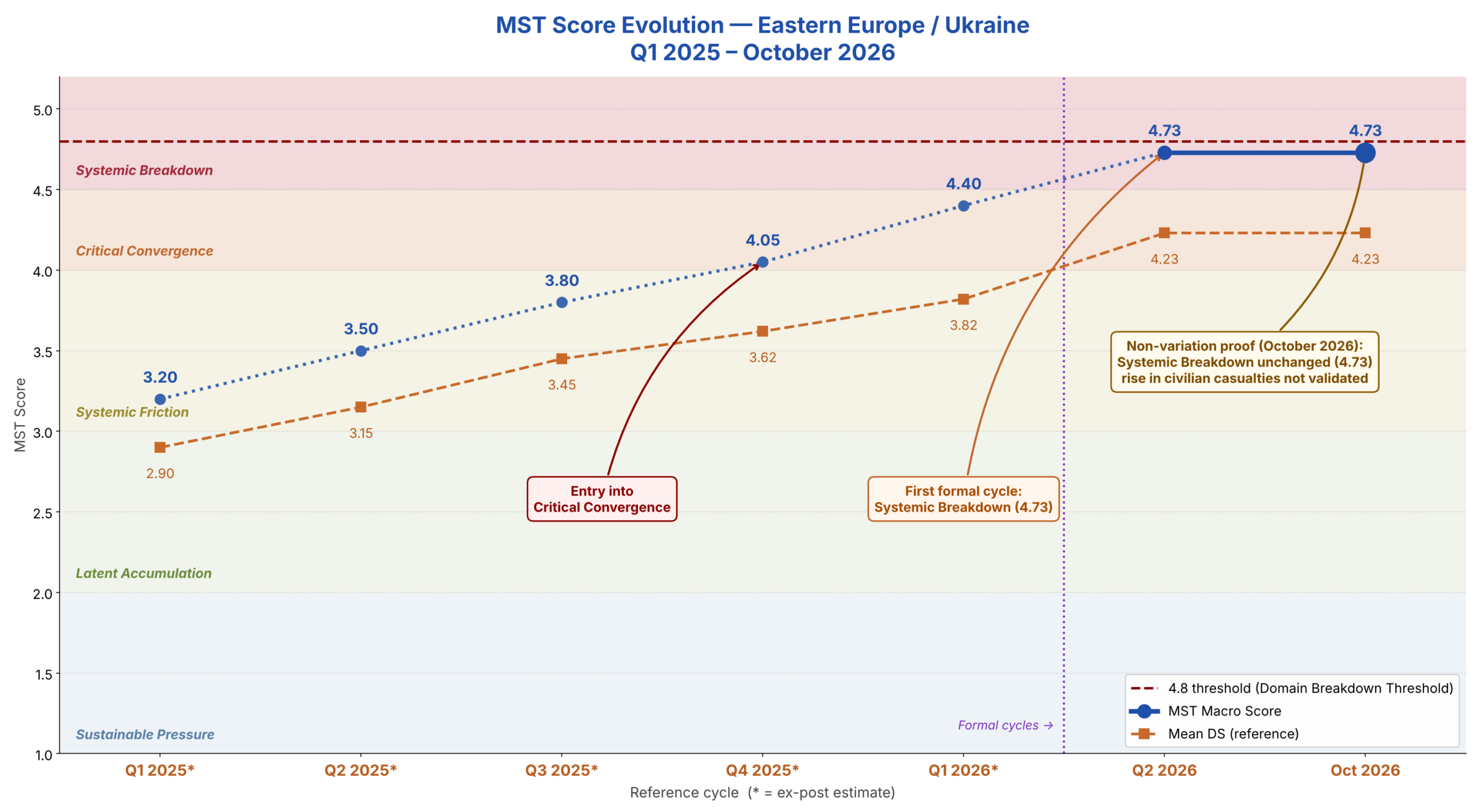
Valid Structural Adjustments in the Current Cycle
In the cycle as of 14 October 2026 no valid structural change is recorded. The cycle constitutes Evidence of No Structural Change: for every domain, structural pressure remains at its June level.
Four pieces of evidence warrant explicit documentation of their classification, as they are relevant but not structurally qualifying:
Rising civilian casualties (July–August): NOT VALIDATED — CONTINUITY
According to the UN Human Rights Monitoring Mission in Ukraine (HRMMU), 298 civilians were killed in June, 448 in July and 372 in August; 2,041, 2,675 and 2,349 were injured. July was the deadliest month since May 2022. The July increase was driven by glide bombs (+143% on June) and short-range drones. It is a new and persistent fact compared with June, but it is confirmed by only one type of source, while other indicators of military pressure fell in the same window: for this reason it does not change the pressure of the Security domain. It is not reclassified as noise and remains on record.
Discordant military pressure: CONTINUITY
Russian long-range drone launches fell from 8,161 in May, the series high, to 5,749 in June, 4,981 in July and 5,166 in August, before rising again to 6,732 in September: below the baseline-period level (Ukrainian Air Force data compiled by the Institute for Science and International Security). According to the Institute for the Study of War, the Russian territorial balance in September was negative (−80.81 km²), after minimal gains in June and July.
Financial support and sanctions: CONTINUITY
On 23 July the EU adopted its 21st sanctions package; on 24 September the Council approved a payment of almost 3 billion euros under the Ukraine Facility, the eighth, including about 800 million for the first time from the Ukraine Support Loan. The sanctions regime and dependence on European funding are already incorporated in the baseline. The National Bank of Ukraine's rate hike to 16% (18 September) is too recent for a structural assessment.
Negotiations: CONTINUITY
On 13 September the Kremlin did not rule out trilateral talks in October; on 8 October US Secretary of State Marco Rubio stated that a negotiated settlement is not currently achievable given Russia's demands on Donbas. Negotiations remain suspended, as at the start of 2026. The Russian drone that hit a train in Yahodyn on 13 September, about 2 km from the Polish border, with no casualties, is an isolated incident.
Eastern Europe Macro-Area: Strategic Assessment by Domain
In October 2026 Eastern Europe / Ukraine is in a configuration that combines three dimensions of simultaneous structural pressure, each with its own trajectory and with potential for mutual amplification.
The first is the military-security dimension, which maintains the highest level of structural pressure in the framework and has triggered the active domain breakdown threshold: the conventional conflict has entered its fourth consecutive year, with dynamics of bilateral attrition that show no structural discontinuities.
The second is the energy and infrastructure dimension, also in the domain breakdown zone, which acts as a multiplier of the Ukrainian system's vulnerabilities through the systematic destruction of production and distribution capacity.
The third is the technological-industrial dimension, which already in the June cycle took on an ambivalent character: a source of high structural pressure due to intense technological competition (active domain breakdown threshold), but also a driver of rapidly expanding Ukrainian defensive capacity.
Security — Hard Security
The Security domain records the highest structural pressure in the analysis, with net pressure above the domain breakdown threshold (DN 4.95). The conventional conflict in Ukraine has entered its fourth year with consolidated dynamics: the Russian spring-summer 2026 counteroffensive produced minimal gains — 14 km² in May — against significant losses documented by Ukrainian forces (over 105 Russian artillery systems destroyed in May alone).
The short truces in April and May (Easter and Victory Day) did not alter the structural posture. In the June cycle ISW documented a systematic misperception by the Russian leadership of its own military capabilities, fuelled by exaggerated estimates from the command. The structural configuration remains: high-intensity conflict on an extended front, with bilateral attrition and no operational discontinuities.
In the October cycle the front stabilised: after minimal Russian gains in June (+30.42 km²) and July (+37.85 km²), in September the Russian territorial balance was negative (−80.81 km², according to ISW). Harm to civilians, by contrast, increased in July and August, mainly from glide bombs and short-range drones. The two signals point in opposite directions: the domain's pressure remains unchanged and the rise in casualties remains on record as a non-validated deterioration.
Energy — Infrastructure
The Energy domain maintains the second-highest structural pressure in the system (DN 4.85, active breakdown threshold). From 1 January 2026 to the June cycle, 217 attacks on Ukrainian energy infrastructure were documented. The Ukrainian system operates at drastically reduced capacity compared with pre-invasion levels. In response, Ukraine intensified strikes against Russian energy infrastructure, hitting 20 refineries and export terminals in April–May 2026. The dynamic is one of symmetric infrastructure warfare, with both national systems under attrition pressure. Ukraine's dependence on external energy and redundant distribution systems remains unchanged.
In the October cycle Naftogaz reported 293 attacks on its facilities since the start of the year, against 229 in the whole of 2025, and the UN Commission of Inquiry documented the systematic targeting of the energy system in winter 2025–26. However, there is no consistent series of damage and repairs before and after June: no measured change. Winter 2026–27 is the next test.
Finance
The Finance domain records the lowest structural pressure in the system (DS 3.6, DN 3.9), but retains a vulnerability profile marked by total dependence on external funding. The approval of the €90 billion EU package (23 April 2026) and progress on the Ukraine Support Act in the United States temporarily resolved the liquidity crisis that threatened defensive capacity in June 2026. However, the structural model has not changed: Ukraine had requested a further $20 billion at the Ramstein meeting on 18 June.
In the October cycle the EU Council approved the eighth Ukraine Facility payment (almost 3 billion euros, 24 September) and the National Bank of Ukraine raised its rate to 16% (18 September). Pressure in the domain is unchanged from the baseline.
Regulatory / Governance
The Regulatory domain reflects the progressive tightening of the international sanctions regime against Russia (DS 4.3, DN 4.6). The EU's 20th package, approved in April, extended restrictions to the Russian military-industrial complex, energy revenues, financial services and the crypto sector; the 21st package, adopted on 23 July, continued along the same lines, and on 12 October the EU added new designations. On the legal front, the Russian Central Bank has initiated proceedings against the EU before the European Court of Justice, challenging the mechanism for using frozen sovereign assets (€210 billion) as collateral for the loan to Ukraine.
In May 2026 Ukraine's Supreme Court issued a ruling declaring transactions in breach of Ukrainian sanctions null and void. On negotiations, on 8 October the US Secretary of State stated that a negotiated settlement is not currently achievable. The regulatory-institutional framework is consolidating with no structural change from the baseline.
Cognitive / Information
The Cognitive domain maintains its structural pressure (DS 3.7, DN 4.0) with an unchanged trajectory.
The Russian-Ukrainian information war remains active on multiple fronts: systematic Russian disinformation aimed at European audiences — focusing on EU cohesion, Ukrainian-Polish relations and the narrative of responsibility for the war — and a Ukrainian information counteroffensive using direct testimony and advanced digital technologies. In the June cycle ISW documented a structurally relevant element: the Russian military leadership systematically provides the Kremlin with exaggerated estimates of operational successes, producing a cognitive misalignment at the decision-making level.
This factor does not change the DS in the current cycle but constitutes an element of structural fragility in the Russian system that the framework will monitor in subsequent cycles.
Technological-Industrial
The Technological-Industrial domain recorded the most dynamic trajectory in the reference period, while keeping its structural pressure unchanged (DS 4.6, DN 4.9, active breakdown threshold). Over the course of the conflict Ukraine has built Europe's most innovative defence industrial base: a target of 7 million drones in 2026 (up from 4 million in 2025), 80 companies at Eurosatory 2026, 10 export centres opened in Europe, production lines launched in Germany and the United Kingdom. Overall industrial capacity is estimated at $55 billion, 55 times the pre-invasion level.
The growth in drone production — from 4 million in 2025 to a target of 7 million in 2026 — does not represent a discontinuity from the trajectory already observed in the previous quarter. The Technological DS of 4.6 in the 30 March baseline already incorporated the transition to industrial-scale production, begun during 2025 with capacity up 75%, as documented by RNBO Ukraine and RAND at the time of recalibration.
The October cycle confirms the trajectory: since 16 September a new drone with LTE connectivity (Brave1 platform) has been in serial production, with no measured structural effects. The CONTINUITY classification reflects methodological rigour, not an underestimation of the phenomenon. Russia retains superior military-industrial capacity in absolute terms, keeping bilateral technological competition in the domain breakdown zone.
ICA — Structural Resilience
Moderate (ICA: 3.4 / 5)
The macro-area's adaptive capacity is classified as Moderate, at 3.4 on a scale from 1 to 5. The value reflects a functional resilience of the Ukrainian system — supported by solid international alliances, a rapidly expanding defence industrial base and internal cohesion maintained despite wartime pressure — which is nonetheless insufficient to contain the structural pressure present in all six domains analysed.
The ICA does not change in the October cycle either, as the conditions required by the framework are not met (no valid DS change in the cycle). This invariance is consistent with the observed dynamics: the system has shown structural staying power over time, but without measurable improvement or deterioration in the reference period. Resilience is maintained by structural inertia rather than active strengthening.
Conditions for Change in the Eastern Europe Macro-Area
The following conditions, if met, would produce a measurable structural change in the MST parameters:
An increase in civilian harm confirmed by multiple types of source and accompanied by renewed military pressure (long-range launches, advances) — possible change in Security DS. The domain is already close to the ceiling (DN 4.95): the effect on the Macro Score would be limited.
Withdrawal or significant reduction of Western military support (≥30 days) — would produce a change in Finance DS and potentially Security DS.
Collapse of EU cohesion on the sanctions regime (≥2 major member states) — change in Regulatory DS.
Qualitative escalation of the conflict (tactical nuclear weapons, geographic widening, direct NATO involvement) — multiple changes with possible FC.
Collapse of the Ukrainian power grid in several key regions, to be monitored in winter 2026–27 — Energy DS already in the breakdown zone, further systemic deterioration.
Prolonged deterioration of Ukraine's internal civil cohesion — change in Cognitive DS and ICA.
Saturation of the European market's capacity to absorb Ukrainian defence exports — change in Technological DS.
Stabilising conditions:
A verifiable ceasefire agreement persisting ≥30 days — first prerequisite for a downward change in Security DS.
Partial financial self-sufficiency through expanded defence exports and revenues from frozen Russian assets — potential reduction in Finance DS.
Defence production integration with Western Europe sufficient to cross the structural threshold — reduction in Technological DS.
Learn More
→ Geopolitical Macro-Areas Dossier
Explore the regional strategic analyses of the international system.
→ Dashboard of the Global Systemic State
View the public summary of the system's configuration.
–> How to Read an MST Assessment
→ MST Method
Explore the framework used to assess structural pressure and adaptive capacity.
CSR Italia — MST v3.2 — Cycle: 14 October 2026 — Eastern Europe / Ukraine Macro-area