


How to read
MST Score: A score on a 1–5 scale summarising the level of structural pressure within the macro-area. It is derived from the average net pressure values across the six domains, increased by the systemic amplification factor.
ICA — Adaptive Capacity Index: Measures the structural resilience of the macro-area. A higher value indicates a greater capacity to absorb pressure and maintain equilibrium. Scale 1–5. It should not be read in isolation: what matters is the relationship between the ICA and the structural pressure in each domain.
Critical Convergence: The fourth of five tiers of the MST scale (4.0–4.5). High pressure distributed across multiple domains, with adaptive margin still present but progressively contracting. The system shows a fragile equilibrium maintained by structural inertia.
Systemic Breakdown: The fifth of five tiers of the MST scale (4.5–5.0). A configuration of maximum systemic pressure: the Macro Score exceeds the 4.5 threshold as a result of multi-domain structural saturation. In this tier the system has no residual internal compensation mechanisms.
Domain Breakdown Threshold (DN ≥4.8): An internal flag activated when the net pressure of a single domain exceeds 4.8. It does not alter the overall configuration, but indicates a domain in a state of critical compression that requires intensified monitoring.
→ MST Method
Learn more about the framework used to assess structural pressure and adaptive capacity.
Last updated: October 2026
Executive Summary: Indo-Pacific Macro-area
The MST cycle as of 14 October 2026 confirms the Critical Convergence tier for the Indo-Pacific / Taiwan-Core, with a Macro Score of 4.08 out of 5, unchanged from June. No valid structural change is recorded: the cycle is Evidence of No Structural Change and all six domains remain at the values of the 13 June baseline. This outcome does not mean nothing new happened. In the South China Sea, Chinese vessels detected by the Armed Forces of the Philippines rose from 48 in July to 101 in September, with clashes at Second Thomas Shoal and Scarborough; around Taiwan, by contrast, Chinese air sorties are declining. The increase in the South China Sea is recorded but not validated: the new level has been observed for only one month and the June data are not comparable.
MST Score: 4.08 / 5
1.0 – 2.0
Sustainable Pressure
2.0 – 3.0
Latent Accumulation
3.0 – 4.0
Systemic Friction
4.0 – 4.5
▲
Critical Convergence
4.5 – 5.0
Systemic Breakdown
Macro-area configuration: Critical Convergence
Adaptive capacity: Low (ICA: 2.75)
Dominant node: Military + Cognitive + Technological
Dominant dynamic: Progressive hardening. Structural competition through orderly accumulation
Prevailing domains: Security · Cognitive
Valid changes in the cycle:0 — Evidence of No Structural Change
Position within the MST Scale
In the October cycle no evidence jointly meets the framework's conditions: change from the baseline, persistence and at least three converging layers of evidence. Taiwan's rearmament and the Chinese task force targeting the November elections, which produced the two valid changes in June, remain incorporated in the values of the Security and Cognitive domains.
Xi Jinping's state visit to Washington (23–25 September 2026) extended the US–China trade truce to 10 January 2027, with no progress on Taiwan: no new act with structural effects.
The macro-area therefore maintains a configuration of: Critical convergence
With an MST Score of 4.08 on a 1–5 scale, the Indo-Pacific / Taiwan-Core macro-area falls within the Critical Convergence band (4.0–4.5). This position is determined mechanically through the application of the MST v3.1 formula to the values recorded across the six domains. The system remains below the Systemic Breakdown threshold (4.5) and does not register any domain at structural saturation (DN 5.0).
Adaptive capacity — measured by an ICA of 2.75, unchanged from the baseline — remains systematically below the level of structural pressure across all six domains. Under the rules of the framework, when ICA < DS, normalised pressure is adjusted to DS + 0.3; this condition is met across all active domains. Economic interdependence between the United States and China, together with multilateral deterrence architectures, continues to function as a structural shock absorber, helping to keep the system within its current band.
Evolution of the MST Macro Score — Indo-Pacific / Taiwan-Core, Q1 2025 – October 2026. The 2025 values are ex-post reconstructed estimates.
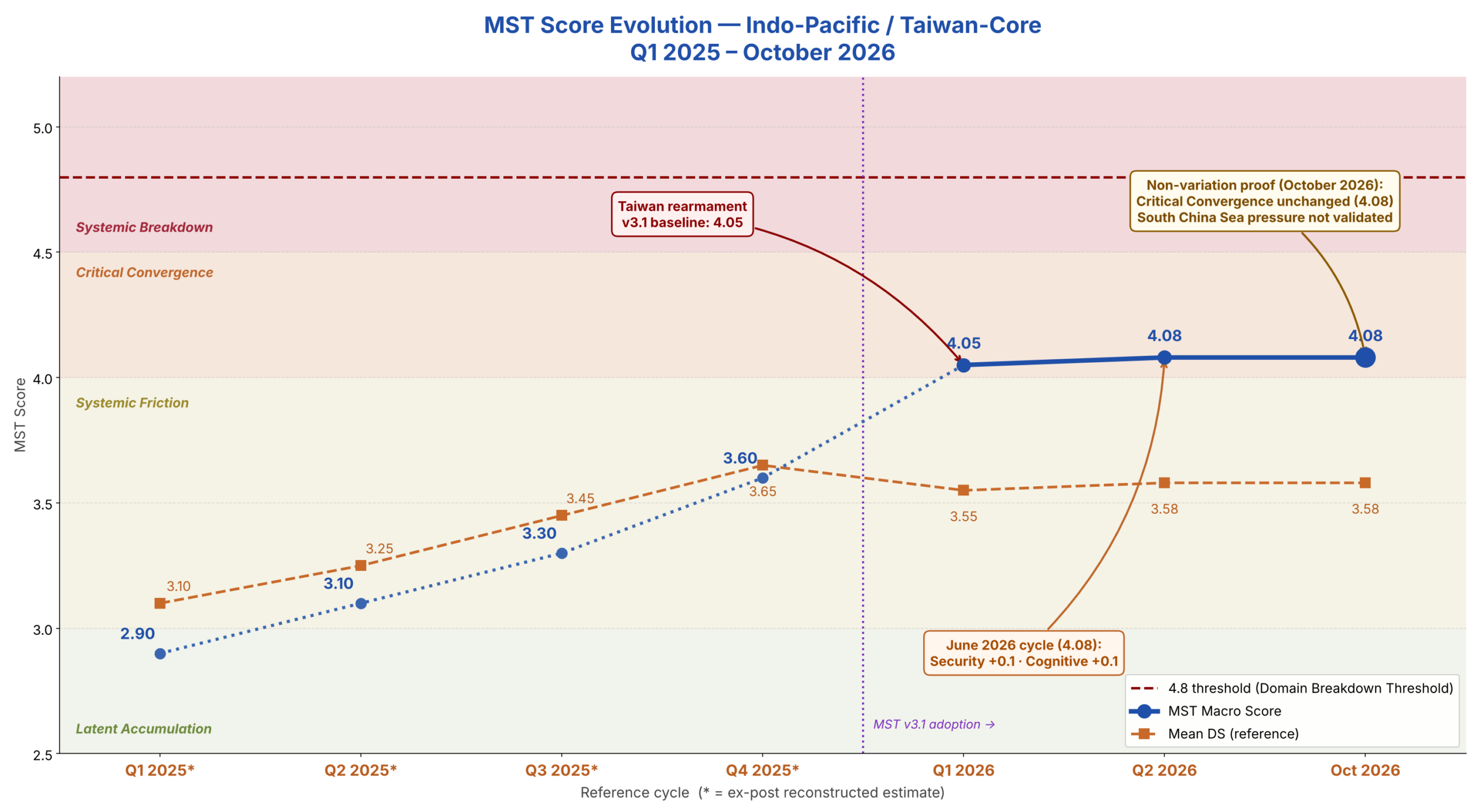
Legend — MST Evolution · Indo-Pacific / Taiwan-Core · 2025–2026
●━━● MST Macro Score
Composite value of the cycle (mean DN + FC). Solid line = formal MST v3.1 cycle; dotted line = ex-post reconstructed estimates.
■ – – ■ Mean DS (reference)
Mean of the Domain Scores of the six domains. A supporting value, not equivalent to the Macro Score.
Coloured bands MST scale
Latent Accumulation (2.0–3.0), Systemic Friction (3.0–4.0), Critical Convergence (4.0–4.5), Systemic Breakdown (4.5–5.0).
— — — Domain Breakdown Threshold (4.8)
Flag active when DN ≥4.8 in at least one domain. It does not coincide with the Systemic Breakdown tier, which begins at 4.5.
⋮ ⋮ ⋮ MST v3.1 adoption (Q1 2026)
Time separator: earlier quarters are reconstructed estimates in v3.1 equivalent.
NOTES — significant structural changes
Q2→Q3 2025* (+0.20):
Reconstructed estimate. PLA escalation around the First Island Chain; first US–China semiconductor export restrictions. Shift towards growing Systemic Friction.
Q3→Q4 2025* (+0.30):
Reconstructed estimate. Approval of US arms packages for Taiwan; intensified PLA naval activity. ICA structurally limited to 2.75.
Q4 2025→Q1 2026 (+0.45):
v3.1 baseline adopted. Macro Score recalculated under MST v3.1: Macro Score 4.05 (Critical Convergence). Discrepancy with the previous framework documented with a METHODOLOGICAL FLAG.
Q1→Q2 2026 (+0.03) [FORMAL CYCLE]:
Formal cycle of 13 June 2026. Two valid changes: Security +0.1 (Taiwan rearmament plan, $24.8B), Cognitive +0.1 (CCP task force for influence operations in Taiwan's November 2026 elections). Macro Score 4.08. ICA and FC unchanged.
Q2 2026→October 2026 (0.00) [FORMAL CYCLE]:
Formal cycle of 14 October 2026. Evidence of No Structural Change: no valid change. Macro Score 4.08, ICA and FC unchanged. Increase in Chinese pressure in the South China Sea recorded but not validated.
* The quarters Q1–Q4 2025 are ex-post reconstructed estimates in MST v3.1 equivalent, in the absence of formal cycles for that period. They do not represent a formally closed MST cycle.
Cycle structural variations
In the cycle as of 14 October 2026 no valid structural change is recorded against the 13 June 2026 baseline. The cycle constitutes Evidence of No Structural Change: for every domain, structural pressure remains at its June level.
Three pieces of evidence warrant explicit documentation of their classification, as they are relevant but not structurally qualifying:
South China Sea: NOT VALIDATED — CONTINUITY
According to the Armed Forces of the Philippines, Chinese vessels detected in the West Philippine Sea numbered 48 in July, 56 in August and 101 in September (69 coast guard and 32 navy). On 20 July, at Second Thomas Shoal, Chinese coast guard personnel injured a Filipino sailor; on 23 July there was a new clash at Scarborough; at the end of September Chinese vessels blocked the resupply of the Sierra Madre. The September level has been observed for only one month, the end-of-September blockade is less than 30 days old at the cycle date, and for June only a weekly figure exists, which is not comparable: the Security domain remains unchanged.
Discordant pressure around Taiwan: CONTINUITY
According to Taiwan's Ministry of National Defense, Chinese air sorties in August numbered 171, 34% fewer than in July (260) and 69% fewer than in August 2025 (555). Chinese government vessels, however, reached their highest level of the year in July (244), and on 23–24 July the People's Liberation Army held a live-fire exercise in the Strait, after President Lai's speech of 19 July. The signals point in opposite directions and show neither an increase nor a decrease in pressure.
US–China tariffs and trade truce: NOT VALIDATED — CONTINUITY
Since 24 July the new US Section 301 tariff regime has been in force, replacing the temporary Section 122 surcharge with differentiated rates and exemptions. It is a new measure, but it continues a trade barrier already in place in June. Xi's state visit to Washington (23–25 September) extended the trade truce from 10 November 2026 to 10 January 2027, with no progress on Taiwan.
The Quad Indo-Pacific Maritime Surveillance Collaboration, deferred in June for insufficient persistence, has been re-examined: the mere passing of 30 days since the announcement is not enough, and no implementation is documented in the cycle. The Regulatory domain remains unchanged.
Macro-area strategic picture
In October 2026 the Indo-Pacific / Taiwan-Core is in a configuration that combines three dimensions of simultaneous structural pressure, each with its own trajectory and with potential for mutual amplification.
Security and Hard Security
The first dimension is military.
Taiwan's institutionalised rearmament marks a structural discontinuity.
With the plan approved in May 2026, the multi-year financial commitment to Taiwan reaches a scale and institutional formalisation without recent precedent in the bilateral relationship, with a binding timetable.
The Balikatan 2026 exercises, held in April with active Japanese participation, and the expansion of the operational perimeter of multilateral deterrence architectures signal a progressive consolidation of the regional response to Chinese pressure.
The Trump–Xi summit (14–15 May 2026) produced no structural changes. The "strategic stability" formula agreed — and the accompanying joint statement — does not alter the operational posture of either of the two main actors. China has not reduced its naval activity around the First Island Chain; the US has not changed its deterrence posture in the area. The event was classified as CONTINUITY in the June cycle.
Military pressure remains structurally high (DS 3.8, DN 4.1), with the update (+0.1) incorporated in the valid change of the June cycle. There are no signs of a direct operational front opening in the short term, but the density of events over the half-year (exercises, parliamentary decisions, progress in armament programmes) amounts to a documentable progressive hardening.
In the October cycle military pressure shifted towards the South China Sea: Chinese vessels detected by the Philippines more than doubled between July and September, with clashes at Second Thomas Shoal and Scarborough. Around Taiwan, by contrast, air sorties have been declining since the May peak. The increase in the South China Sea is recorded but not validated: the October and November counts will show whether the new level persists.
Cognitive Domain
The second dimension is cognitive competition, which in the June cycle became the most dynamic structural axis of the macro-area.
The CCP task force for Taiwan's November 2026 elections is not a tactical initiative: it is China's systemic response to Taiwan's rearmament, designed to shape the electoral outcome without opening a direct military confrontation.
The operational ecosystem — coordination between digital influence units, disinformation on social platforms and identity polarisation campaigns — is structured to operate over a six-month horizon.
US–China narrative competition over Taiwan — already permanent in previous cycles — has overlapped with this operational dimension, generating an information environment that will amplify every event over the half-year. In the current cycle the cognitive domain acts as a factor of systemic amplification, tending to amplify the perceived effects of the other domains.
In the October cycle no measurable new facts emerge: the Atlantic Council's proposal for a multilateral cognitive defence network (23 September) is not an operational network, and Microsoft's digital defence report for Asia (13 October) mainly covers the period before June. The domain is unchanged (DS 3.9, DN 4.2); Taiwan's local elections in November remain the next test.
Technological-Industrial
The third dimension is competition over semiconductors, the structural technological vector of the macro-area. Taiwan remains the most sensitive node in the global competition for advanced chips: TSMC holds a near-monopoly in the production of chips below 3 nm, and this geographic concentration at the point of greatest strategic tension constitutes a systemic vulnerability that no diversification measure has yet eliminated.
In the June cycle, China projected reaching 50% of its domestic AI chip market by the end of 2026. The partial easing of US export controls (April 2026) did not alter the underlying competitive structure: restrictions on the most advanced chips remain in force. The domain remains unchanged from the baseline (DS 3.9, DN 4.2) — the cycle's evidence confirms the structural trajectory without producing an additional threshold change.
In the October cycle TSMC and ASML announced a joint photomask initiative (8 September), which does not yet add production capacity in operation. The domain is unchanged.
Energy and Infrastructure
Western Pacific shipping routes retain a documented structural vulnerability but recorded no prolonged interdiction events in the current cycle. The critical chokepoints — the Strait of Malacca, the Strait of Hormuz via the Indo-Pacific, the Sea of Japan routes — remain operational. Energy pressure (DS 3.2, DN 3.5) is among the lowest in the macro-area and acts as a structural shock absorber. The domain is unchanged.
In the October cycle the International Energy Agency observed in September a recovery in crude flows from the Gulf to Asia, with constraints still present on refined products. The energy shock was already present before June, and no net change for the macro-area as a whole has been demonstrated.
Finance
The regional financial system is characterised by strong structural interdependence among the main economies, acting as a two-way constraint: it reduces the propensity for direct escalation but does not eliminate competitive pressure in strategic sectors. Financial decoupling remains selective and concentrated in sensitive sectors — technology, defence, critical infrastructure. The domain (DS 3.1, DN 3.4) is unchanged from the baseline.
In the October cycle the new US Section 301 tariff regime came into force (24 July) and the US–China trade truce was extended to 10 January 2027: the trade barrier continues with a different legal basis and different rates, with no demonstrated transformation of the regional financial posture.
Normative / Regulatory
In the June cycle the regulatory domain recorded two relevant developments, both below the threshold of structural change. The launch of the Quad Indo-Pacific Maritime Surveillance Collaboration (IPMSC, 26 May 2026) took place 18 days before the cycle date — insufficient to meet the ≥30-day persistence threshold required by the framework for DS<4. The initiative consolidates existing regional cooperation architectures (Quad, AUKUS) without producing an immediate regulatory discontinuity. The domain (DS 3.6, DN 3.9) is unchanged.
Re-examined in the October cycle, the IPMSC programme shows no documented implementation: the mere passing of 30 days since the announcement is not enough. On 15 September conciliation proceedings between Thailand and Cambodia on the disputed maritime areas opened in Singapore: a procedure launched, not a settlement, and at 29 days from the cycle date, below the persistence threshold. The domain remains unchanged.
ICA — Structural Resilience of the Macro-area
Low (ICA: 2.75)
The system shows structurally limited adaptive capacity.
The main dimensions of robustness — deterrence architectures, strategic energy reserves, financial capacity — present significant vulnerabilities that were not resolved in the current cycle. Economic interdependence between the US and China acts as a short-term shock absorber, but it is not a source of structural resilience: it is a symmetrical condition that constrains both actors but does not reduce the underlying systemic pressure.
The ICA also remained unchanged in the October cycle, in the absence of valid DS changes. In June the two changes (Security +0.1, Cognitive +0.1) had produced a cumulative change of ΔDS = +0.2, below the ≥0.3 threshold required by the framework to update the ICA. The value of 2.75 remains the baseline for the next cycle.
Signals to be monitored in next cycle
The following conditions could alter the configuration of the macro-area in the next cycle:
Consolidation of Chinese pressure in the South China Sea: if the October and November counts confirm the September level, a possible change in the Security domain.
Direct military escalation in the Taiwan Strait: the activation of an operational confrontation with an armed response would shift the configuration towards Systemic Breakdown.
Operational interruption of US–China military communication channels: removes the main mechanism of structural de-escalation.
Documented interference in Taiwan's electoral process (November 2026): would bring the Cognitive and Regulatory domains together towards a multiple change.
Prolonged interdiction of Pacific shipping routes: activates the Energy domain and produces global systemic effects.
Simultaneous convergence of financial sanctions and technology restrictions: exceeds the absorption capacity of selective decoupling.
US–China deadlines: China's suspension of rare earth restrictions until 10 November 2026 and the trade truce until 10 January 2027; failure to renew would affect the Finance and Technological-Industrial domains.
Stabilising conditions:
structural progress in US–China negotiations with verifiable commitments, reduced military activity around the First Island Chain, documented diversification of semiconductor production outside Taiwan.
Learn More
→ Geopolitical Macro-Areas Dossier
Explore the regional strategic analyses of the international system.
→ Global System Assessment Dashboard
Consult the public summary of the system’s current configuration.
–> How to Read an MST Assessment
→ MST Framework
Learn more about the framework used to assess structural pressure and adaptive capacity.
Methodological Note
This analysis derives from the application of the Multi-System Tension (MST) framework, developed to assess structural pressure, adaptive capacity and systemic configurations through validated open-source evidence.
The values reported are not forecasts, but a synthesis of the structural state observable in the cycle considered.