


Latin America macro-area: cycle 14 October 2026 | MST Framework v3.2 | CSR Italia
How to read Strategic analysis Macro-area Latin America
MST Score:
Score on a 1–5 scale summarising the overall level of structural pressure in the macro-area. It derives from the combination of the net pressure in each domain and the inter-domain amplification factor. Higher values indicate systems under persistent, multi-domain pressure.
Adaptive capacity (ICA):
Measures the structural resilience of the macro-area: its capacity to absorb, manage and contain the observed pressures. A higher value indicates a greater capacity to maintain systemic balance. Scale 1–5.
Systemic Breakdown:
Fifth of the five bands of the MST scale (4.5–5.0). Configuration of maximum pressure. It occurs when structural pressure is spread across several domains and the system’s compensation mechanisms are no longer sufficient to contain it. The band is determined by the Macro Score.
Critical Convergence:
Fourth band (4.0–4.5). Configuration characterised by high pressure spread across several domains, with adaptive capacity still present but progressively shrinking. The band is determined by the Macro Score.
Domain Breakdown Threshold:
Internal flag triggered when the net pressure of a single domain exceeds 4.8. It does not change the overall configuration, but signals a domain in a state of critical compression requiring intensified monitoring.
–> How to read an MST assessment
Executive Summary
The 14 October 2026 MST cycle for the Latin America macro-area records no valid structural changes compared with the 17 June 2026 baseline. The Macro Score remains 4.10 and the region is confirmed in Critical Convergence, the band it entered in June as a result of the US military intervention in Venezuela and the collapse of the Cuban power grid. The mandatory review of Security, ordered in June on the Venezuelan transition, closes with no change: partial civic openings, talks without implemented outcomes and elections promised but without a date produce neither structural stabilisation nor deterioration. The new collapses of the Cuban grid repeat the condition already recorded; the first round of the presidential election in Brazil is too recent for a structural assessment.
MST Score: 4.1 / 5
1.0 – 2.0
Sustainable Pressure
2.0 – 3.0
Latent Accumulation
3.0 – 4.0
Systemic Friction
4.0 – 4.5
▲
Critical Convergence
4.5 – 5.0
Systemic Breakdown
Macro-area Configuration: Critical convergence
Adaptive Capacity: High (ICA: 3.7)
Dominant Node: Security and Finance (net domain pressure 4.30 each)
Dominant Dynamic: Convergence between regional security and energy vulnerability
Valid changes in the cycle: 0 – Non-variation proof (June: DS Security +0.1 | DS Energy +0.2)
Position within the MST Scale
In October 2026 Latin America is confirmed in a configuration of Critical Convergence (MST Score 4.10), reached in the June cycle for the first time in the recent history of MST monitoring of the region.
The June jump from the Systemic Friction band (3.70) to Critical Convergence (4.10) is not the result of gradual deterioration. It is the structural effect of two high-intensity events — one military, one energy-related — that introduced a systemic discontinuity into the regional picture. The October cycle records neither an easing nor a worsening of that discontinuity.
The macro-area therefore maintains a configuration of: Critical Convergence
Structural pressure is concentrated in four of the six domains analysed: Security (4.30), Finance (4.30), Energy (4.10) and Regulatory/Governance (4.10).
The fact that Regulatory and Energy have reached 4.10 is not due to direct changes in those domains, but to a methodologically significant cascade effect: when regional adaptive capacity falls below the level of structural pressure in a domain, the net pressure in that domain is amplified. This is exactly what happened in the June cycle: the reduction in regional adaptive capacity — from 3.80 to 3.70 — crossed the critical threshold for Energy and Regulatory, whose structural pressure values remained at 3.80.
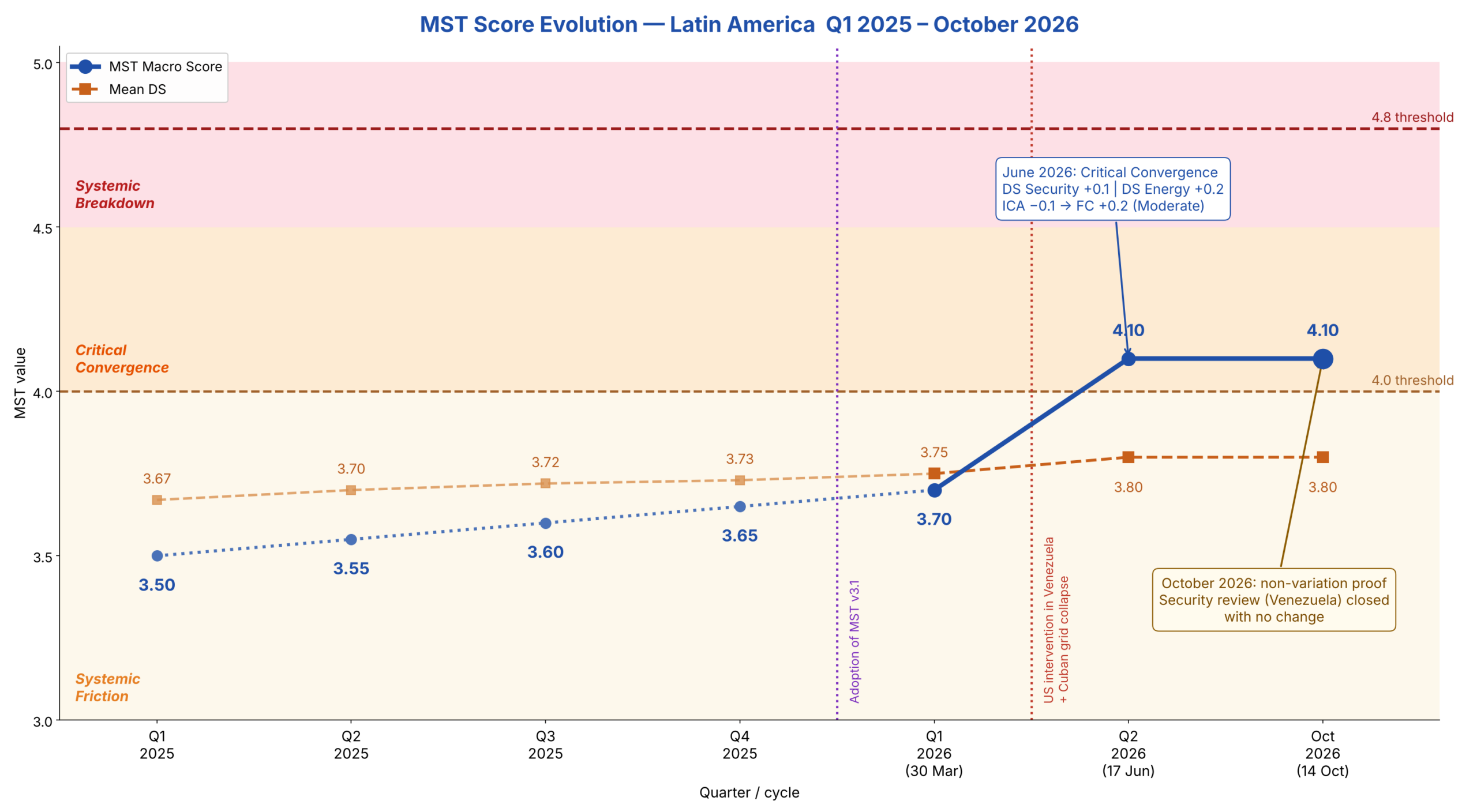
Legend - MST Evolution
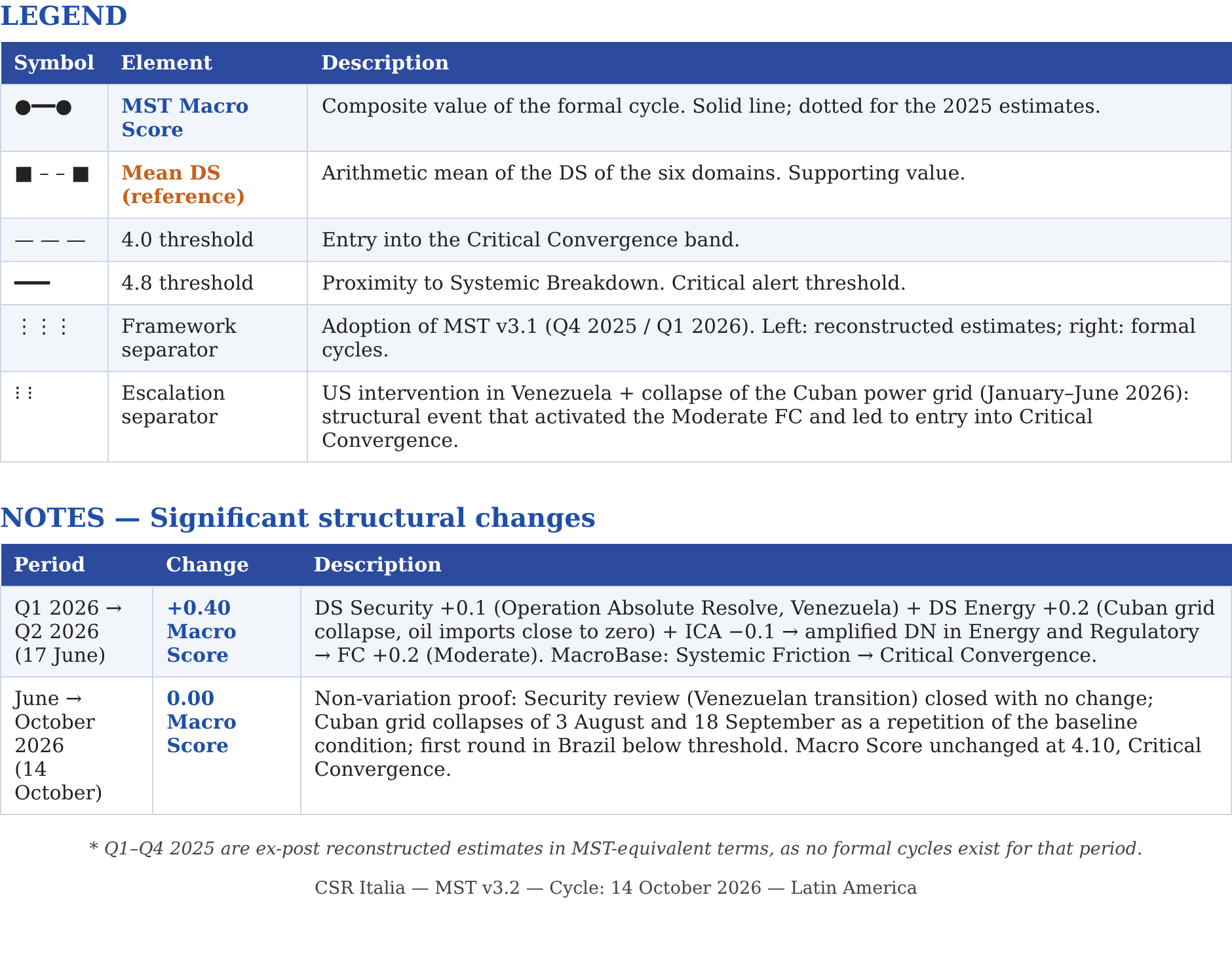
Valid Structural Adjustments in the Current Cycle
No valid structural changes were recorded in the 14 October 2026 cycle. The two June changes — Security +0.1 for the US military intervention in Venezuela and Energy +0.2 for the collapse of the Cuban power grid — remain incorporated in the baseline. The outcome does not mean there were no new facts: the Brazilian run-off and the Venezuelan transition are the main signals to follow.
Venezuela — Security review closed with no change. The interim government of Delcy Rodríguez, in office since 3 January after Maduro’s capture, has opened partial civic space, but the repressive apparatus remains in place (Human Rights Watch, September visit). From mid-September a second round of US-backed talks took place in Caracas; on 23 September, at the UN, Rodríguez promised elections without giving a date; on 4 October María Corina Machado’s opposition called for direct dialogue, while her return to the country remains blocked. No evidence documented by multiple independent sources shows either structural stabilisation or deterioration compared with June: pressure remains unchanged. A firm election date or an implemented agreement could justify a reduction in future cycles.
Cuba — CONTINUITY. The power grid collapsed again on 3 August (the sixth total collapse of 2026) and on 18 September, leaving around 9 million people without electricity; the causes cited are obsolete plants, fuel shortages and the US oil blockade. It is a repetition of the condition already recorded in June, not a measurable deterioration beyond the baseline.
Brazil — NOT VALIDATED. In the first round of the presidential election on 4 October Flávio Bolsonaro won 47.03% and Lula 45.16% (partial results); the 25 October run-off falls after the cycle. With ten days of persistence at the cutoff, the evidence remains below the threshold and becomes the main trigger for the next cycle.
Colombia, the Caribbean and the economic picture — CONTINUITY. Abelardo de la Espriella, backed by Trump, won the presidential run-off of 21 June against Iván Cepeda, who conceded defeat on 24 June: an ordinary alternation of power. The US campaign of strikes on vessels in the Caribbean continues (SOUTHCOM, 4 October). ECLAC confirms regional growth of 2.2% for 2026, and the Banco de México is holding its rate at 6.50%.
Strategic picture by Domain
In October 2026 Latin America is in a configuration that combines three dimensions of structural pressure at the same time, each with its own trajectory and with potential for mutual amplification.
The first dimension is regional security, which recorded the most significant change in June: the US military intervention in Venezuela reshaped the risk profile of the entire hemisphere, setting operational precedents with no equivalent in Latin America’s recent history. In October the Venezuelan transition remains unfinished, with no structural effects in either direction.
The second dimension is energy vulnerability, which in June became the most dynamic vector of escalation: the collapse of the Cuban power grid, causally linked to the cut-off of Venezuelan supplies, turned a latent crisis into an internationally documented structural event. The collapses of August and September confirm the condition.
The third dimension is financial pressure which, while unchanged, is the domain with the highest net pressure (4.30) and represents the longest-term point of accumulation in the regional system.
Security (net pressure 4.30 — unchanged; June change +0.1)
The Security domain maintains a structural pressure of 4.00 and a domain net pressure of 4.30, following the June change (from 3.90 to 4.00).
Operation Absolute Resolve changed the regional security picture along three axes. In Venezuela, the power vacuum following Maduro’s capture opened a transition phase with internal fragmentation dynamics that are still unresolved, and with the risk of inter-factional conflict over control of resources and criminal routes. In the October cycle the interim government of Delcy Rodríguez launched US-backed talks and promised elections, without setting a date; the opposition remains excluded.
In the Caribbean and in Haiti, the US military presence has intensified with active operations (the strike against Tren de Aragua and the formation of a US-led multinational gang-suppression force in Haiti). The campaign of strikes on vessels continues (SOUTHCOM, 4 October). At regional level, the operation broke the implicit balance between Washington and the Latin American governments that had built relations based on non-interference, generating tensions with Brazil, Mexico, Colombia and Argentina.
It should be noted that the net effect of the US intervention on the regional balance in the medium term remains under assessment: the transitional phase generates documented and measurable structural pressure in the current cycle, but an orderly stabilisation of the Venezuelan transition — with an inter-factional agreement, institutional recovery and a reduction in active military presence — could redefine the regional risk profile in a stabilising direction in future cycles.
Energy (net pressure 4.10 — unchanged; June change +0.2)
The collapse of the Cuban power grid is the most intense energy shock documented in the Latin American system in recent years. Cuba is in a state of structural emergency: its near-total dependence on Venezuelan oil for thermoelectric generation, combined with the interruption of those supplies since January 2026, has led to multiple total blackouts during 2026.
In the October cycle the grid collapsed again on 3 August and 18 September (around 9 million people without electricity): a repetition of the condition recorded in June, not a measurable deterioration. This crisis has implications beyond Cuba: Cuban migration towards the United States and the Caribbean coasts has intensified, the potential for social instability on the island is high, and the precedent of the energy blockade as a geopolitical instrument affects how other regional actors perceive their own vulnerability to resource flows controlled by Washington.
Finance (net pressure 4.30 — unchanged)
The Finance domain maintains the highest structural pressure in the region (4.00), with a domain net pressure of 4.30. No change was validated in the June and October cycles, but the picture is mixed and not without risk factors. In Argentina, the stabilisation launched with the IMF agreement and Milei’s policies are producing the first signs of lower inflation, but the path is fragile and depends on political resilience. In Mexico, the tariffs imposed by the US administration have a structural impact on exports and on the competitiveness of the manufacturing sector.
In Brazil, the fiscal deficit remains a structural vulnerability despite economic growth. During the cycle ECLAC confirmed regional growth of 2.2% for 2026, and the Banco de México held its rate at 6.50% (24 September). None of these elements crossed the threshold for a net structural change, but overall pressure remains high (DS 4.00, with no improvement from previous cycles).
Regulatory/Governance (net pressure 4.10 — unchanged)
The Regulatory domain recorded no direct changes (structural pressure unchanged at 3.80), but in the June cycle it underwent a significant amplification of domain net pressure: from 3.50 to 4.10. This is the result of the amplification mechanism: the reduction in regional adaptive capacity reduced the system’s ability to manage existing regulatory pressures, pushing net pressure above structural pressure. The US intervention in Venezuela sparked a regulatory debate of historic scope: a military operation in a sovereign country without UN Security Council authorisation crystallised tensions over the architecture of international law in the Western Hemisphere, with critical positions from Brazil, Mexico, Colombia and Argentina — countries that had traditionally maintained a pragmatic approach in their relations with Washington. In the October cycle: the first round of Brazil’s presidential election (4 October) opens a very close run-off; in Colombia, the June alternation of power ended with acceptance of the result. Neither fact produces a structural change.
Cognitive/Social (net pressure 3.40 — unchanged)
The Cognitive/Social domain recorded no autonomous structural changes (DS 3.70, unchanged). Domain net pressure remains at 3.40 (regional adaptive capacity remains above structural pressure in this domain). The dynamics of political polarisation — Bolivia with the Arce–Morales tensions, Venezuela in a phase of post-Maduro narrative reorganisation, Mexico with the radicalisation of public discourse in the context of US trade policy — are factors of structural continuity already present in previous cycles. The electoral contest in Brazil, with a run-off between Flávio Bolsonaro and Lula, is the main test of trust in electoral institutions for the next cycle. The Venezuelan narrative vacuum, although relevant, was classified as derived from the Security evidence and does not constitute an autonomous multi-layer cognitive change.
Technological-industrial (net pressure 3.20 — unchanged)
The Technological-industrial domain maintains the lowest structural pressure in the region (DS 3.50, net pressure 3.20). US–China competition for control of Latin America’s critical minerals — lithium in Argentina and Chile, copper in Chile and Peru, rare earths in Brazil — continues to take shape as a long-term strategic axis: the United States has committed more than one billion dollars in direct investment in the region, while CATL has announced a five-billion-dollar investment in Argentine lithium. This dynamic is an ongoing structure already present in the baseline and has not recorded changes in intensity that would qualify as a structural shift. In October ECLAC proposed a digital transformation and artificial intelligence strategy for productivity (session of 7–9 October): a policy document, with no new productive capacity.
ICA — Structural resilience
High (ICA: 3.70)
Regional adaptive capacity fell from 3.80 to 3.70 in the June cycle and is unchanged in October. The reduction, although limited in size, is methodologically significant because it crossed the critical threshold for the Energy and Regulatory domains, both with structural pressure at 3.80. As a result, the system can no longer absorb pressure in those two domains through its own adaptive capacities: the resulting net pressure is amplified, as documented by the 4.10 values.
The factors limiting regional adaptive capacity stem mainly from two dynamics: the institutional fragmentation produced by the US intervention in Venezuela, which has reduced cohesion among regional actors and weakened collective response mechanisms through CELAC and MERCOSUR; and the deterioration of Cuban energy resilience, which reduces the regional systemic redundancy available in the event of further shocks.
Conditions for Change
Conditions That Could Worsen the Configuration
Escalation of the Venezuelan crisis: armed conflict between rival factions for control of post-Maduro territory, with the potential for mass migration towards Colombia and Brazil.
Collapses of the Cuban power grid with mass migration effects towards the Caribbean and Florida, generating a regional humanitarian crisis.
A challenge to the result of the Brazilian run-off of 25 October or an institutional crisis in the transfer of power: pressure on the Regulatory and Cognitive domains.
A military response by a Latin American country to the US intervention in Venezuela (even only in the form of diplomatic withdrawal and trade blockade), which would crystallise a structural geopolitical rift in the hemisphere.
Deterioration of Argentina’s macroeconomic conditions with a breakdown of the IMF agreement or a default episode, which would exacerbate the already high financial pressure on the region.
Expansion of US military operations beyond Venezuela (to other Latin American countries), which would structurally raise the security profile of the entire region.
Significant tightening of U.S. tariffs on Mexico and Brazil, resulting in a technical recession in Mexico’s manufacturing sector.
Conditions That Could Stabilise the Configuration
An orderly political transition in Venezuela, with an inter-factional agreement that stabilises institutions and reduces security pressure in the region. A firm election date or an implemented agreement could justify a reduction of pressure in the Security domain.
Resumption of energy supplies to Cuba — through alternatives to Venezuela (for example agreements with Mexico, Trinidad and Tobago, or European partners) — reducing the vulnerability of the Cuban power grid.
Argentine macroeconomic stabilisation confirmed in the coming quarters, with reduced sovereign risk and access to international markets.
Learn More
→ Geopolitical Macro-Area Dossiers
Explore the regional strategic assessments of the international system.
→ Global System Status Dashboard
Consult the public summary of the system’s configuration.
→ How to Read an MST Assessment
→ MST Framework
Learn more about the framework used to assess structural pressure and adaptive capacity.
Methodological Note
This analysis is based on the application of the Multi-System Tension (MST) framework, developed to assess structural pressure, adaptive capacity, and systemic configurations through validated open-source evidence.
The values presented do not constitute forecasts; they represent a synthesis of the observable structural condition of the system during the period under analysis.
CSR Italia — MST v3.2 — Cycle: 14 october 2026 — America Latina macro-area