


How to Read the Middle East / Iran-Core Macro-Area Strategic Analysis
MST Score: a score on a 1–5 scale that summarizes the level of structural pressure within the macro-area. It is derived from the average net pressure values across the six domains, adjusted by the systemic amplification factor.
ICA — Adaptive Capacity Index: measures the structural resilience of the macro-area. A higher value indicates a greater ability to absorb pressure and maintain equilibrium. Scale: 1–5. It should not be interpreted in isolation: what matters is the relationship between ICA and structural pressure within each domain.
Systemic Breakdown: the fifth and highest tier of the MST scale (4.5–5.0). A configuration of maximum systemic pressure, in which the Macro Score exceeds the 4.5 threshold as a result of multi-domain structural saturation. At this level, the system no longer retains residual internal compensation mechanisms. Positioning is determined automatically by the Macro Score.
Domain Breakdown Threshold (DN ≥4.8): an internal flag activated when the net pressure of a single domain exceeds 4.8. It does not alter the overall configuration, but indicates a domain in a state of critical compression that requires intensified monitoring.
–> How to Read an MST Assessment
Last update: October 2026
Executive summary
MST Score: 4.9 / 5
1.0 – 2.0
Sustainable Pressure
2.0 – 3.0
Latent Accumulation
3.0 – 4.0
Systemic Friction
4.0 – 4.5
Critical Convergence
4.5 – 5.0
▲
Systemic Breakdown
Macro-area configuration: Systemic Rupture
Adaptive capacity: High (ICA: 3.5)
Dominant node: Military escalation and post-Khamenei governance vacuum
Dominant dinamic: Multi-domain structural saturation, Hormuz blockade and new Saudi Arabia–Houthi front
Prevailing domains: Security · Energy · Technological
With a Macro Score of 4.9 on a scale of 1 to 5, the Middle East / Iran-Core macro-area falls within the Systemic Rupture range (4.5–5.0), with a distribution of pressure across all six domains that is unprecedented in the systematic monitoring of this macro-area. The assessment cycle records no change in the numerical value of the Macro Score, which remains at 4.9.
The only validated change concerns Security, following the opening of a direct armed front between Saudi Arabia and the Houthis: pressure has increased, but the domain was already at the upper limit of the DN scale (5.0), and its numerical value therefore remains unchanged. Three domains remain at the upper limit: Security, Energy, and Technology.
Adaptive capacity – measured by an ICA of 3.5, unchanged from the baseline – remains consistently below the level of structural pressure across all domains.
The current configuration is equivalent to a system in which the compensatory mechanism has no remaining capacity to absorb additional pressure.
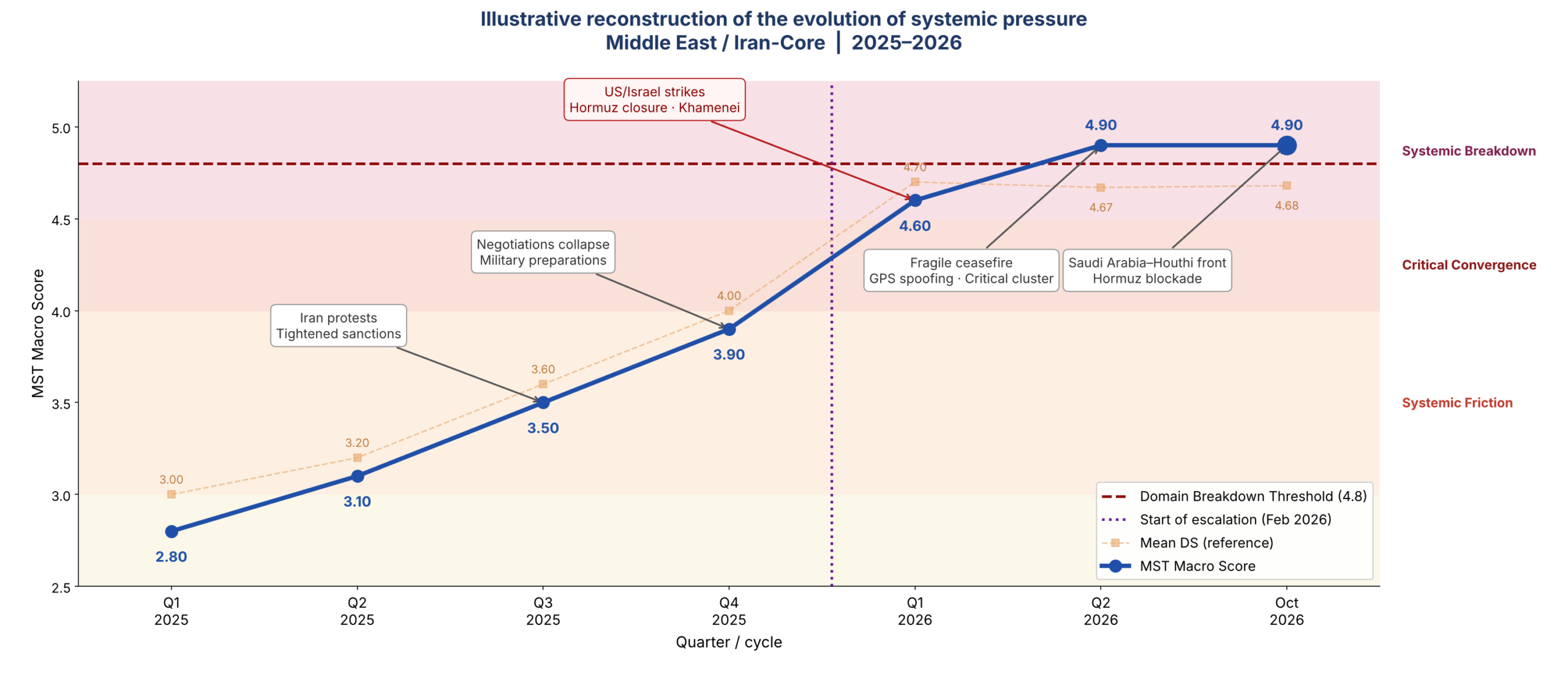
Legend — MST Evolution · Middle East / Iran-Core · 2025–2026
Source: MST Middle East Quarterly Evolution v1.0 (Q1 2025 – Q1 2026); validated MST assessment cycles of June 11 and October 14, 2026.
Q3–Q4 2025 = document-based intermediate estimates.
●━━● MST Macro Score
Composite assessment cycle value (weighted DN average + FC). Solid line = formal MST assessment cycle.
■ – – ■ Average DS (reference)
Average Domain Score across the six domains. Faint line: supporting value, not equivalent to the Macro Score.
— — — Critical Pressure Proximity Zone (4.8)
Indicative threshold. The "Rupture Threshold" flag is activated when all six DN values are ≥ 4.8, not when the Macro Score reaches this level.
⋮ ⋮ ⋮ Onset of Escalation (Feb 2026)
Temporal marker indicating the beginning of the structural escalation phase.
NOTES — Significant Structural Changes
▶ Δ Q2→Q3 2025 (+0.30): Domestic protests in Iran; US sanctions. The main domains exceed the high-pressure threshold. Move into rising Systemic Friction.
▶ Δ Q3→Q4 2025 (+0.40): Final negotiating round; first documented military preparations. ICA falls to 3.9.
▶ Δ Q4 2025→Q1 2026 (+0.70) [STRUCTURAL EVENT]: US/Israeli strikes; closure of the Strait of Hormuz; Khamenei's intervention. Approach to the critical pressure band.
▶ Δ Q1→Q2 2026 (+0.30): Fragile ceasefire; GPS spoofing; critical cluster expanded to 3 domains (S, E, T) with DN 5.0.
▶ Δ June→October 2026 (0.00): failure of the Islamabad Memorandum and reinstatement of the US naval blockade at Hormuz; new armed Saudi Arabia–Houthi front since 13 July. Security +0.1 absorbed by the ceiling: Macro Score unchanged.
The October 2026 assessment cycle confirms that the Middle East / Iran-Core remains in the configuration of maximum systemic pressure observed by the MST framework.
For the third consecutive cycle, the macro-area records a Macro Score of 4.9 out of 5. All six domains maintain net pressure values of 4.8 or higher, with three – Security, Energy, and Technology – at the maximum level (DN 5.0).
Only one domain records a validated structural change in the current cycle:
— Security (+0.1).
This reflects the opening of a direct armed front between Saudi Arabia and the Houthis, absent from the baseline: since July 13, Saudi airstrikes on Yemen, the Houthi blockade of Bab el-Mandeb targeting Saudi ports, attacks on oil tankers and, between October 6 and 11, attacks on the airports of Riyadh, Abha, and Dammam, resulting in at least 19 deaths and more than 350 injuries. Pressure has increased, but the domain was already at the upper limit of the scale: the value used in the assessment remains at 5.0.
The operational context is marked by the failure of the June de-escalation. The June 17 Islamabad Memorandum had led to the lifting of the US naval blockade and a partial reopening of Hormuz. Following attacks on vessels on July 6–7, the ceasefire was declared over on July 8, the United States conducted an air campaign from July 9 to 24, and the blockade was reinstated on July 13–14. As of October 14, the blockade remains in force, and naval exchanges between the United States and Iran continue.
Hormuz remains the focal point of energy-related pressure: by early October, commercial transits had fallen to only a few passages per day, while Qatar's LNG exports remain under force majeure. Supreme Leader Mojtaba Khamenei continues to make no public appearances.
Dominant Structural Elements of the Current Cycle
The October 2026 assessment cycle identifies only one validated structural change relative to the June 11, 2026 baseline: Security (+0.1). It is supported by evidence from multiple independent sources, with verified persistence over 93 days (July 13 – October 14).
The change reflects the reactivation of the armed front between Saudi Arabia and the Houthis, which had remained inactive since the 2022 UN-brokered truce: no Houthi attacks against Saudi Arabia were recorded in 2026 before July 13. The front is assessed as a single structural transformation, spanning from the initial raids in July to the airport attacks in October.
The other five domains show no validated structural changes. Energy remains at the maximum level (DS 5.0): data on Hormuz shipping flows for September and October are not directly comparable and do not demonstrate a change in either direction. Finance remains unchanged: the deterioration in the International Monetary Fund's forecasts for the region is documented, but it is not corroborated by convergent physical measurements and will be reassessed in the next cycle. Regulatory, Cognitive, and Technology domains remain consistent with their baseline trajectories.
Macro-area strategic picture
In October 2026, the Middle East / Iran-Core macro-area is in a configuration combining three simultaneous dimensions of structural pressure, none of which shows verifiable signs of easing in the short term.
The first is military and directly related to security. The de-escalation initiated in June through the Islamabad Memorandum did not hold: the ceasefire was declared over on July 8, followed by a US air campaign (July 9–24) and the reinstatement of the naval blockade. On July 13, a direct armed front between Saudi Arabia and the Houthis emerged, with attacks on Saudi airports in October. The Lebanese front remains active: the June 26 Lebanon–Israel–United States trilateral framework has not been implemented, and UNIFIL's mandate expires on December 31, 2026.
The second is energy-related and geoeconomic. The Strait of Hormuz, through which approximately 20% of globally traded oil passes, remains under naval blockade. In September, some crude oil flows resumed under US escort (approximately 80% of pre-war levels, according to Kpler), but by early October commercial transits had fallen back to only a few passages per day. Brent crude remains above $105, and Qatar's LNG exports remain under force majeure, with gas prices in Asia and Europe approximately three times their pre-war levels. For the macro-area, the interdiction of Hormuz is not merely a signal of pressure – it is the structural condition of the system.
The third is institutional and related to governance. Supreme Leader Mojtaba Khamenei has made no verifiable public appearances, and Iran's information environment is marked by blackouts and the central role of the Islamic Revolutionary Guard Corps. Uncertainty over the continuity of the strategic direction creates an additional cognitive and regulatory risk factor that overlaps with existing pressures.
Regional Security
The Security domain remains at the framework's maximum level (DN 5.0, structural cap) and records the cycle's only validated structural change (DS 4.8→4.9): the opening of a direct armed front between Saudi Arabia and the Houthis. Since July 13, the sequence has included the Saudi raid on Sanaa airport and Houthi missile strikes on Abha, the Houthi blockade of Bab el-Mandeb targeting Saudi ports (July 20), attacks on Saudi oil tankers and, between October 6 and 11, attacks on the airports of Riyadh, Abha, and Dammam, resulting in at least 19 deaths and more than 350 injuries.
The increase does not change the value used in the assessment, which was already at the upper limit of the scale: the framework records the additional pressure as an excess beyond the cap. Beyond the Yemeni front, the domain incorporates naval exchanges between the United States and Iran around Hormuz in September and October, the July 18–19 attack on a base in Jordan hosting US military personnel, the July 29 joint US-Saudi strikes against militias in Iraq, and the Lebanese front.
Energy and Supply
The Energy domain remains at the maximum structural cap (DS 5.0, DN 5.0) for the fourth consecutive assessment cycle. The Strait of Hormuz remains under a US naval blockade, reinstated on July 13–14 following the brief partial reopening after the Islamabad Memorandum (June 18 – July 5).
War-risk insurance premiums range between 3% and 10% of hull value.
The structural impact operates at three levels.
— The first is direct: crude oil flows through Hormuz partially resumed in September under US escort, but by early October commercial transits had fallen to only a few passages per day; in September, a drone launched from Iraq temporarily halted Saudi Arabia's East–West Pipeline.
— The second concerns regional transmission: Brent crude stood at $105.40 on October 14.
— The third is global: Qatar's LNG exports remain under force majeure, with approximately 17% of capacity damaged and LNG prices in Asia and Europe around three times pre-war levels. The available data are not directly comparable and do not demonstrate a change relative to June: the structural condition of the Energy domain in the macro-area remains one of maximum systemic pressure.
Finance and Economic Resilience
The Finance domain maintains stable structural pressure (DS 4.5, DN 4.8). The International Monetary Fund's October forecasts have deteriorated for the region (Middle East and North Africa −2.0% in 2026; Saudi Arabia −3.3%) and assume that Hormuz will reopen only from March 2027. This deterioration has not yet been corroborated by convergent physical measurements – Saudi oil production, for example, increased in September – and the domain remains unchanged: the evidence will be reassessed in the next cycle.
The macro-area's financial condition is characterized by a structural duality: Iran operates under extreme financial pressure, exacerbated by the revocation of the waiver for Iranian crude oil (July 7) and new sanctions targeting the shadow fleet (October 8), while the Gulf states retain significant financial strength through their sovereign wealth funds. However, the prolonged closure of Hormuz also weighs on these countries: the International Monetary Fund now forecasts a 3.3% contraction for Saudi Arabia in 2026.
Regulatory and Institutional Framework
The Regulatory domain maintains stable structural pressure (DS 4.5, DN 4.8). Evidence from the current cycle confirms the baseline condition: the June 17 Islamabad Memorandum has not been formally declared terminated but no longer produces any practical effects; indirect talks between the United States and Iran on the sidelines of the UN General Assembly (September 22) produced no agreements, and the French draft UN Security Council resolution on Hormuz was not adopted; the June 26 Lebanon–Israel–United States trilateral framework has not been implemented.
The Iraqi case confirms the weakness of containment mechanisms: Baghdad described the July 29 US-Saudi strikes as a "flagrant violation of sovereignty", while militias reject disarmament and make any cessation of attacks conditional on a US withdrawal.
Cognitive and Information Domain
The Cognitive domain maintains stable structural pressure (DS 4.5, DN 4.8), with evidence confirming the saturation trajectory already recorded in the baseline.
The main evidence from the current cycle concerns the condition of Mojtaba Khamenei.
His absence from public appearances in recent weeks, combined with reports from a regional intelligence source suggesting that his health may be compromised, generates a level of cognitive uncertainty surrounding the Islamic Republic's decision-making centers unprecedented in systematic monitoring.
In a governance system such as Iran's – where the Supreme Leader concentrates decisive formal and informal authority – the lack of transparency surrounding the primary decision-making center constitutes a structural risk factor under conditions of an active crisis (Hormuz, the Saudi–Houthi front, stalled negotiations).
Technological-Industrial Domain and Infrastructure Resilience
The Technology domain remains at the structural cap (DS 4.7, DN 5.0), reached in the June assessment cycle. Evidence from the current cycle confirms the sustained Iranian cyber campaign already recorded in the baseline: in July, the joint advisory issued by US agencies (FBI, NSA, Department of Energy, and CISA) was expanded to cover Schneider and Siemens industrial controllers, with water systems affected in 12 US states; on October 12, the United Kingdom imposed sanctions in connection with an Islamic Revolutionary Guard Corps plot targeting RAF Fairford. Most targets are located outside the macro-area.
The domain remains within the critical cluster alongside Security and Energy: cyber operations and electronic interference continue to serve as persistent instruments of systemic pressure.
Signals to Monitor in the Next Analytical Cycle
• The status of the naval blockade and shipping transits through the Strait of Hormuz, including any potential UN Security Council resolution.
• Developments on the Saudi Arabia–Houthi front and the operational resilience of Saudi Arabia's East–West Pipeline.
• The US decision on Iran after the 3 November midterm vote.
• The expiry of the UNIFIL mandate (31 December 2026) and the Lebanese front.
• Mojtaba Khamenei’s public appearances and the stability of the Iranian leadership.
• The evolution of the Iranian cyber campaign.
• The financial deterioration forecast by the International Monetary Fund, to be verified with physical measures.• The Convergence Factor (FC): currently absent (0.0). The conditions for its activation could be met if the Saudi–Houthi front or the Hormuz blockade transmit pressure to other domains with measurable effects.
Why the Macro-area is in Systemic breackdown
The macro-area is classified as being in Systemic Rupture (the 4.5–5.0 range on the MST scale) based on a Macro Score of 4.9, automatically derived from the average of the six normalized pressure values (DN). The Macro Score stands at 4.9 for the third consecutive assessment cycle. Three of the six domains remain at the upper limit of the DN scale (5.0), while the increase in Security pressure recorded in the current cycle exceeds the scale ceiling. All six domains simultaneously exhibit DN ≥4.8 – an unprecedented configuration in the systematic monitoring of the macro-area.
Adaptive capacity – measured by an ICA of 3.5, unchanged from the baseline – remains consistently below structural pressure across all six domains. Systemic Rupture describes a condition of extreme saturation in which the system has no remaining internal compensatory mechanisms, and any further increase in pressure is transmitted directly to the structural configuration.
For this reason, the Middle East / Iran-Core macro-area maintains a configuration of: Systemic Rupture
Priority Monitoring Indicators
In the next assessment cycle, particular attention will be given to the Hormuz blockade, the Saudi Arabia–Houthi front, and the stability of Iran's leadership.
With all six domains at DN ≥4.8, three of which are at the upper limit of the scale (DN 5.0), the current configuration exhibits the highest concentration of multidomain pressure ever recorded by the MST framework for this macro-area.
In the medium term (2026–2030), the macro-area will be shaped by the outcome of Iran's leadership succession, the evolution of nuclear doctrine, Hezbollah's ability to maintain an autonomous operational structure, and the durability of regional normalization agreements. In the absence of verifiable structural de-escalation, Systemic Rupture is expected to remain the baseline condition for future assessment cycles.
Learn More
→ Geopolitical Macro-Areas Dossier
Explore the regional strategic analyses of the international system.
→ Global System Assessment Dashboard
Consult the public summary of the system’s current configuration.
–> How to Read an MST Assessment
→ MST Framework
Learn more about the framework used to assess structural pressure and adaptive capacity.
Methodological Note
This analysis is based on the application of the Multi-System Tension (MST) framework, developed to assess structural pressure, adaptive capacity, and systemic configurations through validated open-source evidence.
The values presented do not constitute forecasts; they represent a synthesis of the observable structural condition of the system during the period under analysis.