


South Asia Macro-area Cycle: 14 October 2026 | MST Framework v3.2 | CSR Italia
How to read South Asia macro-area analysis
MST Score:
A score on a 1–5 scale that summarizes the overall level of structural pressure within the macro-area. It is derived from the combination of the net pressure observed in each domain and the inter-domain amplification factor. Higher values indicate systems exposed to persistent and multi-domain pressures.
Adaptive Capacity (ICA):
Measures the structural resilience of the macro-area: its ability to absorb, manage, and contain the pressures observed. A higher value indicates a greater capacity to maintain systemic equilibrium. Scale: 1–5.
Systemic Breakdown:
The fifth and highest tier of the MST scale (4.5–5.0). A configuration of maximum pressure. It occurs when structural pressure is distributed across multiple domains and the system’s compensation mechanisms are no longer sufficient to contain it. It is generally associated with the highest levels of the MST scale, but is not determined solely by the numerical value of the Macro Score.
Critical Convergence:
The fourth tier of the MST scale (4.0–4.5). A configuration characterized by elevated pressure distributed across multiple domains, with adaptive capacity still present but progressively contracting. Classification depends on the overall structure of the system and not solely on the numerical value of the Macro Score.
Domain Breakdown Threshold:
An internal flag activated when the net pressure of a single domain exceeds 4.8. It does not alter the overall configuration, but indicates a domain in a state of critical compression requiring intensified monitoring.
→ How to Read an MST Assessment
Executive Summary
The MST cycle as of 14 October 2026 confirms the Critical Convergence tier for South Asia, with a Macro Score of 4.15 out of 5, unchanged from June.
No valid structural change is recorded: the cycle is Evidence of No Structural Change and all six domains remain at the values of the 14 June baseline, with the Security domain at the upper limit of the scale (DN 5.0).
This outcome does not mean nothing new happened. Pakistan signed the Makkah defence pact with Saudi Arabia and Türkiye, activated on 5 October after Houthi attacks on Saudi cities; on 11 October it declared a state of emergency in Khyber Pakhtunkhwa, suspending the provincial government; on the Afghan border, strikes resumed in September after a pause of almost three months.
None of these facts yet meets the framework's conditions: they are recorded but not validated.
MST Score: 4.15 / 5
1.0 – 2.0
Sustainable Pressure
2.0 – 3.0
Latent Accumulation
3.0 – 4.0
Systemic Friction
4.0 – 4.5
▲
Critical Convergence
4.5 – 5.0
Systemic Breakdown
Macro-area configuration: Critical convergence
Adaptive capacity: High (ICA: 3.9)
Dominant node: Security (DN 5)
Dominant dynamic: Strengthening of nuclear deterrence and narrowing room for de-escalation
Valid changes in the cycle: 0 — Evidence of No Structural Change
Position within the MST Scale
With an MST Score of 4.15, South Asia falls within the Critical Convergence tier (4.0–4.5), the fourth in the framework.
The value reflects high and distributed structural pressure, in which the Security domain reaches the upper limit of the net pressure scale, while the macro-area's adaptive capacity, assessed as High at 3.9 on a 1–5 scale, is structurally below the pressure observed in three of the six domains. Under the framework's automatic rule, when adaptive capacity is lower than the pressure measured in a domain, that domain's net pressure is amplified.
In the Security domain — with pressure at 4.7 and adaptive capacity at 3.9 — the resulting net pressure is 5.0, the upper limit of the scale. This does not indicate stabilisation: the system can continue to deteriorate structurally even with the domain already at its maximum scale value.
Two other domains (Finance, DN 4.5, and Cognitive, DN 4.3) maintain net pressures above the Critical Convergence threshold. The absence of changes in the October cycle indicates that existing pressure is consolidating without any validated structural discontinuity emerging.
The macro-area therefore maintains a configuration of: Critical convergence
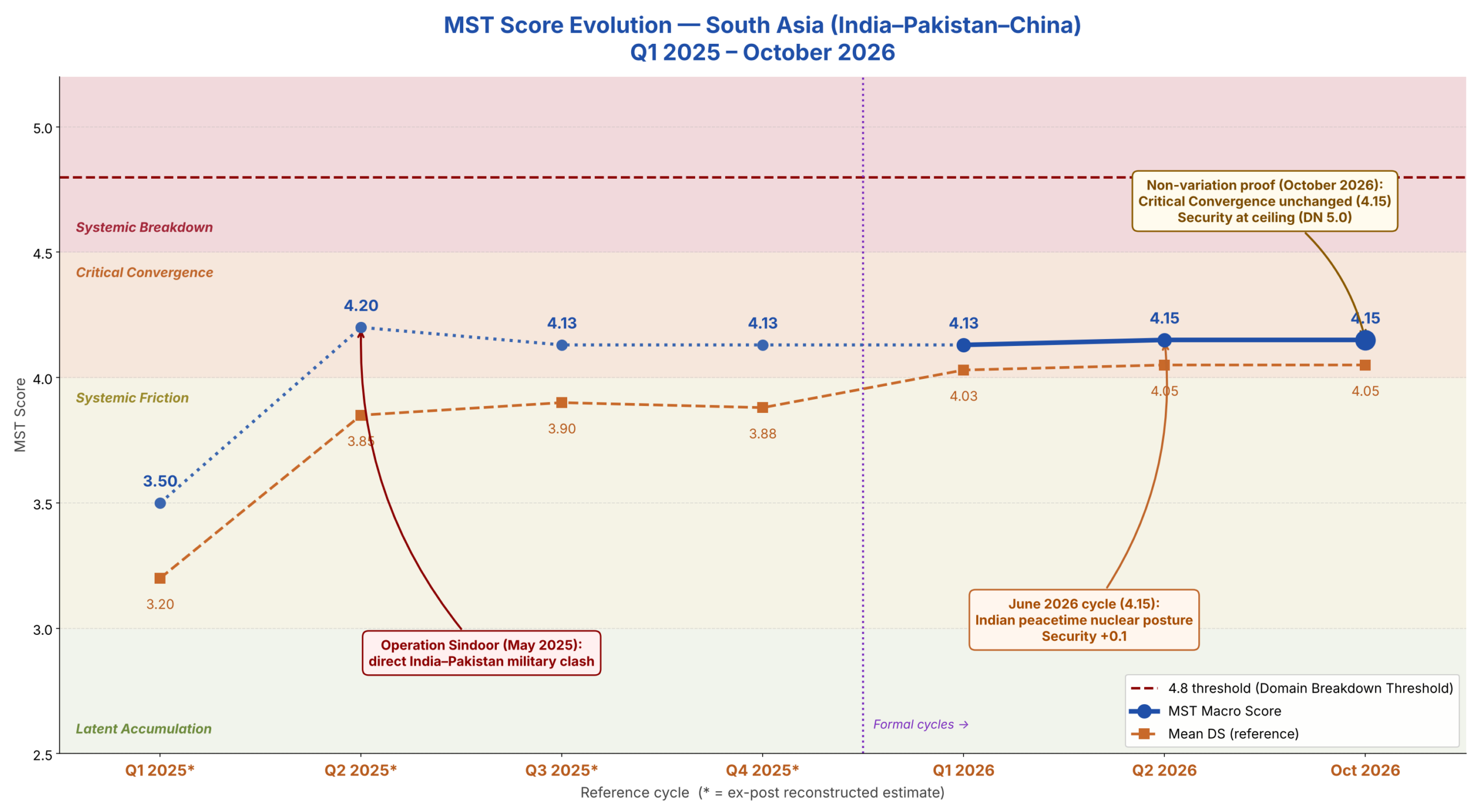
Legend — MST Evolution · South Asia · 2025–2026
Source: MST Cycle 14 October 2026 | Q1–Q4 2025 = ex-post reconstructed estimates
LEGEND
●━━● MST Macro Score: Composite value of the formal cycle. Solid line.
■ – – –■ Mean DS (reference): Mean DS of the six domains. Supporting value.
Coloured bands: MST scale — Latent Accumulation, Systemic Friction, Critical Convergence (from 4.0), Systemic Breakdown (from 4.5).
— — — 4.8 threshold: Domain Breakdown Threshold (DN ≥4.8 in one domain). It does not coincide with Systemic Breakdown, which begins at 4.5.
⋮ ⋮ ⋮ ⋮ ⋮ Cycle separator: Ex-post estimates | formal MST v3.1 cycles.
○–·–○ Ex-post estimates Q1–Q4 2025: Reconstruction in MST equivalent. Not a formal cycle.
NOTES — SIGNIFICANT STRUCTURAL CHANGES
▶ Δ Q2 2025 (+0.70): Operation Sindoor (7–10 May 2025) — first direct India–Pakistan military exchange involving drones and missiles. Estimated Macro Score: 4.20. Escalation in the Security, Cognitive and Finance domains.
▶ Δ Q3–Q4 2025 (stabilisation at 4.13): fragile post-Sindoor ceasefire; structural parameters consolidate at a high level without new valid formal changes.
▶ Δ Q1 2026 (formal baseline 30 March 2026): first formal MST v3.1 cycle. Macro Score: 4.13. MacroBase: Critical Convergence (realignment from Systemic Friction under v2.7).
▶ Δ Q2 2026 (+0.02): Security DS +0.1 for India's nuclear posture shift (SIPRI, 9 June 2026). First peacetime deployment of Indian nuclear warheads. Security DN: 5.0 — DOMAIN BREAKDOWN THRESHOLD flag. Macro Score: 4.15.
▶ Δ October 2026 (0.00): formal cycle of 14 October 2026. Evidence of No Structural Change: no valid change. Macro Score 4.15, ICA and FC unchanged; Security at the ceiling (DN 5.0).
▶ Q1–Q4 2025 (*): Ex-post projected values — not a formal MST v3.1 cycle.
* The quarters Q1–Q4 2025 are ex-post reconstructed estimates in MST v3.1 equivalent, in the absence of formal cycles.
CSR Italia — MST v3.2 — Cycle: 14 October 2026 — South Asia
Valid Structural Adjustments in the Current Cycle
In the cycle as of 14 October 2026 no valid structural change is recorded against the 14 June 2026 baseline. The cycle constitutes Evidence of No Structural Change: for every domain, structural pressure remains at its June level.
Four pieces of evidence warrant explicit documentation of their classification, as they are relevant but not structurally qualifying:
Makkah defence pact: NOT VALIDATED — CONTINUITY
On 7 August Pakistan, Saudi Arabia and Türkiye signed the Makkah joint defence pact, which builds on the bilateral Pakistan–Saudi Arabia agreement of September 2025. On 5 October, at an emergency meeting in Riyadh following Houthi attacks on Saudi cities, the pact was activated with the "rapid deployment" of the agreed forces; on 7 October the Pakistani military spokesman confirmed the presence of Pakistani troops in the Kingdom, which, however, have been there "for decades". No additional deployment is documented and the activation is 9 days old at the cycle date, below the persistence threshold: the Security and Regulatory domains remain unchanged. The pact links South Asia to the Saudi–Houthi front in the Middle East.
Emergency in Khyber Pakhtunkhwa: NOT VALIDATED — CONTINUITY
On 11 October Pakistan's president declared a state of emergency in Khyber Pakhtunkhwa province, governed by Imran Khan's party (PTI), suspending the provincial government for an initial six months and deploying troops; Amnesty International reported detentions and communication shutdowns. It is a new and significant institutional measure, but only 3 days old at the cycle date: below all persistence thresholds. It is the main point to follow in the next cycle.
Pakistan–Afghanistan border: SEQUENCE — NO NET CHANGE
After the Pakistani strikes of 28 June in Afghanistan, air strikes stopped for almost three months. They resumed on 21 September in Kunar and Paktika provinces, after the Kohat bombing of 18 September, and since 5 October, after the Moscow talks failed, there have been clashes along the border. By 14 October the situation had returned to the June level: the intermediate improvement has been reabsorbed and the resumption does not exceed the baseline. The Security domain remains unchanged.
Semiconductors in India: NOT VALIDATED — CONTINUITY
On 4 July CG Semi started commercial chip assembly and testing (OSAT) at Sanand; on 15 July the second phase of India's semiconductor mission was approved, and in September the government reported five production units. It is a real production start within a programme already in the baseline, but neither output nor import-substitution capacity has been measured, and assembly is not equivalent to wafer fabrication. The Technological-Industrial domain remains unchanged.
Strategic picture by Domain
In October 2026 South Asia is in a configuration that combines three dimensions of simultaneous structural pressure, each with its own trajectory and with potential for mutual amplification.
The first dimension is nuclear and conventional security, which in the June cycle became the axis of structural change: the peacetime deployment of Indian nuclear warheads turns deterrence from a conceptual posture into an operationally activated capability, narrowing de-escalation margins in a context where the two states already conducted direct military operations in 2025.
The second dimension is the asymmetric financial pressure between India and Pakistan, which produces a growing structural gap: India in sustained economic expansion (6.6% growth forecast for 2026), Pakistan in fiscal crisis with growth at 3% and more than 40% of the population in absolute poverty despite IMF support, with foreign debt limiting its capacity to respond to new shocks.
The third dimension is multi-level cognitive and technological competition, which is consolidating as a systemic axis: India has set up a tri-service Cognitive Warfare Action Force with AI tools, while competition in semiconductors and advanced supply chains is redefining the vectors of power in the region over decade-long horizons.
Security
In the June cycle the Security domain recorded the first valid structural change, with DS rising from 4.6 to 4.7. The change is driven by the shift in India's nuclear posture documented by SIPRI: the peacetime deployment of warheads represents a paradigm shift in India–Pakistan bilateral deterrence. At the same time, India is carrying out its largest military reorganisation since independence, creating integrated theatre commands designed to face Pakistan and China simultaneously. The ceasefire that followed Operation Sindoor is technically in force but fragile, with shrinking room for de-escalation. The Belfer Center (June 2026) notes that India's nuclear shift compresses decision-making time in crisis scenarios, reducing the window for diplomatic intervention. The domain's net pressure (DN 5.0) reaches the scale maximum, triggering the Domain Breakdown Threshold flag.
In the October cycle pressure shifted to Pakistan's western front: renewed strikes in Afghanistan and border clashes since 5 October, activation of the Makkah pact, emergency in Khyber Pakhtunkhwa. On the India–China border, the meeting between Xi Jinping and Narendra Modi at the BRICS summit in New Delhi (12 September) called for maintaining peace, without verified military disengagement. The domain remains at the ceiling (DS 4.7, DN 5.0), with no valid changes.
Energy
The Energy domain retains its existing structure (DS 3.9, DN 3.6). Regional energy pressure continues to stem from import dependence — South Asia is the region most exposed to energy shocks among emerging markets — and from the indirect transmission of Middle East price increases along maritime routes. The World Bank's June 2026 GEP forecasts regional growth moderating to 6.3% precisely because of the impact of energy prices. No autonomous structural discontinuities are recorded in the domain during the period observed. DS unchanged.
The World Bank's October report confirms high energy costs, compensation measures and the drawdown of reserves, with resilient domestic demand; its data exclude China and are not comparable with the CSR perimeter. No change.
Finance
The Finance domain maintains DS 4.2 and DN 4.5. Asymmetric financial pressure between India and Pakistan remains structurally embedded in the system. Pakistan operates with 3% growth, constrained access to capital markets and rising foreign debt despite the $7 billion IMF programme. The IMF benchmark for end-June 2026 (roadmap towards a "riba-free" economy) adds a structural constraint on debt management. India, by contrast, is growing at 6.6% with robust domestic demand and high public investment. The structural gap produces growing asymmetric vulnerability. No new change against the baseline: DS unchanged.
In the October cycle the State Bank of Pakistan kept its policy rate at 11.5% (14 September) and the IMF reached a staff-level agreement with Pakistan on the fourth review of the programme (about $1.2 billion), still subject to Board approval; inflation stood at 10.3% in September. The programme continues as in the baseline.
Regulatory / Governance
The Regulatory domain maintains DS 3.7 and DN 3.4. Regional regulatory fragmentation and strategic divergences in Asian multilateral mechanisms continue without structural changes in the cycle. India continues its bilateral dialogue with China on the Himalayan border with a "stable but vigilant" posture, after completing formal disengagement in 2024. The completion of the Zojila tunnel (strategic infrastructure for Ladakh connectivity) signals structural investment in border operational capabilities, but does not constitute an autonomous DS change. DS unchanged.
In the October cycle there were two new institutional acts: the Makkah defence pact (signed on 7 August) and the state of emergency in Khyber Pakhtunkhwa (11 October). The former has no documented operational effects yet, the latter is too recent: the domain remains unchanged.
Cognitive / Social
The Cognitive domain maintains DS 4.0 and DN 4.3. Cognitive competition in the region is consolidating: India is operationalising the Cognitive Warfare Action Force with integrated AI capabilities, sentiment analysis and meme-warfare tools coordinated across the three armed services. Regional information polarisation — amplified by the use of AI deepfakes during Operation Sindoor in 2025 — persists as a structural feature. The CWAF was announced in March 2026, before the 28 May baseline; its progressive operationalisation in the current cycle does not constitute a structural discontinuity sufficient for a DS change, in the absence of converging multi-layer evidence of a new level of actual capability. DS unchanged.
In the October cycle the emergency in Khyber Pakhtunkhwa brought communication shutdowns, and on 24 September India's defence minister named drones, cyberattacks and disinformation among the main threats: facts in continuity with the baseline or too recent. DS unchanged.
Technological-Industrial
The Technological-Industrial domain maintains DS 3.8 and DN 3.5. India has launched Semiconductor Mission 2.0 and approved five-year tax exemptions for the semiconductor supply chain in the 2026 budget, aiming to have four plants operational by the end of 2026. The DLI (Design Linked Incentive) programme has reached 315 academic institutions and 104 start-ups. The trajectory is structurally positive for India, but the gap with technologically mature economies remains large: India is not yet able to meet domestic demand for advanced chips on its own. The policy is progressive and predates the baseline. DS unchanged.
In the October cycle CG Semi's commercial production started at Sanand (4 July), with no output measures; in Balochistan a separatist attack on a lithium exploration site (September) is part of an ongoing campaign. DS unchanged.
ICA — Structural Resilience
High (ICA: 3.9)
South Asia's adaptive capacity remains High at 3.9. The main limit to structural resilience is the concentration of pressure in the Security domain, where the ICA–DS gap (3.9 vs 4.7) produces full amplification that takes the DN to the scale maximum. In three of the six domains pressure exceeds adaptive capacity (Security, Finance, Cognitive), preventing effective systemic absorption of accumulated tensions. Partial resilience is provided by the stability of the Indian economy, the diversification of multilateral cooperation and the strength of India's foreign exchange reserves. The ICA remains unchanged at 3.9 in the October cycle as well, in the absence of valid DS changes.
Conditions for Change
The following conditions, if met, would produce a measurable structural change in the MST parameters:
A new direct India–Pakistan military escalation (drones, missiles, special forces) exceeding the level of Operation Sindoor — immediate activation of the Systemic Breakdown MacroBase.
Deliberate or inadvertent use of tactical nuclear capabilities in a crisis — crossing of the framework's maximum structural threshold.
Pakistani default or collapse of the IMF programme — rapid transmission to the Finance domain with regional Cognitive and Governance effects.
Chinese escalation in the Himalayan sector at the same time as India–Pakistan tensions — opening of a second structural front with FC amplification.
A large-scale terrorist attack in India attributed to Pakistan — high probability of a retaliation cycle beyond the 2025 ceasefire threshold.
Disruption of maritime energy routes (Strait of Hormuz, Gulf of Aden) — direct impact on the Energy domain cascading into Finance.
Continuation of the state of emergency in Khyber Pakhtunkhwa beyond the persistence threshold, with troops deployed — possible change in the Regulatory and Cognitive domains.
Documented deployment of Pakistani forces to Saudi Arabia under the Makkah pact, linked to the Saudi–Houthi front — transmission of the Middle East crisis to the Security domain.
Sustained escalation on the Afghan border after the failure of the Moscow talks — possible additional pressure on the Security domain, already at the ceiling.
Stabilising conditions:
Stabilisation of the India–Pakistan ceasefire with a bilateral verification protocol — gradual reduction of pressure in the Security domain.
India–China trade agreement with regulation of the Himalayan border — structural reduction of Regulatory and Security pressures.
Pakistani economic recovery supported by regional investment (China, Gulf) — easing of asymmetric financial pressure.
IMF Board approval of the fourth review of Pakistan's programme — confirmation of Pakistan's financial resilience.
Learn More
→ Geopolitical Macro-Area Dossiers
Explore the regional strategic assessments of the international system.
→ Global System Status Dashboard
Consult the public summary of the system’s configuration.
→ How to Read an MST Assessment
→ MST Framework
Learn more about the framework used to assess structural pressure and adaptive capacity.
Methodological Note
This analysis derives from the application of the Multi-System Tension (MST) framework, developed to assess structural pressure, adaptive capacity and systemic configurations through validated open-source evidence.
The values reported are not forecasts, but a synthesis of the structural state observable in the cycle considered.
CSR Italia — MST v3.2 — Cycle: 14 October 2026 — South Asia – India–Pakistan