


Cycle: 14 October 2026 | Africa Macro-area | MST Framework v3.2 | CSR Italia
How to read the Strategic Analysis of the Africa Macro-area (Sub-Saharan + Southern MENA)
MST Score:
A score on a 1–5 scale that summarises the overall level of structural pressure within the macro-area. It is derived from the combination of the net pressure of each domain and the inter-domain amplification factor. Higher values indicate systems under persistent, multi-domain pressure.
Adaptive capacity
Measures the structural resilience of the macro-area: its ability to absorb, manage and contain the pressures observed. A higher value indicates a greater capacity to maintain systemic equilibrium. Scale 1–5. When the ICA is lower than the pressure in a domain, that domain's net pressure is amplified; when it is higher, it is reduced.
Critical convergence
The fourth of five tiers of the MST scale (4.0–4.5). High pressure distributed across multiple domains, with adaptive margin still present but progressively contracting.
System Breckdown
The fifth tier (4.5–5.0). A configuration of maximum pressure: internal compensation mechanisms are no longer sufficient to contain pressure distributed across multiple domains.
Domain Breackdown Threshold
An internal flag activated when the net pressure of a single domain exceeds 4.8. It does not alter the overall configuration, but indicates a domain in a state of critical compression that requires intensified monitoring.
–> How to Read an MST Assessment
Executive summary
The MST cycle as of 14 October 2026 confirms the Critical Convergence tier for Sub-Saharan Africa and Southern MENA, with a Macro Score of 4.28 out of 5, unchanged from June. The cycle does, however, record one valid structural change: pressure in the Security domain rises by 0.1, from 4.7 to 4.8, owing to the resumption of war in Tigray, northern Ethiopia, from 1 August.
The overall score does not change because the Security domain was already at the upper limit of the net pressure scale (5.0): the deterioration is real, but it can no longer rise in the calculation. The Domain Breakdown Threshold is active in Security.
The other five domains remain at their June values. New facts not validated include the constitutional referendum in Guinea-Bissau, pipeline blockades in Libya and the recovery of transits through the Suez Canal.
MST Score: 4.28 / 5
1.0 – 2.0
Sustainable Pressure
2.0 – 3.0
Latent Accumulation
3.0 – 4.0
Systemic Friction
4.0 – 4.5
▲
Critical Convergence
4.5 – 5.0
Systemic Breakdown
Macro-area configuration: Critical convergence
Adaptive capacity:High (ICA: 4.3)
Dominant node: ecurity (DN 5.0)
Dominant dynamic: Mutual amplification of security crises, financial distress and institutional vacuum
Valid changes in the cycle: 1 — Security DS +0.1 (resumption of war in Tigray)
Position within the MST Scale
With an MST Score of 4.28, Sub-Saharan Africa and Southern MENA fall within the Critical Convergence tier (4.0–4.5), the fourth in the framework.
The macro-area's adaptive capacity, assessed as High at 4.3 on a 1–5 scale, is lower than the structural pressure in two domains, Security (4.8) and Finance (4.4), where net pressure is amplified to 5.0 and 4.7. In the other four domains adaptive capacity is equal to or higher than the pressure, and net pressure is reduced.
From this cycle onwards, net pressure is calculated domain by domain, under the framework's current rule. This is why the Security and Finance values are higher than those published in June (then 4.4 and 4.1), while the inter-domain amplification factor is expressed on the new scale (+0.20, Moderate level). The Macro Score remains 4.28: the change in calculation is not a deterioration and does not alter the tier.
The macro-area therefore maintains a configuration of: Critical Convergence
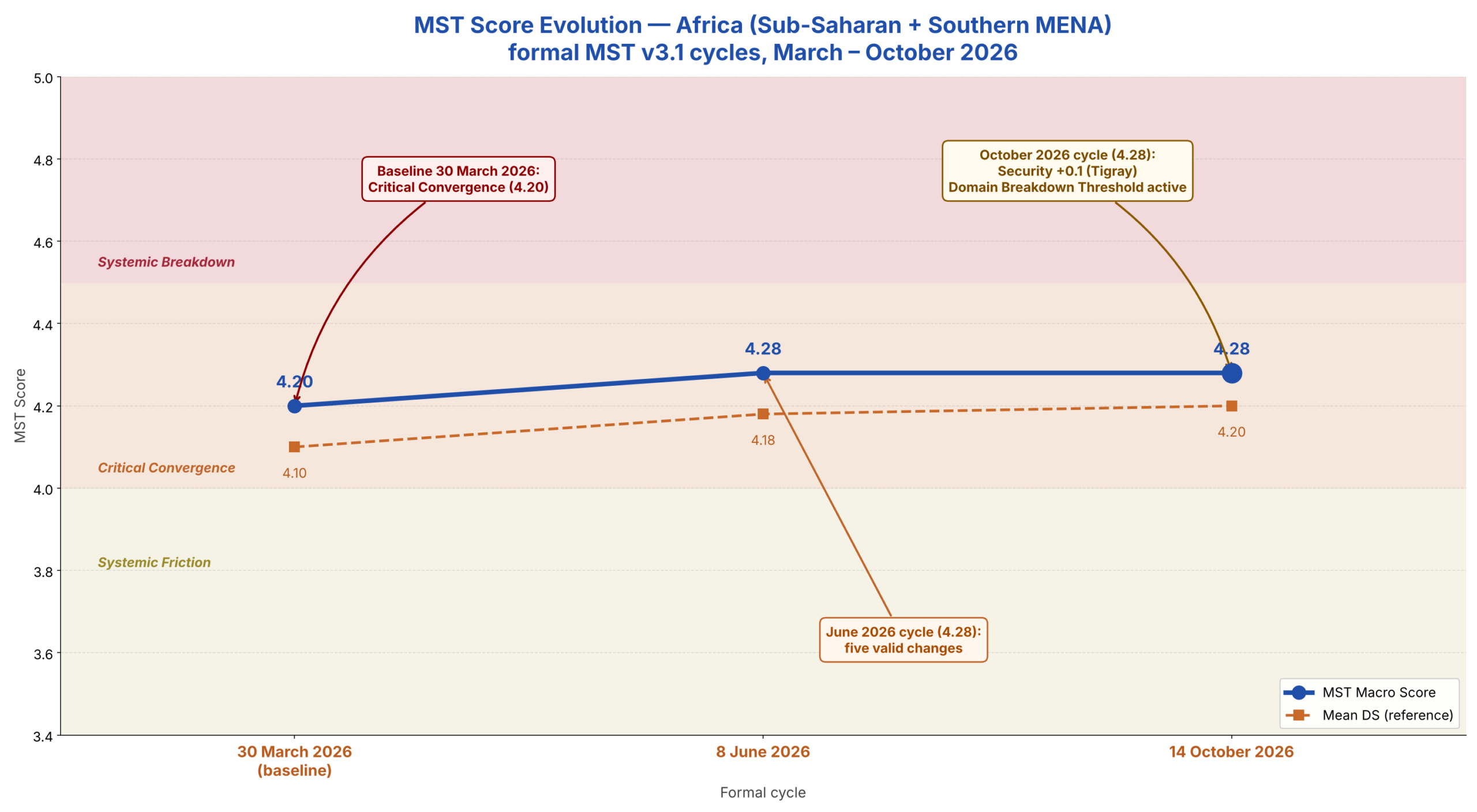
Evolution of the MST Macro Score — Africa (Sub-Saharan + Southern MENA), formal cycles from March to October 2026.
Legend — MST Evolution · Africa · 2026
●━━● Macro Score MST
Composite value of the cycle (mean DN + FC). Formal MST v3.1 cycles.
■ – – ■ Mean DS (reference)
Mean of the Domain Scores of the six domains. A supporting value, not equivalent to the Macro Score.
Coloured bands MST scale
Systemic Friction (3.0–4.0), Critical Convergence (4.0–4.5), Systemic Breakdown (4.5–5.0).
▶ NOTES — significant structural changes
30 March 2026 baseline (4.20):
March → June 2026 (+0.08) [FORMAL CYCLE]:
March → June 2026 (+0.08) [FORMAL CYCLE]:
Formal cycle of 8 June 2026. Five valid changes: Security, Energy, Finance, Regulatory and Cognitive +0.1 each. Macro Score 4.28.
June → October 2026 (0.00) [FORMAL CYCLE]:
Formal cycle of 14 October 2026. One valid change: Security +0.1 owing to the resumption of war in Tigray. Security net pressure at the ceiling (5.0), Domain Breakdown Threshold active. Macro Score 4.28, ICA unchanged.
Valid Structural Adjustments in the Current Cycle
In the cycle as of 14 October 2026 one valid structural change is recorded against the 8 June 2026 baseline.
Security (+0.1): resumption of war in Tigray
Since 1 August fighting has resumed between the Tigray People's Liberation Front (TPLF) and Ethiopian federal forces, with new fronts and realignments. Between 23 September and 3 October control of Mekelle airport and city changed hands twice, with a communications blackout of about nine days; on 1 October Ethiopia broke off diplomatic relations with Eritrea, and Eritrean forces were reported in Tigray in the following days. The sequence is documented by the ACLED timeline, by AP and Médecins Sans Frontières and by satellite imagery: 73 days of observed hostilities, above the 14-day persistence threshold. The change is not the emergence of tensions, already present in June, but the shift to open war.
The other evidence in the cycle is relevant but not structurally qualifying:
Constitutional referendum in Guinea-Bissau: NOT VALIDATED — CONTINUITY
On 30 August Guinea-Bissau approved by referendum a new constitution that expands presidential powers. It is a new fact, but there are not yet three converging layers of evidence on its effects: the Regulatory domain remains unchanged.
Libya, pipelines and mediation: CONTINUITY
In September two blockades of the pipelines to Zawiya, of five days each, remained below the persistence threshold; UN mediation to implement the 30 August agreement continues, with the division of the judicial system still unresolved.
Suez Canal: CONTINUITY
In August Suez Canal transits numbered 1,358 (+27% year on year) and revenue reached $567.1 million, against $326 million in August 2025, according to data reported by Ahram Online. The recovery is partly linked to the diversion of traffic caused by the Hormuz crisis, and annual revenue remains less than half that of 2023. The data are not comparable with the situation in June: the Finance domain remains unchanged.
Sub-Saharan Africa: Strategic Picture by Domain
In October 2026 Sub-Saharan Africa and Southern MENA are in a configuration that combines three dimensions of simultaneous structural pressure, which reinforce one another.
The first is military: jihadist insurgencies with growing capabilities in the Sahel, wars in Sudan and, since August, again in Ethiopia. The second is financial: a debt spiral that international mechanisms are unable to break, reducing resources for security, governance and energy. The third is capacity: the system is unable to turn national resources and responses into a coordinated regional response.
Security
The Security domain (DS 4.8, DN 5.0) is the dominant node of the macro-area. In the Sahel, the jihadist group JNIM went from fewer than 10 drone attacks in 2024 to about 80 in 2025 and extended its operations towards the borders between Benin and Nigeria. In Sudan the war between the army and the Rapid Support Forces has already caused more than 150,000 deaths and millions of displaced people.
In the October cycle the resumption of war in Tigray is added, with Eritrea's involvement and a regional realignment: on 4 October Egypt, Eritrea, Somalia and Sudan signed the El Alamein declaration. It is the only valid change in the cycle.
Energy
The Energy domain (DS 4.3, DN 4.0) reflects a structural deficit: hundreds of millions of people in Sub-Saharan Africa still lack electricity, generation is growing more slowly than demand and there is a shortage of skilled technicians to build and operate grids.
In the October cycle there are positive but limited signals: in South Africa the availability of Eskom plants rose to 68.2% since the start of the financial year, with fewer outages, in continuity with the stabilisation already visible in May. The domain is unchanged.
Finance
The Finance domain (DS 4.4, DN 4.7) has the second-highest pressure: in June 22 Sub-Saharan African countries were in or at high risk of debt distress, the G20 Common Framework had produced very few complete restructurings and 42% of external debt was held by private creditors.
In the October cycle the World Bank forecasts growth of 4.3% for Sub-Saharan Africa in 2026, with public debt at around 57% of GDP and still heavy debt service: a mixed picture that does not change the domain.
Regulatory / Governance
The Regulatory domain (DS 4.1, DN 3.8) is marked by the proliferation of military regimes: six governments without a credible transition in Sub-Saharan Africa, with two coups in 2025, in Guinea-Bissau and Madagascar.
In the October cycle the referendum in Guinea-Bissau strengthened presidential powers, and in Libya UN mediation continues without having yet healed the institutional division. The domain is unchanged.
Cognitive
The Cognitive domain (DS 3.9, DN 3.6) is affected by influence operations by external actors, from Russia in the Sahel to AI-enhanced campaigns, which erode trust in institutions.
In the October cycle the Africa Center documented information campaigns in Nigeria and restrictions on independent voices in the Sahel, together with new verification initiatives: threats and responses already present in June. The domain is unchanged.
Technological-Industrial
The Technological-Industrial domain (DS 3.7, DN 3.4) has the lowest pressure and shows the clearest signs of response: bans on raw mineral exports in more than 13 countries, the first lithium refinery in Zimbabwe ($400 million), and the economic zone between the Democratic Republic of the Congo and Zambia.
In the October cycle no new measurable production capacity emerges: economic corridors and mineral supply chains remain projects in progress. The domain is unchanged.
ICA — Structural Resilience
High (ICA: 4.3)
The adaptive capacity of Sub-Saharan Africa and Southern MENA is High, at 4.3: individual countries respond, some industrial policies advance, civil society mobilises. The limit is the regional coordination needed to turn these responses into system-wide resilience.
The ICA does not change in the October cycle: only one domain has changed, while the framework requires changes in at least two domains to update it.
Conditions for Change
The following conditions, if met, would produce a measurable structural change in the MST parameters:
Escalation of the war in Tigray into a direct confrontation between Ethiopia and Eritrea, or military involvement of the signatories of the El Alamein declaration — further pressure on Security, already at the ceiling, with possible transmission to the Regulatory and Finance domains.
Further JNIM advances towards coastal West Africa or towards Libya — increased pressure on Security and spillover towards the Mediterranean.
A country defaulting without an agreement under the G20 Common Framework — change in the Finance domain.
A new coup in the region (Gabon and Chad remain at risk) — change in the Regulatory domain.
Worsening traffic conditions in the Red Sea or the Gulf — change in the Finance and Energy domains of Southern MENA.
Stabilising conditions:
A verifiable ceasefire in Tigray lasting at least 14 days — first prerequisite for a reduction of pressure on Security.
The first complete debt restructurings under the G20 Common Framework — reduction of financial pressure.
Regional coordination of policies on critical minerals and energy — strengthening of adaptive capacity.
Learn More
→ Geopolitical Macro-Areas Dossier
Explore the regional strategic analyses of the international system.
→ Global System Assessment Dashboard
Consult the public summary of the system’s current configuration.
–> How to Read an MST Assessment
→ MST Framework
Learn more about the framework used to assess structural pressure and adaptive capacity.
Methodological Note
This analysis derives from the application of the Multi-System Tension (MST) framework, developed to assess structural pressure, adaptive capacity and systemic configurations through validated open-source evidence.
The values reported are not forecasts, but a synthesis of the structural state observable in the cycle considered.
CSR Italia — MST v3.2 — Cycle: 14 October 2026 — Africa Macro-area (Sub-Saharan + Southern MENA)