


United States macro-area cycle: 14 October 2026 | MST Framework v3.2 | CSR Italia
How to read
MST Score:
Score on a 1–5 scale summarising the overall level of structural pressure in the macro-area. It derives from the combination of the net pressure in each domain and the inter-domain amplification factor. Higher values indicate systems under persistent, multi-domain pressure.
Adaptive capacity (ICA):
Measures the structural resilience of the macro-area: its capacity to absorb, manage and contain the observed pressures. A higher value indicates a greater capacity to maintain systemic balance. Scale 1–5.
Systemic Breakdown:
Fifth of the five bands of the MST scale (4.5–5.0). Configuration of maximum pressure. It occurs when structural pressure is spread across several domains and the system’s compensation mechanisms are no longer sufficient to contain it. The band is determined by the Macro Score; at the 4.50 boundary value the retention rule described in the text applies.
Critical Convergence:
Fourth band (4.0–4.5). Configuration characterised by high pressure spread across several domains, with adaptive capacity still present but progressively shrinking. The band is determined by the Macro Score.
Domain Breakdown Threshold:
Internal flag triggered when the net pressure of a single domain exceeds 4.8. It does not change the overall configuration, but signals a domain in a state of critical compression requiring intensified monitoring.
–> How to read an MST assessment
Executive Summary
The 14 October 2026 analytical cycle for the United States macro-area records zero valid structural changes compared with the 15 June 2026 baseline. The OSINT evidence for the period — the Federal Reserve rate hike and the peak in Treasury yields, the new Section 301 tariff regime, the reinstatement of the naval blockade of Hormuz, the federal advisory on attacks on water facilities, the Greenland agreement and foreign influence operations ahead of the midterm elections — was classified as CONTINUITY, not validated or, for the naval blockade, as a sequence returning to the baseline state. The system is confirmed in Critical Convergence at the boundary value with Systemic Breakdown, with high and stable multi-domain pressure.
MST Score: 4.5 / 5
1.0 – 2.0
Sustainable Pressure
2.0 – 3.0
Latent Accumulation
3.0 – 4.0
Systemic Friction
4.0 – 4.5
▲
Critical Convergence
4.5 – 5.0
Systemic Breakdown
Category: retained at the 4.50 boundary value (ends at the first change in the score)
Macro-area configuration: Critical Convergence
Adaptive capacity: Moderate ( ICA: 3.0)
Dominant node: Security (net pressure: 4.7)
Dominant dynamic: High multi-domain pressure with moderate modulation capacity
Valid changes in the cycle: 0 – Non-variation proof
Position within the MST Scale
In October 2026 the United States sits at the upper limit of the Critical Convergence band, with an MST Score of 4.50. The value coincides exactly with the boundary between Critical Convergence and Systemic Breakdown: under the framework’s rules, the category assigned in June is retained as long as the score, rounded to two decimal places, remains 4.50. At the first change, in either direction, the retention ends and the band is reassigned according to the score. This position reflects high structural pressure spread across four of the six domains analysed — security, finance, cognitive and technological — while the remaining two domains (energy and regulatory) operate at lower but not negligible levels.
Adaptive capacity remains at moderate levels: the system retains the ability to redistribute and modulate pressure without eliminating it. This asymmetry — adaptive capacity lower than structural pressure in all domains — produces a net pressure amplified relative to the raw values. The mechanism applies systematically: when response capacity is lower than the structural stress of a domain, the final net pressure is higher than the underlying structural stress.
The inter-domain convergence factor, at moderate levels, reflects the structural transmission already documented in the baseline: pressure in the security domain feeds the debt cycle through global defence spending; technological competition with China produces effects in the cognitive domain (information polarisation) and the regulatory domain (AI and export regulation). These transmissions are persistent and cross-cycle.
The United States macro-area therefore maintains a configuration of: Critical Convergence
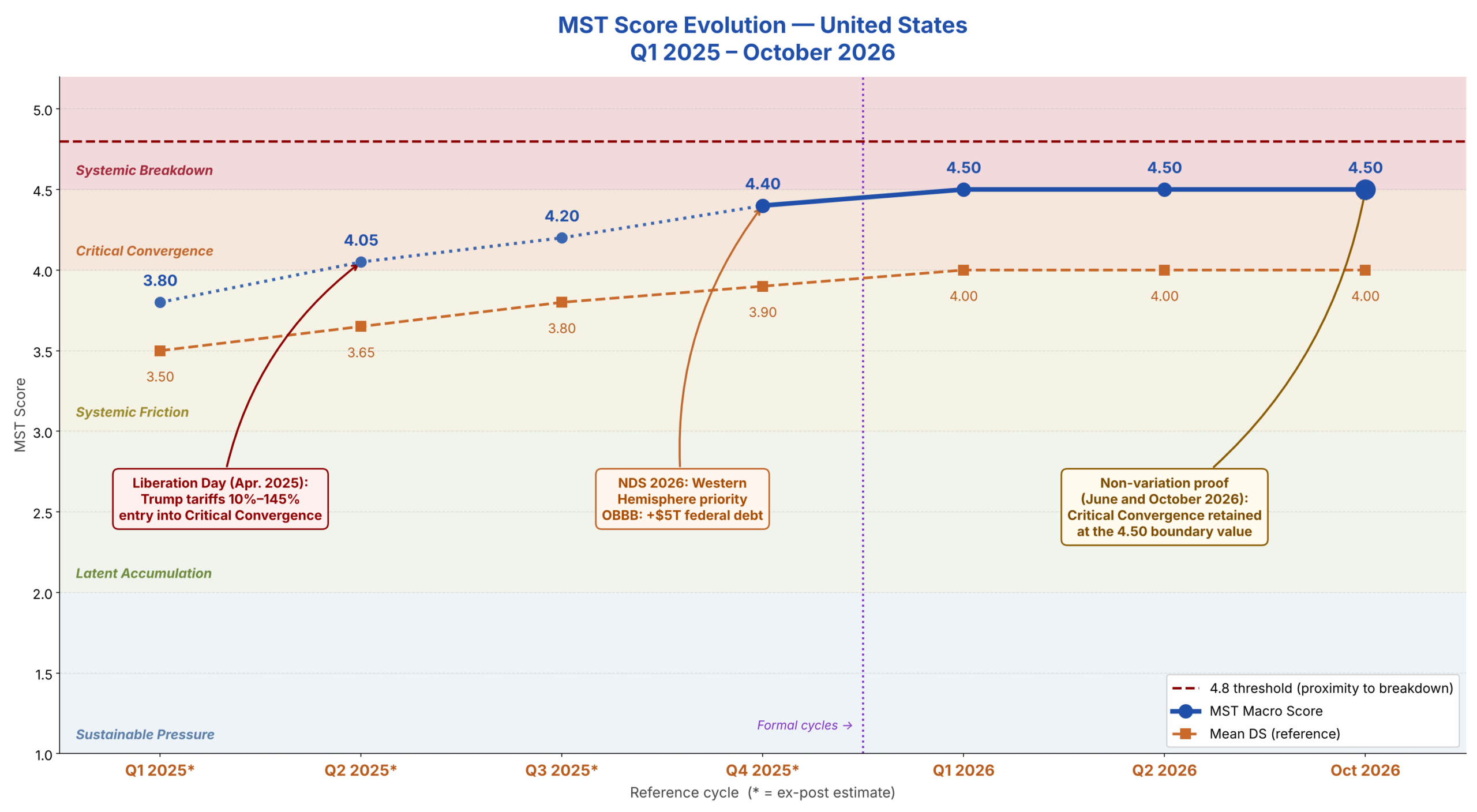
Evolution Legend — MST Framework · United States Macro-Area · 2025–2026
●━━● MST Macro Score
Final value of the macro-area. It includes domain pressure, adjusted by structural resilience mechanisms (ICA) and by systemic convergence factors.
■ – – ■ Mean DS
Average of the pressures across the six domains.
Descriptive reference indicator.
It does not by itself determine the final configuration of the macro-area.
⋮⋮⋮ Cycle separator
Distinguishes ex-post reconstructions from formal MST cycles.
○–·–○ Ex-post estimates
Retrospective reconstruction in MST-equivalent terms.
Not a published formal cycle.
The 4.8 threshold is an operational indicator of proximity to systemic breakdown, not a separate band of the MST classification.
* Values reconstructed ex post by retrospective application of the MST framework. CSR Italia — MST v3.2 — Cycle: 14 October 2026 — United States macro-area.
Valid Structural Adjustments in the Current Cycle
The 14 October 2026 cycle records no valid structural changes. The evidence gathered between 15 June and 14 October 2026 was classified as CONTINUITY of pre-existing dynamics, as NOT VALIDATED owing to insufficient persistence or corroboration, or as a sequence returning to the baseline state. The outcome does not mean there were no new facts: financial tightening and pre-election influence operations are the main signals to follow.
Monetary tightening and yields: NOT VALIDATED — CONTINUITY. On 16 September the Federal Reserve raised rates by 25 basis points, to 3.75–4.00%, its first hike since 2023, with inflation at 3.4% in August. On 1 October the 10-year Treasury yield reached 5.33%, its highest since 2002, before falling to 5.26% on 6 October. The two pieces of evidence were assessed together: the yield peak lasted only a few days and the available corroboration is not sufficient for a valid change. They remain the main signal in the Finance domain.
Section 301 tariff regime: NOT VALIDATED — CONTINUITY. Since 24 July, on the expiry of the temporary surcharge introduced after the Supreme Court ruling on the IEEPA tariffs, a new regime based on Section 301 of the Trade Act of 1974 has been in force. It continues a trade barrier already present in June, on a different legal basis; additional structural effects have not been demonstrated.
Hormuz naval blockade: sequence with an INVARIANCE outcome. The US naval blockade, lifted on 18 June after the Islamabad memorandum, was reinstated on 13–14 July, during the air campaign against Tehran of 9–24 July. As of 14 October it is in force as it was at the baseline date: the intermediate improvement has been reabsorbed, with no further documented deterioration.
Water facilities and Greenland agreement: NOT VALIDATED — CONTINUITY. The joint FBI–CISA–EPA advisory of 30 July on the compromise of Internet-exposed industrial controllers has precedents dating back to 2023 and does not document the duration and scale of the effects. The security agreement with Denmark and Greenland of 22 September has not yet been implemented.
Influence operations, federal funding and the China truce: CONTINUITY. The AI-enabled campaigns attributed to Russia, Iran and China ahead of the midterm elections have precedents dating back to 2016; the stopgap funding approved on 1 September averted a federal government shutdown until 11 December; the trade truce with China was extended to 10 January 2027 during Xi’s visit to Washington.
Strategic picture by Domain
In October 2026 the United States is in a configuration that combines three dimensions of structural pressure at the same time, each with its own trajectory and with potential for mutual amplification.
The first dimension is security and global military posture, which generates the highest structural pressure in the system and remains the dominant node of the macro-area.
The United States maintains a permanent and rotational military presence of around 90,000 personnel in the European theatre, an active presence in the Indo-Pacific and a multi-theatre engagement that includes indirect support to Ukraine through the PURL mechanism (Prioritised Ukraine Requirements List).
The most demanding theatre remains the Middle East: the war with Iran, which began on 28 February 2026, and the naval blockade around the Strait of Hormuz. The 2026 National Defense Strategy reorients priorities towards the Western Hemisphere, but does not reduce the extent of global commitments.
The Heritage Foundation’s 2026 Index of U.S. Military Strength documents concerns about operational readiness stemming from chronic underfunding and prolonged deployments — a structural vulnerability that does not show up in power-projection statistics but grows quietly over the cycle.
The second dimension is public finance and the position of the dollar, the second vector of structural pressure, with a long-term trajectory that consolidates cycle after cycle. Federal debt exceeded 38.4 trillion dollars in January 2026 and continues to grow.
The OBBB raised the debt ceiling by 5 trillion, at an estimated cost of 3.4 trillion over ten years (over 4 trillion including interest). Bond markets continue to signal growing attention to the long-term sustainability of federal debt: in early October the 10-year yield reached its highest level since 2002.
The tariff regime — with the IEEPA-based tariffs struck down by the Supreme Court in February 2026, replaced first by a temporary surcharge and since 24 July by the Section 301 regime, the trade truce with China extended to 10 January 2027 and the USMCA renegotiation still open — adds volatility to the trade environment without resolving it structurally.
The third dimension is cognitive-social pressure, the most dynamic dimension in the current cycle in terms of public mobilisation, although it does not reach the threshold for a valid structural change. Domestic political polarisation is consolidating along increasingly entrenched fault lines: immigration, the federal role, institutional cohesion. The anti-ICE protest movement and the “No Kings” demonstrations signal a systemic challenge that goes beyond individual events and reflects a long-term trajectory of domestic narrative misalignment. Ahead of the midterm elections, foreign influence operations are added, while federal countermeasures appear to have been scaled back.
Security and military posture
The domain has the highest net pressure in the macro-area. Structural pressure remains unchanged from the baseline: a global military presence across five main theatres (Europe, Indo-Pacific, Middle East, Western Hemisphere, Pacific), with an adaptive capacity index that remains low in this domain because of the risk of operational overstretch documented by the 2026 index. The PURL mechanism has reduced direct financial exposure to Ukraine, but political and logistical involvement remains structurally high. During the cycle the Hormuz naval blockade was lifted on 18 June and reinstated on 13–14 July; as of 5 October Central Command reported 130 ships diverted. The security agreement with Denmark and Greenland of 22 September has not yet been implemented. (Structural pressure 4.4; net pressure 4.7)
Energy and infrastructure
The domain is the least pressured in the macro-area and shows a positive trajectory. The United States is the world’s largest LNG exporter, with volumes exceeding 16 billion cubic feet per day in 2026 and new capacity (Golden Pass LNG, Corpus Christi Stage 3) coming onto the market during the year. Domestic energy autonomy is high. Prices, however, remain exposed to the Hormuz crisis: the EIA distinguishes domestic production and inventories from global prices, and the International Energy Agency reports that Gulf flows are still constrained. The cycle’s data show no structural change. (Structural pressure 3.4; net pressure 3.7)
Finance and banking system
The domain maintains high structural pressure stemming from the federal debt trajectory and trade uncertainty. The cycle records a tightening: the Federal Reserve’s first rate hike since 2023 (16 September) and the 10-year yield peaking at 5.33% (1 October), driven by energy inflation, the conflict in the Middle East and the fiscal outlook. There are no liquidity crises or systemic market events, and the yield peak lasted only a few days: the evidence confirms the pressure already incorporated in the baseline without producing a valid change. The global centrality of the dollar and of the US financial system remains a factor of structural resilience, but does not neutralise the pressure of the debt cycle. (Structural pressure 4.3; net pressure 4.6)
Regulatory and governance
The domain records the lowest structural pressure among the four high-pressure domains. The dissolution of DOGE as a centralised entity (November 2025) and the documented savings have not produced structural changes in the institutional profile. The Freedom House 2026 report points to new limitations on fundamental rights and reduced institutional capacity — confirmation of the existing trajectory, not an acceleration. Political polarisation continues to slow federal decision-making without paralysing it. During the cycle Congress approved stopgap funding until 11 December, averting a federal government shutdown, and the Section 301 tariff regime came into force: neither act produces a structural change. (Structural pressure 3.6; net pressure 3.9)
Cognitive and social
The domain remains under high structural pressure, sustained by domestic political polarisation and by cycles of social protest linked to immigration policies. The anti-ICE protests of January–February 2026 — with significant episodes in Minnesota, New York City and Portland, and the “No Kings” movement spreading nationwide — signal a trajectory of anti-systemic mobilisation that is consolidating over time. The October cycle adds AI-enabled influence operations attributed to Russia, Iran and China ahead of the midterm elections (on 8 October OpenAI closed Russian and Iranian accounts), while federal countermeasures appear to have been scaled back or suspended. These dynamics have documented precedents: the pressure remains within the perimeter of the 15 June baseline. (Structural pressure 4.2; net pressure 4.5)
Technological-industrial
The domain reflects strategic competition with China, which remains the main pressure vector. The fragmentation of the bipartisan consensus on export restrictions for advanced chips — with the AI OVERWATCH Act going through Congress and the executive’s withdrawal of a proposal for further restrictions — signals growing complexity in managing technology policy. The Chinese AI ecosystem continues to gain competitiveness despite the restrictions. Manufacturing reshoring and the semiconductor strategy remain the domain’s structural priorities. During the cycle a joint FBI–CISA–EPA advisory (30 July) reported the compromise of Internet-exposed industrial controllers in the water sector, with operational disruptions, without sufficient information on the duration and scale of the effects. (Structural pressure 4.1; net pressure 4.4).
Adaptive capacity — ICA
Moderate (ICA: 3.0)
The adaptive capacity of the United States remains at moderate levels. The system retains its global operational capacity — military projection, financial centrality, technological leadership — but with modulation margins reduced by high structural pressure in four domains.
Energy resilience is the most positive contribution to the adaptive profile, while domestic cognitive polarisation and structural financial vulnerability are the main constraining factors. The moderate ICA value does not change in the cycle: no valid structural change affected the domains relevant to adaptive capacity, and the system recorded neither sudden deterioration nor significant structural recovery. The ICA remains unchanged, confirming the non-variation proof recorded in the cycle.
Conditions for Change
The following conditions, if they materialise, would produce a measurable structural change in the MST parameters:
Any change in the Macro Score, in either direction: the retention of the category at the 4.50 boundary value ends and the band is reassigned according to the score.
Direct escalation in a new operational theatre (Europe, Indo-Pacific, Middle East) that exceeds the absorption capacity of the defence budget and forces a choice between theatres: Security pressure +0.2–0.3.
Sovereign debt crisis or loss of confidence in long-term bond markets (yields above the sustainability threshold relative to nominal GDP): Finance pressure +0.2. To be followed: the Federal Reserve meetings in October and December and the level of yields after the early-October peak.
Expiry of federal funding on 11 December and of the trade truce with China on 10 January 2027: effects on the Finance and Regulatory domains in the event of a government shutdown or the reinstatement of tariffs.
Domestic escalation of cognitive polarisation: systematic episodes of political violence or a breakdown of institutional cohesion at federal level (Cognitive pressure +0.2).
Chinese technological breakthrough in advanced semiconductors that removes the structural dependence on US supplies: reversal of the competitive leverage in the Technological domain (+0.2–0.3).
Failed USMCA renegotiation with structural deterioration of North American value chains: joint pressure on Finance and Technological.
Stabilising conditions:
→ Multi-theatre de-escalation and reduced military overstretch, with an orderly withdrawal from one or more global garrisons, accompanied by a process of rebalancing the defence budget.
→ A structural trade agreement with China that reduces tariff uncertainty and consolidates technology value chains (stabilising effect on Finance and Technological).
→ A bipartisan coalition on credible long-term fiscal consolidation measures, capable of reducing structural pressure in the Finance domain.
After the cycle: midterm elections
On 3 November, after the cycle’s evidence cutoff (14 October), the Democrats won the House and the Senate according to Associated Press race calls.
From 3 January 2027 the president will govern with a hostile Congress. The vote does not change the values of this cycle: it will be measured in the next common cycle, especially in the Regulatory, Finance and Cognitive domains, and it is the first test for the retention of the category at the boundary value.
CSR’s reading of divided government is set out in the article “US Midterms 2026: Divided Government and Foreign Policy”.
Learn More
→ Geopolitical Macro-Area Dossier
Explore the regional strategic analyses of the international system.
→ Global Systemic State Dashboard
Consult the public summary of the system’s configuration.
–> How to read an MST assessment
→ MST Method
Explore the framework used to assess structural pressure and adaptive capacity.
→ US Midterms 2026: Divided Government and Foreign Policy
CSR’s reading of the 3 November vote.
Methodological Note
This analysis is based on the application of the Multi-System Tension (MST) framework, developed to assess structural pressure, adaptive capacity, and systemic configurations through validated open-source evidence.
The values presented do not constitute forecasts; they represent a synthesis of the observable structural condition of the system during the period under analysis.
CSR Italia — MST v3.2— Cycle: 14 October 2026 — United States macro-area