


`Cycle: 14 June 2026 | Macro-area Africa | Framework MST v3.1 | CSR Italia
How to read the Strategic Analysis of the Africa Macro-Area (Sub-Saharan + Southern MENA)
MST Score:
score on a scale of 1–5 that summarises the level of structural pressure in the macro-area. It derives from the average of the net pressure values across the six domains, increased by the systemic amplification factor.
ICA — Adaptive Capacity Index:
measures the structural resilience of the macro-area. A higher value indicates a greater capacity to absorb pressures and maintain equilibrium. Scale 1–5. It should not be read in isolation: what matters is the relationship between ICA and structural pressure in each domain.
Critical Convergence:
fourth band out of five on the MST scale (4.0–4.5). Signals multi-domain structural pressure in which multiple forces mutually amplify each other and adaptive capacity is insufficient to compensate for all of them.Domain Breakdown Threshold (DN ≥ 4.8): internal flag that activates when the net pressure of a single domain exceeds 4.8. It does not modify the overall configuration, but signals a domain in a state of critical compression requiring intensified monitoring.
–> How to read an MST assessment`
Executive summary
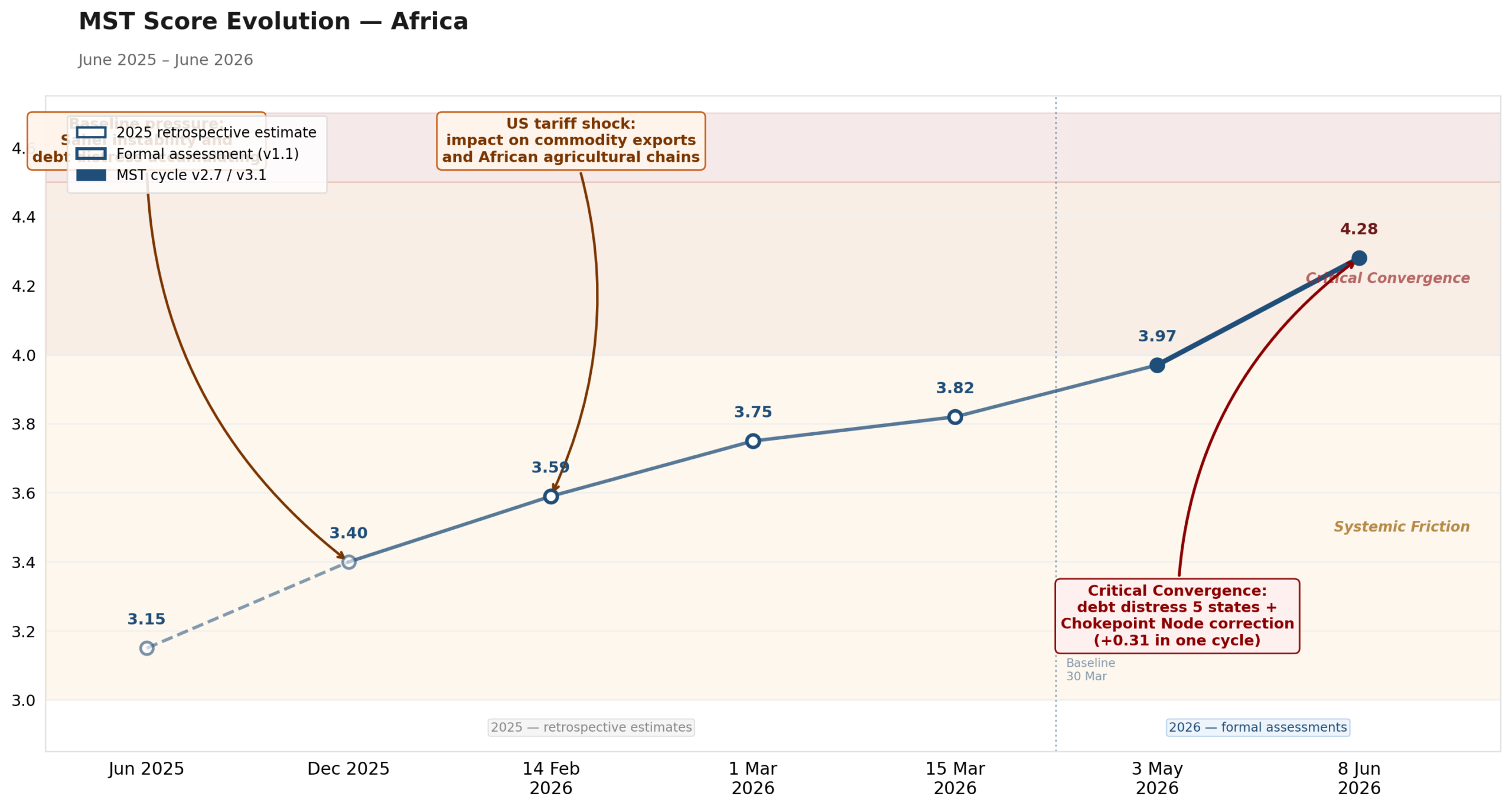
In June 2026, Sub-Saharan Africa and the Southern MENA region record five documented structural changes across the six domains analysed. With an MST Score of 4.28, the macro-area consolidates its position within the Critical Convergence band — a configuration in which security pressures, financial fragility, and governance deficits do not merely accumulate but reinforce one another. The cycle confirms and deepens the trajectory already observed in the March 2026 baseline.
The Sahel has evolved from an area of diffuse conflict into a theatre of systemic insurgency characterised by advanced drone capabilities, economic warfare, and expanding geographic ambitions toward coastal Africa. The regional financial system remains trapped in a debt-distress spiral that the G20 Common Framework has failed to reverse: 22 Sub-Saharan African countries are currently classified as either in distress or at high risk. The governance vacuum continues to deepen, with two additional coups recorded in 2025 and six military regimes lacking credible transition processes.
The macro-area retains a relatively high adaptive capacity (ICA 4.3/5): individual countries are responding, industrial policies continue to advance in selected sectors, and social movements remain active. The problem is structural: the region lacks the coordination required to transform these isolated responses into systemic resilience. It is precisely this asymmetry — between the presence of capacity and the absence of system-wide coordination — that makes the African configuration qualitatively different from that of other macro-areas.
Africa functions as a reservoir of pressure with indirect propagation mechanisms: its instabilities extend into Europe, Asia, and neighbouring macro-areas through three principal channels — migration, industrial supply chains (critical minerals), and security spillovers (jihadist expansion). Stakeholders operating in the region should consider that the structural conditions for investment, asset management, and medium-term planning have deteriorated significantly compared with the March 2026 baseline.
MST Score: 4.28 / 5
1.0 – 2.0
Sustainable Pressure
2.0 – 3.0
Latent Accumulation
3.0 – 4.0
Systemic Friction
4.0 – 4.5
▲
Critical Convergence
4.5 – 5.0
Systemic Breakdown
Macro-area configuration: Critical Convergence Critical convergence
Adaptive capacity:Alta (4.3)
Dominant node: Sahel centrale e Corno d’Africa
Dominant dinamic: Amplificazione reciproca tra crisi di sicurezza, distress finanziario e vuoto istituzionale
Positioning on the GSA scale
Dominant Structural Factors
The current configuration is not the product of a single crisis. It is the result of three structural forces operating simultaneously and reinforcing one another within a system that is unable to translate its resources into an effective systemic response.
The first force is military:
the Sahel has evolved into a theatre of systemic insurgency characterized by advanced technological capabilities, economic objectives, and expanding geographic ambitions, while the Horn of Africa faces the risk of cascading inter-state conflict.
The second force is financial:
22 countries are trapped in a debt-distress spiral from which international mechanisms have proven unable to release them, compressing the resources available for security, governance, and energy.
The third force is structural capacity:
the system lacks the ability to transform resources and potential into a coordinated response.
It is the interaction among these three forces — rather than any one of them in isolation — that produces the MST Score of 4.28 and keeps the Security domain only 0.4 points below the Domain Breakdown Threshold (DN ≥ 4.8).
—> The Sahel War as a System
JNIM completed an operational transformation in 2025 that changes the very nature of the Sahelian conflict: from insurgent movement to a hybrid warfare actor capable of positional warfare, economic warfare, and technological warfare. The number of drone attacks increased from fewer than 10 in 2024 to approximately 80 in 2025 — an eightfold increase within twelve months. The expansion of operations toward the Benin–Nigeria borderlands indicates that the insurgency has moved beyond the boundaries of the historical Sahel and is projecting itself toward coastal West Africa.
In the Horn of Africa, tensions between Ethiopia and Sudan represent the most immediate risk of an inter-state conflict with cascading effects on Eritrea, the DRC, and South Sudan. The ongoing conflict in Sudan between the SAF and RSF has already caused more than 150,000 deaths and millions of displaced persons: any further escalation would reduce the remaining margin for regional stabilization.
The picture is further shaped by the proliferation of military regimes: six governments across Sub-Saharan Africa remain without credible transition processes, with two additional coups recorded in 2025 (Guinea-Bissau and Madagascar). This is not episodic instability; it represents a systemic reconfiguration of the regional governance architecture, one that continues to reinforce itself in the absence of effective external pressure.
—> The Debt Trap
Twenty-two Sub-Saharan African countries are currently classified as being in debt distress or at high risk, according to the World Bank (2026). The G20 Common Framework, designed to provide a structured response, has delivered very few complete debt restructurings. As a result, countries continue to accumulate debt from private creditors at higher interest rates and shorter maturities, with little prospect of escaping the cycle.
Today, 42% of Africa’s external debt is held by private creditors: a structural transformation in the composition of debt that significantly reduces governments’ negotiating leverage. At the same time, the World Bank has cut MENA growth forecasts by 2.4 percentage points, lowering projected growth to 1.8% in 2026 — the most significant downward revision among all monitored regions.
The systemic consequence is direct: the public resources available for governance, security, and energy are shrinking precisely when structural pressures on these sectors are at historic highs. The debt trap is not merely a financial problem; it acts as a multiplier of all other pressures.
—> The Structural Capacity Deficit
More than 600 million Africans lack access to electricity. Power generation growth remains below 2% annually in a continent where population growth and energy demand are increasing at significantly higher rates. Per-capita electricity consumption is declining — a structural signal that the African energy system is failing to keep pace. The BISI report of May 2026 identifies a specific bottleneck: the shortage of skilled labor required to install and operate electrical networks. Even when capital becomes available, the technical capacity needed to convert it into operational infrastructure remains insufficient.
At the same time, cognitive warfare conducted by external actors — including Russia/Wagner operations in the Sahel and AI-enhanced influence campaigns documented by the WEF in March 2026 — is eroding collective decision-making processes and institutional trust. In low-trust environments such as Nigeria and South Africa, alternative narratives find fertile ground, making coordinated responses increasingly difficult to build.
Africa does exhibit positive signals of adaptive response: raw mineral export bans in more than 13 countries, the first lithium refinery in Zimbabwe ($400 million), and the DRC–Zambia Special Economic Zone launched in 2025. These developments are real, but they remain isolated responses. The regional coordination required to transform them into structural resilience is still missing: the challenge is not a lack of resources, but a lack of system.
Strategic picture
Africa functions as a reservoir of systemic pressure with indirect propagation dynamics toward neighboring macro-areas through three primary channels.
Migration: the security crisis in the Sahel and the ongoing economic deterioration are driving migration flows toward the MENA region and Europe that existing management frameworks are increasingly unable to absorb. The 990 deaths recorded in the Mediterranean during the first months of 2026 are indicators of a broader trajectory, not an anomaly.
Industrial: global dependence on African critical minerals — including cobalt, lithium, and the minerals required for batteries and green technologies — directly links African stability to the energy and technological agendas of Europe, the United States, and China. The escalation of U.S.–China competition over these resources generates mixed effects: increased Western investment, but also regulatory fragmentation and supply-chain instability.
Security: JNIM’s expansion toward North African borders through Niger and Libya represents a channel of pressure transmission toward the Mediterranean. The spillover is not hypothetical; it is documented and ongoing.
For those operating in the region — investors, financial institutions, and industrial actors — the observed configuration indicates that the structural conditions for conducting business, managing assets, and planning across multi-year horizons have deteriorated significantly compared with the March 2026 baseline.
Why the Mscro-area is in Critical convergence
The June 2026 cycle documents five validated structural changes across the six domains analyzed. An MST Score of 4.28 places the macro-area within the Critical Convergence range (4.0–4.5): structural multi-domain pressure, overloaded containment mechanisms, and adaptive capacity that remains present but insufficient to offset the convergence of pressures across all domains.
The most critical signal is the Security domain’s proximity to the Domain Breakdown Threshold: DN = 4.4 against a threshold of 4.8 — a gap of only 0.4 points. Any further documented deterioration in the Sahel or the Horn of Africa could activate the framework’s intensified monitoring flag for this domain.
The African configuration is qualitatively different from that of other macro-areas: it is not concentrated in a single crisis epicenter but is instead distributed across a vast geographic area through mechanisms of indirect propagation. It is precisely this distribution — diffuse, persistent, and structural — that makes it simultaneously less visible and more deeply entrenched.
Trajectories to monitor
• Sahel Security — JNIM and Coastal West Africa: the insurgency continues to advance through the adoption of advanced drone capabilities and the expansion of operations toward the Benin–Nigeria corridor. Any further consolidation of territorial influence across the Sahel would generate a measurable increase in pressure within the Security domain. Monitoring should also focus on expansion trajectories toward Libya and the Mediterranean through Niger.
• Horn of Africa — Ethiopia–Sudan Escalation: tensions continue to carry the risk of an inter-state conflict with cascading effects across Eritrea, the DRC, and South Sudan. The Sudan SAF–RSF conflict (>150,000 deaths) is already the most severe ongoing conflict on the continent; any additional regional involvement would activate a destabilization scenario without recent precedent.
• Debt Distress — Common Framework Stagnation: if no country successfully completes a restructuring process under the G20 framework in the coming months, the mechanism itself may become recognized as structurally ineffective. Monitoring should also focus on the growing share of debt held by private creditors (already at 42%) and the downward revision of MENA growth forecasts (1.8% for 2026).
• Energy and Capacity Deficit — Access and Critical Minerals: monitor developments in electricity access (more than 600 million Africans remain without access) and the progress of critical-mineral processing projects (Zimbabwe lithium refinery, DRC–Zambia Special Economic Zone). These represent the most significant indicators of a potential structural reversal over the medium term.
• Governance and Propagation — Coups and Spillover Flows: Guinea-Bissau, Gabon, and Chad remain key risk areas. Any additional coup would reinforce the systemic trend and increase pressure within the Governance domain. At the same time, migration flows toward Europe and Asia, as well as the escalation of U.S.–China competition for African critical minerals, should be monitored as indicators of indirect pressure propagation.
Learn More
→ Geopolitical Macro-Areas Dossier
Explore the regional strategic analyses of the international system.
→ Global System Assessment Dashboard
Consult the public summary of the system’s current configuration.
–> How to Read an MST Assessment
→ MST Framework
Learn more about the framework used to assess structural pressure and adaptive capacity.
Methodological Note
This analysis is based on the application of the Multi-System Tension (MST) framework, developed to assess structural pressure, adaptive capacity, and systemic configurations through validated open-source evidence.
The values presented do not constitute forecasts; they represent a synthesis of the observable structural condition of the system during the period under analysis.