


Macro-area America latina: ciclo 17 giugno 2026 | Framework MST v3.1 | CSR Italia
How to read Analisi strategica Macro-area America latina
MST Score:
A score on a 1–5 scale that summarizes the overall level of structural pressure within the macro-area. It is derived from the combination of the net pressure observed in each domain and the inter-domain amplification factor. Higher values indicate systems exposed to persistent and multi-domain pressures.
Adaptive Capacity (ICA):
Measures the structural resilience of the macro-area: its ability to absorb, manage, and contain the pressures observed. A higher value indicates a greater capacity to maintain systemic equilibrium. Scale: 1–5.
Systemic Breakdown:
The fifth and highest tier of the MST scale (4.5–5.0). A configuration of maximum pressure. It occurs when structural pressure is distributed across multiple domains and the system’s compensation mechanisms are no longer sufficient to contain it. It is generally associated with the highest levels of the MST scale, but is not determined solely by the numerical value of the Macro Score.
Critical Convergence:
The fourth tier of the MST scale (4.0–4.5). A configuration characterized by elevated pressure distributed across multiple domains, with adaptive capacity still present but progressively contracting. Classification depends on the overall structure of the system and not solely on the numerical value of the Macro Score.
Domain Breakdown Threshold:
An internal flag activated when the net pressure of a single domain exceeds 4.8. It does not alter the overall configuration, but indicates a domain in a state of critical compression requiring intensified monitoring.
→ How to Read an MST Assessment
Executive Summary
The MST cycle of 17 June 2026 for the Latin America macro-area identified two valid structural changes and activated the Convergence Factor for the region for the first time. The result is an MST Score of 4.10, placing Latin America within the Critical Convergence range — a significant progression from the Systemic Friction configuration recorded in the previous cycle (1 June 2026, MST Score 3.70). The change is driven by the U.S. military intervention in Venezuela and the total collapse of Cuba’s electrical grid: two causally linked and structurally persistent developments that were not adequately captured under the previous methodological framework.
MST Score: 4.1 / 5
1.0 – 2.0
Sustainable Pressure
2.0 – 3.0
Latent Accumulation
3.0 – 4.0
Systemic Friction
4.0 – 4.5
▲
Critical Convergence
4.5 – 5.0
Systemic Breakdown
Macro-area Configuration: Critical convergence
Adaptive Capacity: High (ICA: 3.7)
Dominant Node: Security and Finance (net domain pressure 4.30 each)
Dominant Dynamic: Convergence between regional security and energy vulnerability
Valid Changes During the Cycle: 2 – Security DS +0.1 | Energy DS +0.2
Position within the MST Scale
Latin America entered June 2026 in a Critical Convergence configuration (MST Score 4.10), for the first time in the recent history of MST monitoring of the region. The shift from the Systemic Friction band (3.70) to Critical Convergence (4.10) is not the result of gradual deterioration. It is the structural outcome of two high-intensity events — one military and one energy-related — that have introduced a systemic discontinuity into the regional landscape.
The macro-area therefore maintains a configuration of:
Critical convergence
Structural pressure is concentrated across four of the six domains analyzed:
Security (4.30),
Finance (4.30),
Energy (4.10), and
Governance/Regulatory (4.10).
The fact that the Governance/Regulatory and Energy domains have both reached a value of 4.10 is not the result of direct changes within those domains. Instead, it reflects a methodologically significant cascading effect: when regional adaptive capacity falls below the structural pressure threshold of a domain, the net pressure within that domain is automatically amplified. This is precisely what occurred during the current cycle. The decline in regional adaptive capacity — from 3.80 to 3.70 — crossed the critical threshold relative to both the Energy and Governance/Regulatory domains, whose structural pressure values remained unchanged at 3.80.
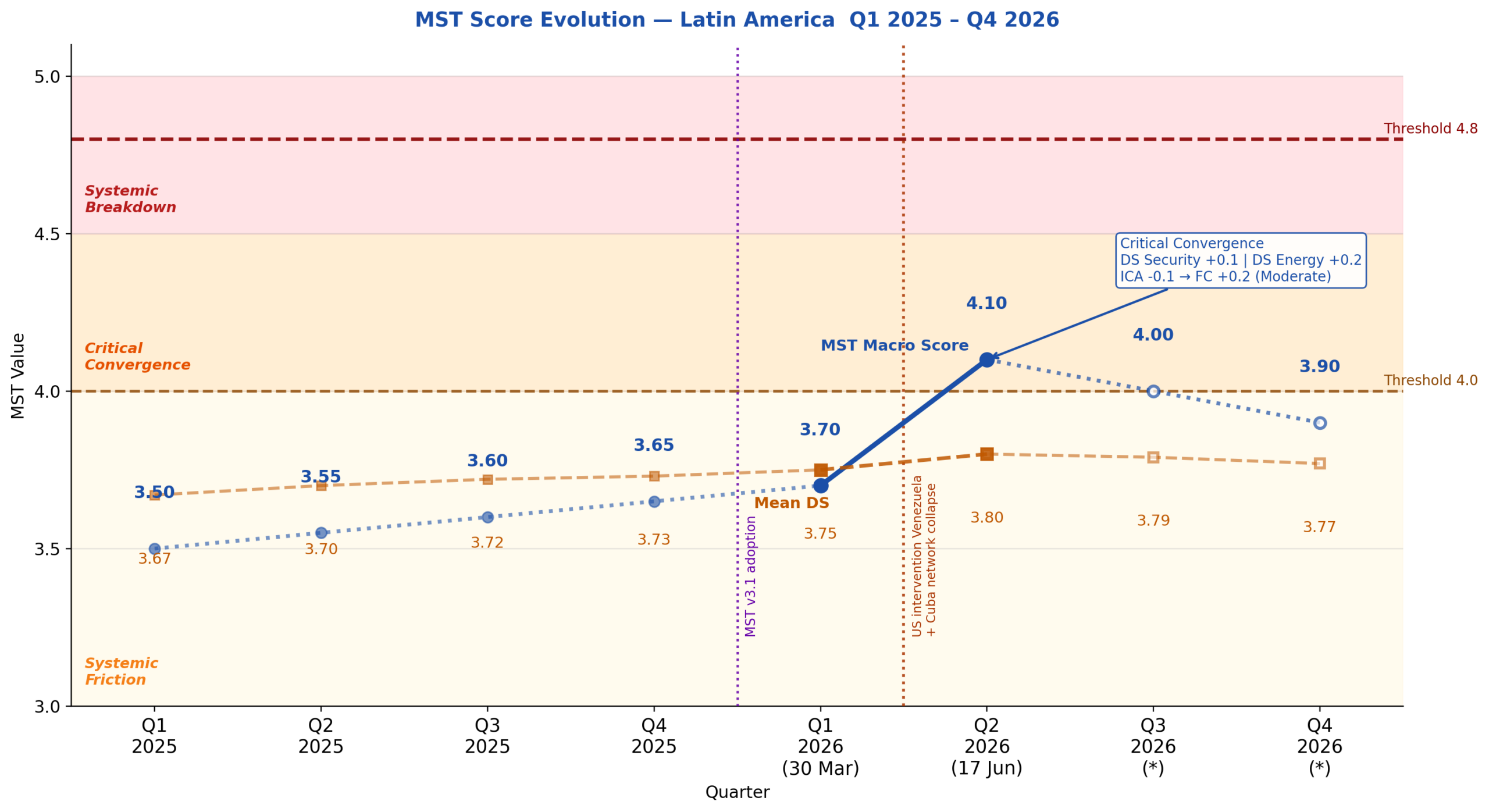
Legend - MST Evolution

Valid Structural Adjustments in the Current Cycle
During the 17 June 2026 cycle, two structural changes were validated. Both affect domains that had been assessed incompletely in the previous cycle, which was conducted under the earlier methodological framework: the U.S. military intervention in Venezuela was absent from the Security assessment, while the Cuban energy crisis had been classified only as a “candidate” without formal validation. Methodological Framework v3.1 corrects both deficiencies.
Security (+0.1)
On 3 January 2026, U.S. special forces conducted Operation Absolute Resolve, extracting Nicolás Maduro from Caracas.
The former Venezuelan president is currently detained in New York awaiting trial on charges related to narcotics trafficking and terrorism.
The operation generated three persistent structural effects on regional security: a power vacuum in Caracas accompanied by fragmentation among government factions; the establishment of an operational U.S. military presence in the Caribbean (including strikes against Tren de Aragua and the formation of a U.S.-led anti-gang force in Haiti); and the breakdown of the implicit deterrence architecture that had previously characterized relations between Washington and Latin American governments critical of U.S. policy.
This event was absent from the previous cycle. Verified persistence: 165 days at the time of assessment (required threshold: 30 days). Multi-layer Tier-1 evidence (CFR, Brookings, CSIS, International Crisis Group).
Energy (+0.2)
Cuba’s electrical grid experienced multiple total collapses throughout 2026.
By June 2026, residents of Matanzas had endured 72 consecutive hours without electricity, while some areas of Ceiba Mocha remained without power for an entire week. The structural collapse is directly linked to the interruption of oil imports: Venezuelan supplies ceased in January 2026 as a consequence of the U.S. intervention, while Mexico suspended its own exports. Cuba is now operating with near-zero oil imports and is unable to sustain its thermoelectric generation capacity.
The previous cycle classified this development as a candidate for a +0.1 adjustment. The June 2026 evidence — including total grid collapse documented by NPR, Britannica, and the Associated Press — justifies a +0.2 adjustment relative to the baseline.
Structural persistence: more than 200 days. The causal nexus with the Security adjustment (the interruption of Venezuelan oil supplies as a consequence of the U.S. operation) constitutes the inter-domain transmission mechanism that activated the Convergence Factor.
Methodological Note:
The increase in pressure within the Governance/Regulatory domain and the cognitive implications of the Venezuelan crisis were classified as Structural Continuity rather than as autonomous variations, despite the magnitude of the event.
This classification reflects the methodological rigor of the framework: the regional sovereignty crisis derives from the Security evidence and does not possess an independent structural trajectory within the Governance domain. Its effects are therefore correctly captured through the reduction of regional adaptive capacity and the activation of the Convergence Factor.
Strategic Overview by Domain
Latin America entered June 2026 in a configuration characterized by three simultaneous dimensions of structural pressure, each following its own trajectory while retaining the potential for mutual amplification.
The first dimension is regional security, which recorded the most significant adjustment during the current cycle: the U.S. military intervention in Venezuela has reshaped the risk profile of the entire hemisphere, creating operational precedents without equivalent in recent Latin American history.
The second dimension is energy vulnerability, which emerged during the current cycle as the most dynamic vector of escalation: the collapse of Cuba’s electrical grid, causally linked to the interruption of Venezuelan energy supplies, transformed a latent crisis into a structurally significant event documented at the international level.
The third dimension is financial pressure, which, although unchanged during this cycle, remains the domain with the highest net pressure (4.30) and represents the longest-term accumulation point within the regional system.
Security (Net Pressure 4.30 — Adjustment +0.1)
The Security domain recorded the most significant structural adjustment of the current cycle, increasing from a structural pressure of 3.90 to 4.00, with net domain pressure reaching 4.30.
Operation Absolute Resolve altered the regional security environment along three distinct axes. In Venezuela, the power vacuum created by Maduro’s capture opened a transitional phase marked by unresolved internal fragmentation and the risk of factional conflict over the control of resources and criminal networks.
In the Caribbean and Haiti, the U.S. military presence intensified through active operations, including strikes against Tren de Aragua and the establishment of a U.S.-led multinational anti-gang force in Haiti. At the regional level, the operation disrupted the implicit equilibrium that had characterized relations between Washington and Latin American governments traditionally committed to non-interference, generating tensions with Brazil, Mexico, Colombia, and Argentina.
It should be noted that the net effect of the U.S. intervention on the medium-term regional balance remains under assessment. The transitional phase generates documented and measurable structural pressure in the current cycle; however, an orderly stabilization of the Venezuelan transition — through inter-faction agreements, institutional recovery, and a reduction in active military presence — could produce a stabilizing adjustment in the regional risk profile in future cycles.
Energy (Net Pressure 4.10 — Adjustment +0.2)
The collapse of Cuba’s electrical grid represents the most significant energy-related adjustment documented within the Latin American system in recent years. Cuba is facing a structural emergency: its near-total dependence on Venezuelan oil for thermoelectric generation, combined with the interruption of those supplies since January 2026, has resulted in multiple nationwide blackouts throughout 2026.
This crisis has implications extending beyond Cuba itself. Cuban migration flows toward the United States and the Caribbean have intensified, the potential for social instability on the island remains elevated, and the precedent of energy disruption as a geopolitical instrument influences how other regional actors perceive their own vulnerability to resource flows controlled by Washington.
Finance (Net Pressure 4.30 — Unchanged)
The Finance domain continues to register the highest structural pressure in the region (4.00), with net domain pressure at 4.30. No structural adjustment was validated during the current cycle, yet the overall picture remains complex and far from risk-free.
In Argentina, stabilization efforts driven by the IMF agreement and the policies of the Milei administration are beginning to produce early signs of declining inflation, although the process remains politically fragile. In Mexico, tariffs imposed by the U.S. administration continue to exert structural pressure on exports and manufacturing competitiveness. In Brazil, the fiscal deficit remains a long-term source of vulnerability despite ongoing economic growth.
None of these developments exceeded the threshold required for a structural adjustment during the current cycle, but overall pressure remains elevated (DS 4.00) in the absence of meaningful improvement from previous cycles.
Governance / Regulatory (Net Pressure 4.10 — Unchanged)
The Governance domain did not record any direct adjustment during the current cycle (structural pressure unchanged at 3.80), but experienced a significant increase in net domain pressure, rising from 3.50 to 4.10.
This outcome reflects the framework’s amplification mechanism: the decline in regional adaptive capacity reduced the system’s ability to absorb existing governance pressures, causing net pressure to rise above the structural pressure level.
The U.S. intervention in Venezuela generated a governance debate of historic significance. Conducting a military operation within a sovereign state without authorization from the UN Security Council crystallized tensions surrounding the architecture of international law in the Western Hemisphere, prompting criticism from Brazil, Mexico, Colombia, and Argentina — countries that had traditionally maintained pragmatic relations with Washington.
Cognitive / Social (Net Pressure 3.40 — Unchanged)
The Cognitive/Social domain did not register any autonomous structural adjustment during the current cycle (DS 3.70, unchanged). Net domain pressure remains at 3.40, as regional adaptive capacity continues to exceed the structural pressure recorded in this domain.
Political polarization dynamics — including tensions between Arce and Morales in Bolivia, Venezuela’s post-Maduro narrative reorganization, and the radicalization of public discourse in Mexico within the context of U.S. trade policy — represent elements of structural continuity already present in previous cycles.
Although significant, the Venezuelan narrative vacuum was classified as a derivative effect of the Security domain and does not constitute an autonomous multi-layer cognitive adjustment.
Technological–Industrial (Net Pressure 3.20 — Unchanged)
The Technological–Industrial domain continues to display the lowest structural pressure in the region (DS 3.50, net pressure 3.20). Competition between the United States and China for control of Latin America's critical minerals — lithium in Argentina and Chile, copper in Chile and Peru, and rare earths in Brazil — continues to develop as a long-term strategic axis.
The United States has committed more than one billion dollars in direct regional investments, while CATL has announced a five-billion-dollar investment in Argentina’s lithium sector. This dynamic represents a continuation of trends already incorporated into the baseline and did not exhibit sufficient changes in intensity during the current cycle to qualify as a structural adjustment.
ICA — Resilienza strutturale
High (ICA: 3.70)
Regional adaptive capacity declined from 3.80 to 3.70 during the current cycle. Although limited in magnitude, the reduction is methodologically significant because it crossed the critical threshold relative to both the Energy and Governance domains, each of which maintains a structural pressure value of 3.80. As a consequence, the system is no longer able to absorb pressure within these domains through its own adaptive capacity. The resulting net pressure is therefore amplified, as reflected in the documented values of 4.10.
The factors constraining regional adaptive capacity during the current cycle can be traced primarily to two dynamics: the institutional fragmentation generated by the U.S. intervention in Venezuela, which reduced cohesion among regional actors and weakened collective response mechanisms through CELAC and MERCOSUR; and the deterioration of Cuba’s energy resilience, which reduces the level of regional systemic redundancy available in the event of additional shocks.
Conditions for Change
Conditions That Could Worsen the Configuration
Escalation of the Venezuelan crisis: armed conflict between rival factions for control of post-Maduro territory, with the potential for mass migration towards Colombia and Brazil.
Total collapse of Cuba’s electrical grid, triggering mass migration flows towards the Caribbean and Florida and generating a regional humanitarian crisis.
A military response by a Latin American country to the U.S. intervention in Venezuela (even if limited to diplomatic withdrawal and trade restrictions), which would crystallise a structural geopolitical fracture across the hemisphere.
Deterioration of Argentina’s macroeconomic conditions through a breakdown of the IMF agreement or a sovereign default event, further exacerbating the region’s already elevated financial pressure.
Expansion of U.S. military operations beyond Venezuela (to other Latin American countries), structurally increasing the security risk profile of the entire region.
Significant tightening of U.S. tariffs on Mexico and Brazil, resulting in a technical recession in Mexico’s manufacturing sector.
Conditions That Could Stabilise the Configuration
An orderly political transition process in Venezuela, supported by an inter-faction agreement that stabilises institutions and reduces regional security pressure.
The restoration of energy supplies to Cuba — through alternatives to Venezuela (for example agreements with Mexico, Trinidad and Tobago, or European partners) — reducing the vulnerability of Cuba’s electricity grid.
Confirmed macroeconomic stabilisation in Argentina over the coming quarters, accompanied by a reduction in sovereign risk and renewed access to international financial markets.
Learn More
→ Geopolitical Macro-Area Dossiers
Explore the regional strategic assessments of the international system.
→ Global System Status Dashboard
Consult the public summary of the system’s configuration.
→ How to Read an MST Assessment
→ MST Framework
Learn more about the framework used to assess structural pressure and adaptive capacity.
Methodological Note
This analysis is based on the application of the Multi-System Tension (MST) framework, developed to assess structural pressure, adaptive capacity, and systemic configurations through validated open-source evidence.
The values presented do not constitute forecasts; they represent a synthesis of the observable structural condition of the system during the period under analysis.