


How to Read the Arctic / High North Macro-Area Strategic Assessment
MST Score: a score on a 1–5 scale that summarises the level of structural pressure affecting the macro-area.
It is derived from the average net pressure values across the six domains, adjusted by the systemic amplification factor.
ICA — Adaptive Capacity Index: measures the structural resilience of the macro-area. A higher value indicates a greater ability to absorb pressure and maintain equilibrium. Scale: 1–5. It should not be interpreted in isolation: the relationship between ICA and structural pressure within each domain is what matters.
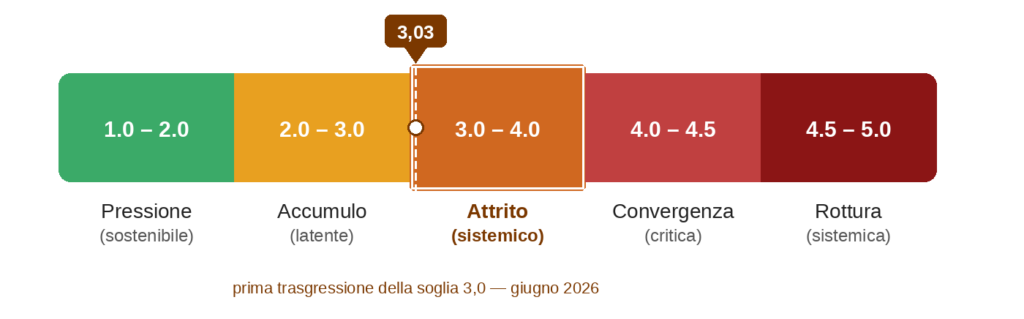
Systemic Friction: the third of five bands within the MST scale (3.0–4.0). It indicates multi-domain structural pressure in which tensions between actors, resources, and governance capacities generate persistent friction that gradually erodes stability margins, without yet producing full mutual amplification across domains.
Domain Breakdown Threshold (DN ≥ 4.8): an internal flag activated when the net pressure of a single domain exceeds 4.8. It does not alter the overall configuration but identifies a domain experiencing critical compression that requires intensified monitoring.
→ How to Read an MST Assessment
Strategic Summary
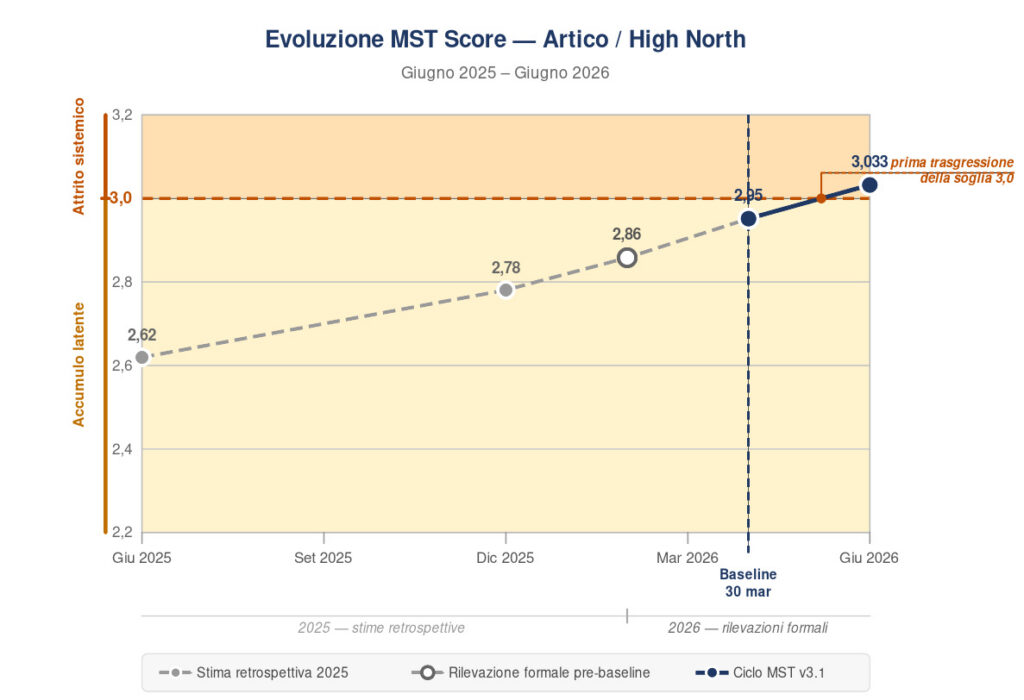
In June 2026, the Arctic and High North record the first documented structural threshold transition for this macro-area: with an MST Score of 3.03, the macro-area exceeds the 3.0 threshold for the first time and enters the Systemic Friction band.
Strategic Summary
Military repositioning is the most visible driver of change: NATO’s Arctic Sentry operation, the doubling of British Royal Marines deployed in Norway, and Russia’s consolidated posture along the GIUK Gap–Siberian coastline axis are redefining the High North as a space of permanent strategic competition. No longer merely a theatre for military exercises, it is becoming an arena of structural positioning in which both sides are investing in enduring capabilities.
In the energy domain, the signal points in the opposite direction: declining traffic along the Northern Sea Route (–2.3% in 2025) and the sanctions regime targeting Arctic LNG 2 are constraining Russia’s ability to monetise Arctic resources. Yet this compression is not producing de-escalation; it is producing repositioning. Russia is intensifying Arctic militarisation precisely as its Arctic energy revenues decline.
The technological dimension completes the picture: the United States, Canada, and Finland have formalised a joint next-generation icebreaker programme, while China has deployed its first commercial nuclear-powered icebreaker. The Arctic is no longer a bilateral Russia–West competition; it has become a multipolar theatre in which every major power seeks to establish permanent capabilities.
The macro-area retains a medium-high adaptive capacity (ICA 3.7/5): Arctic democracies continue to respond, invest, and coordinate. The challenge lies in the pace of structural change relative to the speed of institutional adaptation. It is this asymmetry of tempo — between accelerating pressures and gradual responses — that pushes the macro-area beyond the threshold of Systemic Friction.
Updated: June 2026
Positioning on the GSA scale
MST Score: 3.03/ 5
Macro-area configuration Systemic friction
Adaptive capacity: medium-high (3.7)
Dominant node: GIUK Gap and the Russian–Nordic Siberian coastline
Dominant dinamic: First structural threshold transition; multipolar military repositioning and growing competition over Arctic routes and resources.
Dominant Structural Factors
La configurazione attuale non è il prodotto di un’unica crisi. È il risultato di tre forze strutturali che operano simultaneamente e si rinforzano progressivamente — in un sistema in cui le risposte esistono, ma il ritmo di escalation supera la velocità di adattamento istituzionale.
La prima forza è militare: l’High North ha subito nel 2025–2026 una trasformazione da teatro di esercitazioni periodiche a spazio di confronto strutturale, con operazioni permanenti, integrazioni nordiche nel comando NATO e potenziamento continuo della postura russa sull’asse settentrionale.
La seconda è energetico-sanzionatoria: le restrizioni su Arctic LNG 2 e il calo del traffico sul Northern Sea Route hanno interrotto la traiettoria di crescita delle rotte artiche, senza ridurre le ambizioni russe — spostandole.
La terza è tecnologica: la competizione multilaterale per le capacità di navigazione artica, con USA, Canada, Finlandia e Cina che lanciano programmi contemporaneamente, trasforma l’Artico in arena di proiezione tecnologica permanente.
È l’interazione tra queste tre forze — non ognuna singolarmente — che produce l’MST Score di 3,03 e la prima trasgressione di soglia strutturale per questa macro-area.
Il riposizionamento militare nell’High North
L’operazione NATO Arctic Sentry, avviata nel febbraio 2026, rappresenta la prima presenza aeronavale permanente dell’Alleanza nell’High North in forma strutturata: non più esercitazioni periodiche, ma pattugliamenti continui. Contestualmente, Finlandia e Svezia sono state integrate nel comando JFC Norfolk (dicembre 2025), completando l’architettura militare nordica dell’Alleanza.
Sul versante britannico, il raddoppio dei Royal Marines in Norvegia (2.000 unità su tre anni) segnala un impegno strutturale, non tattico, della capacità anfibia atlantica nell’Artico europeo. Questi movimenti avvengono in risposta — e in specularità — al potenziamento russo: installazione di sistemi S-400 lungo la costa settentrionale e consolidamento della flotta sottomarina documentato da Bloomberg e Arctic Institute.
Il risultato strutturale non è un equilibrio ritrovato: è una competizione permanente per il controllo degli spazi strategici nell’High North. La logica Cold War readiness citata nelle fonti NATO non è retorica: è descrittiva di una postura effettivamente adottata da entrambe le parti. Ogni incremento da un lato produce risposta strutturata dall’altro — una dinamica che comprime sistematicamente il margine per de-escalation unilaterale.
La pressione energetica e finanziaria
Il Northern Sea Route ha registrato nel 2025 un calo del 2,3% del traffico cargo: 37 milioni di tonnellate contro il target ufficiale russo di 80 milioni. È il primo dato strutturalmente negativo dalla ripresa post-2022 e segnala che l’ambizione russa di fare del NSR la rotta commerciale dominante per l’Asia è in stallo strutturale, non in attesa di recupero.
Arctic LNG 2, il progetto di punta di Novatek per l’esportazione di GNL artico, è bloccato da sanzioni con insufficienza di flotta Arc7 certificata e utilizzo di transshipment opaco su navi russe per aggirare le restrizioni. Il primo metaniero della stagione 2026 è arrivato più tardi del previsto — segnale operativo diretto della compressione della capacità produttiva.
In parallelo, il lato occidentale della competizione è in forte espansione finanziaria: il piano USA da 30 miliardi di dollari per le infrastrutture marittime artiche, il contratto Arctic Security Cutter da 3,5 miliardi (maggio 2026) e gli investimenti combinati Canada–fondi sovrani globali superano i 50 miliardi di dollari allocati nella macro-area. La compressione energetica russa coesiste con un’accelerazione degli investimenti occidentali: una divergenza strutturale che ridisegna le rotte della dipendenza energetica globale dall’Artico.
La competizione tecnologica per i ghiacci
The trilateral Canada–Finland–United States meeting held in Helsinki (6–7 May 2026) to coordinate the next-generation icebreaker programme was not merely a diplomatic event: it represented the formalisation of a Western–Nordic technological bloc focused on Arctic navigation capabilities. Canada is advancing its own national programme; Finland contributes its shipbuilding expertise; and the United States is moving forward through the US$3.5 billion Coast Guard contract.
During the same period, China launched its first commercial nuclear-powered icebreaker (March 2026): a permanent power-projection capability extending Beijing’s Arctic presence beyond the diplomatic sphere. The North Pole is no longer the exclusive domain of traditional Arctic powers; it has become a multipolar theatre in which every major power seeks to establish permanent capabilities before the rules of the game are fully defined.
At the same time, Russian cognitive influence operations conducted through the GIUK Gap — documented by NAADSN and the Arctic Institute — reinforced the “Arctic militarisation” narrative across Western media throughout 2025–2026. This framing tends to equate NATO responses with Russian military expansion, thereby eroding public support for Nordic defence investment. It is not a side effect: it is a deliberate component of Russia’s Arctic strategy.
Strategic Outlook
The Arctic is emerging as a macro-area of increasing pressure with structural spillover effects extending into adjacent macro-areas through three principal channels.
Security:
The militarisation of the High North propagates directly into the NATO–Atlantic system through the GIUK Gap — the strategic bottleneck between Greenland, Iceland, and the United Kingdom that controls movement between the North Atlantic and the North Sea. Every increase in Russian submarine activity in the Arctic directly raises operational pressure on NATO’s northern flank. This is not a hypothetical spillover mechanism; it is established strategic geography.
Energy:
Restrictions affecting Arctic LNG 2 and declining NSR traffic transmit directly to Europe through the reduced availability of alternative energy diversification routes. At a time when the European Union is systematically reducing dependence on Russian gas, the Arctic’s capacity to supply alternative LNG has become a structural component of Europe’s energy equation. Its sanction-driven compression therefore produces consequences for both Russia and European buyers.
Industrial-Technological:
Competition for Arctic critical minerals (rare earths, nickel, gas resources) and control of NSR commercial routes links Arctic stability to the broader global energy and technology agenda. Regulatory friction between the United States, China, and Russia concerning access, navigation rights, and Arctic governance continues to generate instability across strategic supply chains.
For stakeholders operating in the region — energy companies, financial institutions exposed to Arctic shipping routes, and maritime logistics operators — the current configuration indicates that the structural conditions for medium-term planning and investment have changed qualitatively compared with the March 2026 baseline.
Why the Macro-Area Is in Systemic Friction
The June 2026 cycle records five validated structural changes across six domains. An MST Score of 3.03 places the macro-area within the Systemic Friction band (3.0–4.0): multi-domain structural pressure, response mechanisms that remain present but increasingly asymmetric relative to the pace of escalation, and a medium-high adaptive capacity (ICA 3.7) that is no longer sufficient to offset the cumulative pressures affecting all domains.
The most significant signal is not the absolute value — 3.03 remains near the lower boundary of the Systemic Friction band — but the trajectory itself. For the first time since MST monitoring began for this macro-area, the 3.0 threshold has been crossed. The transition from Latent Accumulation to Systemic Friction (Macro Score 2.95 → 3.03) is documented, methodologically valid, and structurally consistent with the OSINT evidence collected.
No domain is currently approaching the Domain Breakdown Threshold (DN ≥ 4.8): the highest value is recorded in the Technological-Industrial domain at DN = 3.3. This is therefore not an emergency configuration, but a transitional one — with an upward trajectory should the observed forces remain unchecked by effective adaptive mechanisms during the next cycle.
Trajectories to Monitor
• Security — Arctic Sentry and the Russian–Nordic posture: persistence and further intensification of NATO operations and Russian responses across the northern theatre. Any additional documented force increases or operational incidents (air or maritime) would directly raise the Security DS, already elevated to 3.4. Monitor also Nordic integration within JFC Norfolk and submarine exercises in the North Atlantic.
• Energy — NSR and Arctic LNG 2: trajectory of NSR traffic throughout 2026 and the evolution of sanctions affecting Arctic LNG 2. If annual NSR traffic falls below 35 million tonnes, or if new sanctions target the Arc7 fleet, the Energy DS could decline further from 3.3. Monitoring should also include progress on the U.S. Coast Guard icebreaker programme.
• Regulatory — Arctic Council and the Greenland question: the political suspension of the Arctic Council has been structural since 2022. The principal destabilising factor for the next cycle is pressure from the Trump administration regarding Greenland, which could transform a diplomatic issue into a broader territorial governance crisis. Further regulatory deterioration would push the Regulatory DS beyond 3.1.
• Cognitive — narrative competition around the GIUK Gap: escalation of Russian influence operations documented by NAADSN and the Arctic Institute. The structural consolidation of the “Arctic militarisation” narrative within Nordic and Atlantic media ecosystems has already occurred; future trajectory will depend on whether and how Western institutions respond at the strategic communications level.
• Technological — icebreaker programmes and China’s positioning: completion of the first U.S. Arctic Security Cutter, operational launch of the trilateral Canada–Finland–United States programme, and the first commercial deployment of China’s nuclear-powered icebreaker. These developments would signal a consolidation of multipolar competition and could push the Technological DS above 3.6.
Learn More
→ Geopolitical Macro-Areas Dossier
Explore the regional strategic analyses of the international system.
→ Global System Assessment Dashboard
Consult the public summary of the system’s current configuration.
–> How to Read an MST Assessment
→ MST Framework
Learn more about the framework used to assess structural pressure and adaptive capacity.
Methodological Note
This analysis is based on the application of the Multi-System Tension (MST) framework, developed to assess structural pressure, adaptive capacity, and systemic configurations through validated open-source evidence.
The values presented do not constitute forecasts; they represent a synthesis of the observable structural condition of the system during the period under analysis.