


How to read
MST Score: Score on a 1–5 scale that summarises the level of structural pressure affecting the macro-area. It is derived from the average net pressure values across the six domains, adjusted by the systemic amplification factor.
ICA — Adaptive Capacity Index: Measures the structural resilience of the macro-area. A higher value indicates a greater ability to absorb pressures and maintain systemic equilibrium. Scale: 1–5. It should not be interpreted in isolation: what matters is the relationship between ICA and structural pressure within each domain.
Critical Convergence: Fourth of the five MST scale bands (4.0–4.5). High pressure distributed across multiple domains, with adaptive capacity still present but progressively contracting. The system maintains a fragile equilibrium sustained by structural inertia.
Systemic Breakdown: Fifth of the five MST scale bands (4.5–5.0). Configuration of maximum systemic pressure: the Macro Score exceeds the 4.5 threshold as a result of multi-domain structural saturation. Within this band, the system no longer possesses residual mechanisms of internal compensation.
Domain Breakdown Threshold (DN ≥ 4.8): Internal flag activated when the net pressure of a single domain exceeds 4.8. It does not alter the overall configuration, but signals a domain under critical compression requiring intensified monitoring.
→ MST Methodology
Explore the framework used to assess structural pressure and adaptive capacity.
Last updated: June 2026
Executive summary Macro-area Indo-Pacifico
The June 2026 cycle confirms the Indo-Pacific / Taiwan-Core macro-area’s consolidated position within the Critical Convergence band, with a Macro Score of 4.08 out of 5. The cycle records two validated structural changes relative to the 30 March 2026 baseline: both the Security and Cognitive domains increase by 0.1 points, supported by multi-layer OSINT evidence with verified persistence. The remaining four domains remain unchanged.
MST Score: 4.08 / 5
1.0 – 2.0
Sustainable Pressure
2.0 – 3.0
Latent Accumulation
3.0 – 4.0
Systemic Friction
4.0 – 4.5
▲
Critical Convergence
4.5 – 5.0
Systemic Breakdown
Macro-area configuration: Critical convergence
Adaptive capacity: Low (ICA: 2.75)
Dominant node: Military + Cognitive + Technological
Dinamica dominante: Irrigidimento progressivo. Competizione strutturale per accumulo ordinato
Domini prevalenti: Sicurezza · Cognitivo
Positioning on the GSA scale
The Security variation reflects Taiwan’s structural rearmament: Taipei’s parliament approved a US$24.8 billion special defence programme over eight years, representing the most significant recent multi-year formalisation of Taiwan’s rearmament effort within the bilateral framework, including direct procurement programmes and a binding delivery schedule. The Cognitive variation reflects the documented establishment by the Chinese Communist Party of a dedicated task force for influence operations targeting Taiwan’s local elections scheduled for November 2026, supported by an operational ecosystem that is already active.
The Trump–Xi summit (14–15 May 2026) did not produce any structural changes: the agreed formula of “strategic stability” does not affect the parameters measured by the framework. The launch of the Quad Indo-Pacific Maritime Surveillance Collaboration (26 May 2026) strengthens the multilateral deterrence architecture without altering the overall level of systemic pressure.
The macro-area therefore maintains a configuration of:
Critical convergence
With an MST Score of 4.08 on a 1–5 scale, the Indo-Pacific / Taiwan-Core macro-area falls within the Critical Convergence band (4.0–4.5). This position is determined mechanically through the application of the MST v3.1 formula to the values recorded across the six domains. The system remains below the Systemic Breakdown threshold (4.5) and does not register any domain at structural saturation (DN 5.0).
Adaptive capacity — measured by an ICA of 2.75, unchanged from the baseline — remains systematically below the level of structural pressure across all six domains. Under the rules of the framework, when ICA < DS, normalised pressure is adjusted to DS + 0.3; this condition is met across all active domains. Economic interdependence between the United States and China, together with multilateral deterrence architectures, continues to function as a structural shock absorber, helping to keep the system within its current band.
Illustrative reconstruction of the evolution of systemic pressure — Indo-Pacific / Taiwan-Core (2025–2026). Q3–Q4 2026: trend projection..
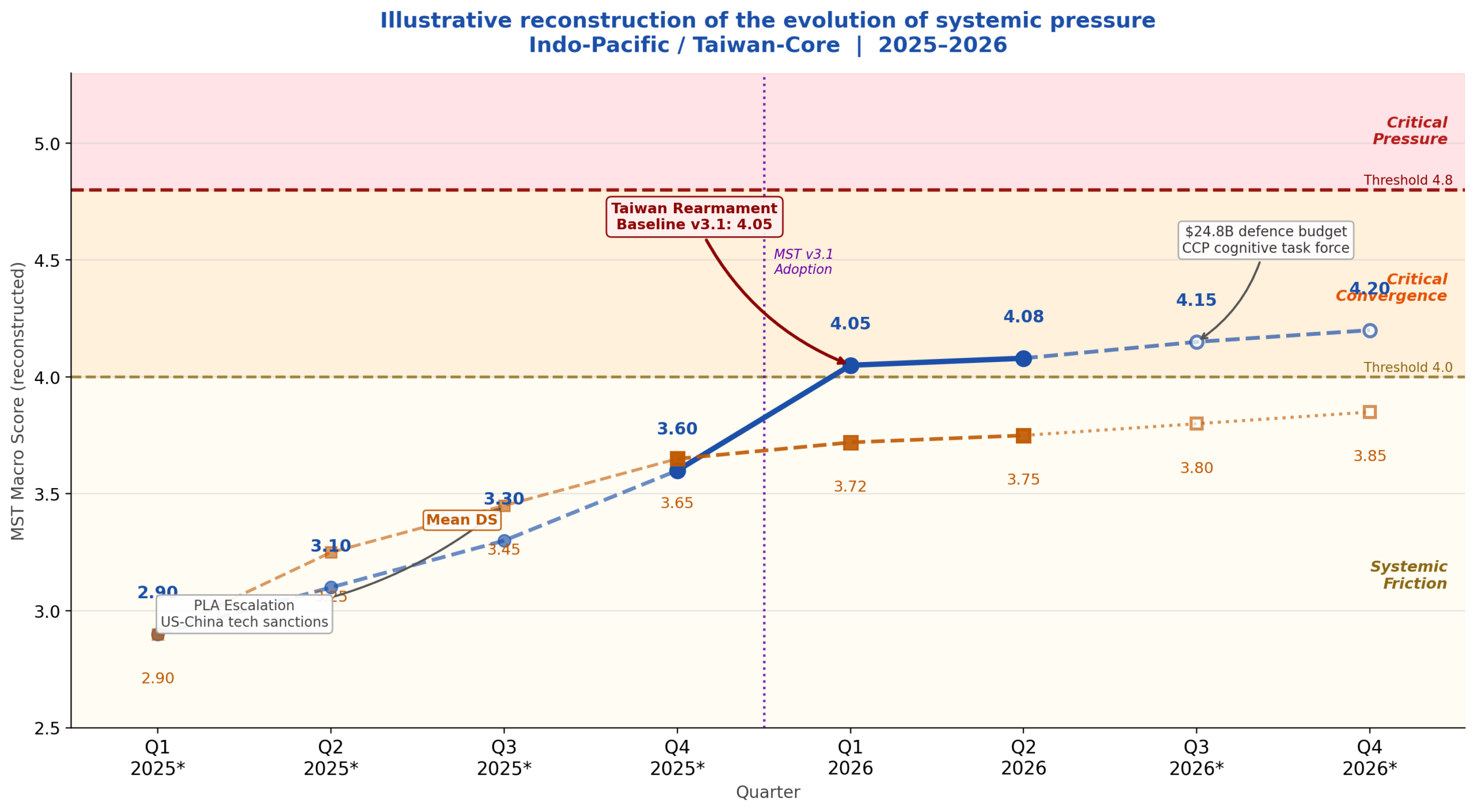
Legend — MST Evolution · Indo-Pacific / Taiwan-Core · 2025–2026
MST Macro Score
Composite cycle value (average DN + FC). Solid line = formal MST v3.1 cycle.
Average DS (reference)
Average Domain Score across the six domains. Reference value only; not equivalent to the Macro Score.
Critical Convergence Threshold (4.0)
Indicative threshold. The system enters Critical Convergence when the Macro Score exceeds 4.0.
Critical Pressure Threshold (4.8)
Proximity to Systemic Breakdown. Flag activated when DN ≥ 4.8 in at least one domain.
Adoption of MST v3.1 (Q1 2026)
Temporal separator: previous quarters are reconstructed estimates converted into MST v3.1 equivalents.
Trend Projection 2026 H2
Q3–Q4 2026 values projected on the basis of structural trends. They do not constitute a formal MST v3.1 cycle and remain subject to revision.
NOTES — Significant Structural Changes
Q2→Q3 2025* (+0.20):
Reconstructed estimate. PLA escalation around the First Island Chain; initial U.S.–China semiconductor export restrictions. Transition towards increasing Systemic Friction.
Q3→Q4 2025* (+0.30):
Reconstructed estimate. Approval of U.S. arms packages for Taiwan; intensification of PLA naval activity. ICA structurally constrained at 2.75.
Q4 2025→Q1 2026 (+0.45):
MST v3.1 baseline adopted. Macro Score recalculated under MST v3.1: Macro Score 4.05 (Critical Convergence). Discrepancy with the previous framework documented through a METHODOLOGICAL FLAG.
Q1→Q2 2026 (+0.03) [FORMAL CYCLE]:
Formal cycle of 13 June 2026. Two validated changes: Security +0.1 (Taiwan rearmament programme, US$24.8B), Cognitive +0.1 (CCP task force for influence operations targeting Taiwan’s November 2026 elections). Macro Score 4.08. ICA and FC unchanged.
Q3–Q4 2026 (*):
Values projected on the basis of structural trends — they do not constitute a formal MST v3.1 cycle. Subject to revision during the July 2026 cycle.
* Q1–Q4 2025 quarters are ex-post reconstructed estimates converted into MST v3.1 equivalents, as no formal cycles were produced during that period. They do not represent formally closed MST cycles.
Cycle structural variations
The June 2026 cycle records two validated structural changes relative to the 30 March 2026 baseline: Security (+0.1) and Cognitive (+0.1). Both are supported by primary-source evidence, convergent directional indicators, and verified persistence.
Security (+0.1). The variation reflects the special rearmament programme approved by Taiwan’s parliament: US$24.8 billion over eight years, including direct procurement from the United States and a binding implementation schedule. Structural persistence is verified: the parliamentary resolution of 7 May 2026 initiated a multi-year financial and operational commitment extending well beyond the current cycle. This represents one of the most significant institutional formalisations of Taiwan’s rearmament effort in recent years and constitutes a permanent structural change in the macro-area’s security profile.
Cognitive (+0.1). The variation reflects the establishment by the Chinese Communist Party of a dedicated task force for influence operations targeting Taiwan’s local elections in November 2026. The operational ecosystem — coordination between digital influence units, social media disinformation activities, and identity-based polarisation campaigns — is already active and documented by convergent structural OSINT and COGINT sources. Persistence is verified: the task force has been operating for more than 30 days as of the cycle date, and Taiwan’s electoral calendar ensures continuity through November 2026.
The four domains that did not register changes (Energy, Finance, Regulatory, and Technological-Industrial) contain relevant evidence during the current cycle, but none satisfies all three framework requirements simultaneously (threshold ≥0.1, persistence, and convergent multi-layer evidence). The Regulatory domain warrants particular attention: the launch of the Quad Indo-Pacific Maritime Surveillance Collaboration (26 May 2026) occurred only 18 days before the cycle date — insufficient to satisfy the ≥30-day persistence threshold required for domains with DS<4. It will therefore be reassessed in the next cycle.
Macro-area strategic picture
The Indo-Pacific / Taiwan-Core macro-area is in June 2026 characterised by a configuration combining three simultaneous dimensions of structural pressure, each following its own trajectory and possessing the potential for mutual amplification.
Security and Hard Security
The first dimension is military.
Taiwan’s institutionalised rearmament marks a structural discontinuity.
With the programme approved in May 2026, Taiwan’s multi-year financial commitment reaches a scale and degree of institutional formalisation without recent precedent in the bilateral relationship, supported by a binding implementation schedule. The Balikatan 2026 exercises, conducted in April with active Japanese participation, together with the expansion of multilateral deterrence architectures, signal a progressive consolidation of the regional response to Chinese pressure.
The Trump–Xi summit (14–15 May 2026) did not produce structural changes. The agreed formula of “strategic stability” — and the accompanying joint declaration — did not alter the operational posture of either principal actor. China has not reduced naval activity around the First Island Chain; the United States has not modified its deterrence posture in the region. The event was therefore classified in this cycle as CONTINUITY.
Military pressure remains structurally elevated (DS 3.8, DN 4.1), incorporating the valid +0.1 variation recorded during the cycle. There are no indicators of an imminent direct operational confrontation, but the density of events during the semester — exercises, parliamentary decisions, and weapons programme developments — reflects a documented pattern of progressive hardening.
Cognitive Domain
The second dimension is cognitive competition, which has become the most dynamic structural axis of the macro-area during the current cycle.
The CCP task force targeting Taiwan’s November 2026 local elections is not a tactical initiative; it represents China’s systemic response to Taiwan’s rearmament, designed to influence electoral outcomes without triggering direct military confrontation.
The operational ecosystem — coordination between digital influence units, social media disinformation activities, and identity-based polarisation campaigns — is structured to operate over a six-month period.
The U.S.–China narrative competition over Taiwan — already a permanent feature of previous cycles — has become superimposed upon this operational dimension, generating an information environment likely to amplify every significant event throughout the semester. In the current cycle, the cognitive domain acts as a systemic amplification factor, increasing the perceived effects of developments in other domains.
Technological-Industrial Domain
The third dimension is semiconductor competition, which constitutes the macro-area’s principal technological vector.
Taiwan remains the most sensitive node in the global competition for advanced chips: TSMC continues to hold a near-monopoly position in the production of sub-3nm semiconductors. This geographical concentration at the point of greatest strategic tension creates a systemic vulnerability that diversification efforts have not yet eliminated.
During the current cycle, China is projected to reach 50% of its domestic AI chip market by the end of 2026. The partial easing of U.S. export controls in April 2026 has not altered the underlying competitive structure: restrictions on the most advanced chips remain in force. The domain remains unchanged from the baseline (DS 3.9, DN 4.2), with current-cycle evidence confirming the structural trajectory without generating an additional threshold variation.
Energy and Infrastructure
Western Pacific maritime routes continue to exhibit documented structural vulnerabilities but did not experience prolonged interdiction events during the current cycle. Critical chokepoints — the Strait of Malacca, the Strait of Hormuz within the Indo-Pacific framework, and the Sea of Japan maritime routes — remain fully operational. Energy pressure (DS 3.2, DN 3.5) remains the lowest within the macro-area and functions as a structural stabiliser. The domain remains unchanged.
Finance
The regional financial system is characterised by strong structural interdependence among the principal economies, acting as a two-way constraint: it reduces incentives for direct escalation while preserving competitive pressure in strategic sectors. Financial decoupling remains selective and concentrated in sensitive areas such as technology, defence, and critical infrastructure. The domain (DS 3.1, DN 3.4) remains unchanged from the baseline.
Regulatory / Governance
The regulatory domain recorded two significant developments during the current cycle, although neither reached the threshold required for a structural variation. The launch of the Quad Indo-Pacific Maritime Surveillance Collaboration (IPMSC) on 26 May 2026 occurred only 18 days before the cycle date — insufficient to satisfy the framework’s ≥30-day persistence requirement for domains with DS<4. The initiative strengthens existing regional cooperation architectures (Quad, AUKUS) without producing an immediate regulatory discontinuity. The domain (DS 3.6, DN 3.9) remains unchanged and will be reassessed during the July 2026 cycle.
ICA — Structural Resilience of the Macro-Area
Low (ICA: 2.75)
The system displays structurally limited adaptive capacity.
The principal dimensions of resilience — deterrence architectures, strategic energy reserves, and financial capabilities — continue to exhibit significant vulnerabilities that have not been resolved during the current cycle. Economic interdependence between the United States and China functions as a short-term stabiliser but does not constitute a source of structural resilience: it is a symmetrical condition that constrains both actors without reducing the underlying systemic pressure.
ICA remains unchanged from the baseline. The cycle’s validated structural changes (Security +0.1, Cognitive +0.1) generate a cumulative ΔDS of +0.2, below the ≥0.3 threshold required by the framework to trigger an ICA update. The value of 2.75 therefore remains the baseline for the next cycle.
Signals to be monitored in next cycle
The following conditions could alter the macro-area’s configuration in the next cycle:
Direct military escalation in the Taiwan Strait:
The activation of an operational confrontation involving armed responses would shift the configuration towards Systemic Breakdown.
Operational interruption of U.S.–China military communication channels:
This would remove the principal mechanism of structural de-escalation currently available to both actors.
Documented interference in Taiwan’s electoral process (November 2026):
This would create convergence between the Cognitive and Regulatory domains, potentially generating multiple structural variations.
Prolonged disruption of Pacific maritime routes:
This would activate the Energy domain and generate systemic effects on a global scale.
Simultaneous convergence of financial sanctions and technological restrictions:
This would exceed the absorption capacity of the current selective decoupling model.
Stabilising conditions:
Meaningful progress in U.S.–China negotiations supported by verifiable commitments, a reduction in military activity around the First Island Chain, and documented diversification of semiconductor production capacity outside Taiwan.
Learn More
→ Geopolitical Macro-Areas Dossier
Explore the regional strategic analyses of the international system.
→ Global System Assessment Dashboard
Consult the public summary of the system’s current configuration.
–> How to Read an MST Assessment
→ MST Framework
Learn more about the framework used to assess structural pressure and adaptive capacity.
Methodological Note
This analysis is based on the application of the Multi-System Tension (MST) framework, developed to assess structural pressure, adaptive capacity, and systemic configurations through validated open-source evidence.
The values presented do not constitute forecasts; they represent a synthesis of the observable structural condition of the system during the period under analysis.