
 English

Geopolitical Analysis
Analysis of geopolitical and international security dynamics in the Euro-Atlantic and global context. Focus on great power competition, conflicts, alliances, deterrence, regional stability, and strategic governance.
-
Sport as an Arena of Legitimization: FIFA, the Board of Peace, and the Contested Neutrality of Milano-Cortina
Sports geopolitics is redefining the role of FIFA, the IOC, and major international sporting events as instruments of political legitimacy and strategic competition.
-
Italian Military Bases in Operation Epic Fury Against Iran
On 24 June 2026, in an interview with Fox News, NATO Secretary General Mark Rutte stated that approximately 500 U.S. aircraft had departed from American military bases located on Italian territory as part of Operation Epic Fury, the U.S. operation conducted against Iran.
-
European cooperation as a multiplier of capacity — or centralization as a multiplier of error?

The Charlemagne Prize awarded to Mario Draghi reopens a broader question: will Europe become more resilient through greater centralisation, or through stronger nation states capable of cooperating while preserving their strategic autonomy?
-
Global Water Crisis: The Distributed Chokepoint of the Global System
Water Scarcity, Food Security, Energy, Supply Chains, and Emerging Geopolitical Pressures
Water is no longer merely an environmental resource. It has become a strategic infrastructure of the global system. Food production, energy generation, industrial processes, public health, urban stability, supply chain continuity and, ultimately, the capacity of states to govern all depend upon it.
When water systems become unstable, the result is not simply an environmental crisis. It is a reduction in the overall resilience of economic, social and political systems.
The global water crisis should therefore be understood as a distributed systemic pressure. Unlike maritime chokepoints such as Hormuz or Suez, there is no single strategic bottleneck. Water functions instead as a diffuse chokepoint, simultaneously compressing agriculture, energy, industry, urban systems, migration, and... -
Europe’s Real Decision-Making Margin
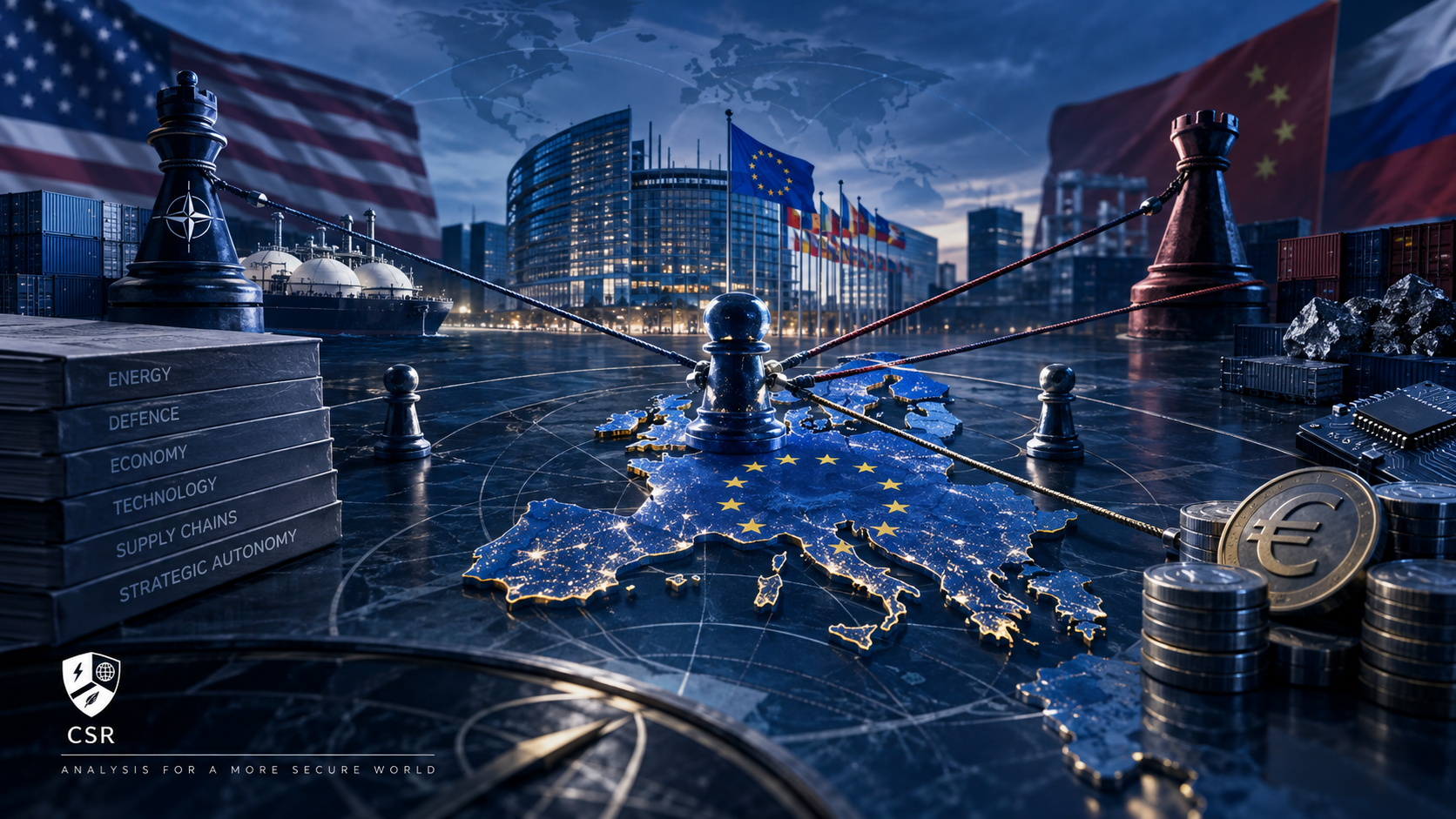
Europe's room for manoeuvre is not measured by diplomatic declarations, but by its ability to bear the political, military, technological, and economic costs of acting autonomously.