
 English

Geopolitical Analysis
Analysis of geopolitical and international security dynamics in the Euro-Atlantic and global context. Focus on great power competition, conflicts, alliances, deterrence, regional stability, and strategic governance.
-
Brazil and Mexico: Two Latin American trajectories within the emerging multipolar order
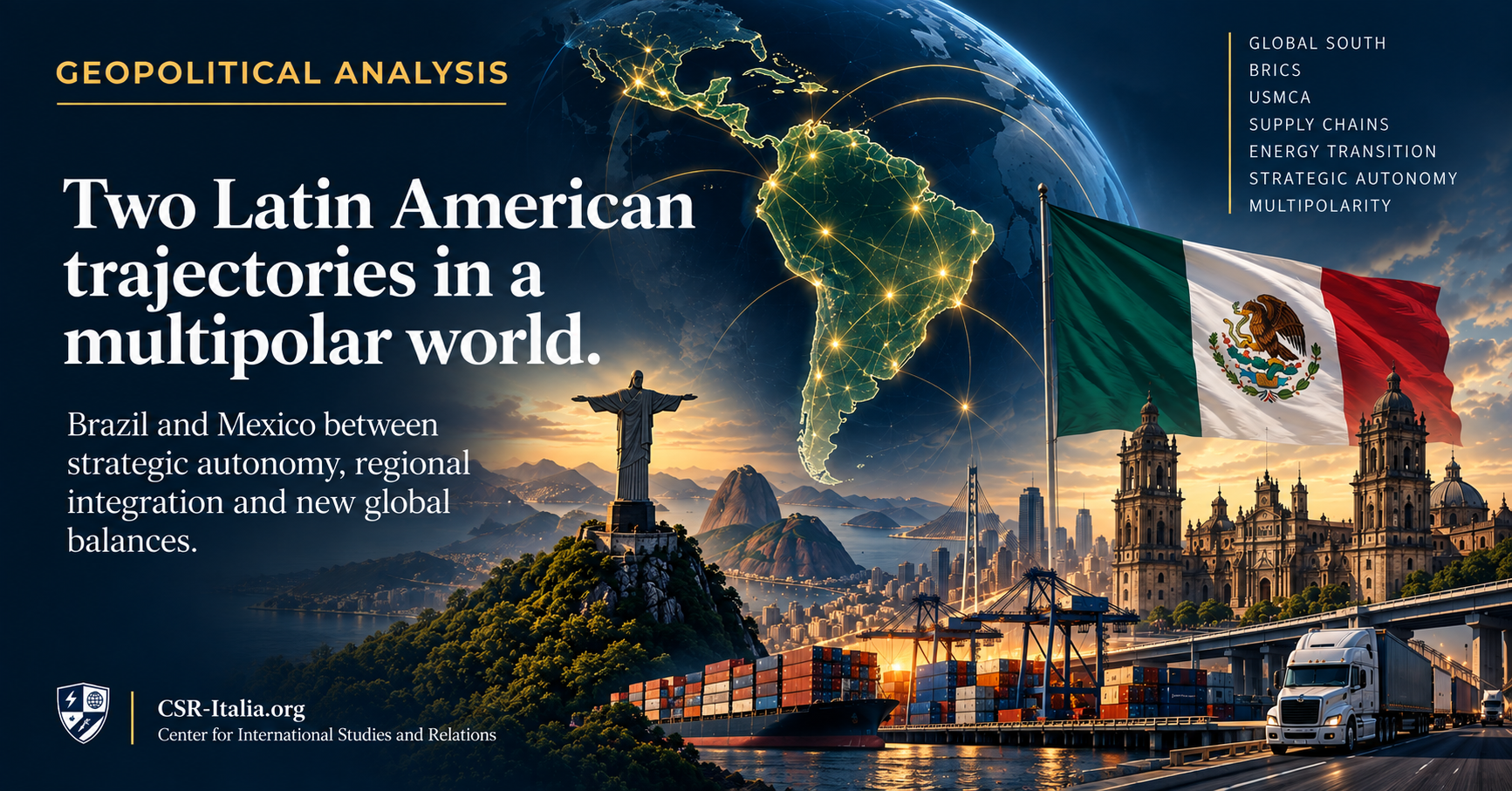
Brazil and Mexico are reshaping Latin America’s systemic role through distinct trajectories: Brazil as a driver of Global South and BRICS reform, Mexico as a hybrid platform between North American integration and strategic diversification.
-
Latin America: When Criminal Violence Redefines the State
Latin America is no longer merely a major theater of global drug trafficking. Across wide areas of the region, the convergence of illicit economies, systemic corruption, institutional fragility, and organized violence is eroding substantive state sovereignty. Mexico and Ecuador offer two particularly clear trajectories of this decline in state capacity.
-
Israel and the West: Alliance, Dependence, and Influence
This analysis is part of a series examining Israel’s role in the contemporary international system across three dimensions: territory, region, and its relationship with the West. —> General Introduction to the Series —> Israel as a Systemic Actor in the Middle East —> The Invisible Annexation: How the West Bank Reveals the Silent Transformation of Territorial Control in the Contemporary International System Israel and the West no longer represent a simple privileged relationship between ally and protector. In the contemporary international system, this relationship must be understood as a structure of asymmetric interdependence, in which alliance, dependence, and influence overlap without fully coinciding. Israel depends on the West, particularly the United States, for strategic protection,…
-
Israel as a systemic actor in the Middle East
Deterrence, Iran, Proxies, and Regional Pressure This analysis is part of a series examining Israel’s role in the contemporary international system across three dimensions: territory, region, and its relationship with the West. → General Introduction to the Series → The Invisible Annexation → Israel and the West: Alliance, Dependence, and Influence Israel can no longer be understood merely as one of the actors in the Middle Eastern conflict. In the current strategic cycle, its role must be understood within a broader framework: Israel operates as a regional systemic actor, capable of influencing not only its immediate security environment but also the entire strategic configuration of the Middle East. Its significance…
-
Israel in the Contemporary International System: Territory, Region, the West
Three Dimensions for Understanding Israel's Role in the Contemporary International System
Within the international system of the twenty-first century, Israel occupies a paradoxical position. On the one hand, it is a relatively small state exposed to existential threats and lacking strategic depth. On the other, it is an actor capable of projecting influence well beyond its borders, reshaping regional balances and affecting Western decision-making architectures.
This series examines Israel's role within the contemporary international system through three structural dimensions: territorial transformation, its regional systemic function, and its relationship with the West.