

European Union macro - area | Cycle: 14 October 2026 | Framework MST v3.2 | CSR Italia
How to read Macro-area European Union strategic analysis
MST Score
Composite Structural Pressure Index on a scale from 1 to 5. Combines the pressure values of six systemic domains (Security, Energy, Finance, Regulatory, Cognitive, Technological) with the inter-domain amplification factor. Values above 4.0 indicate elevated and persistent structural pressure.
Adaptive Capacity (ICA):
Adaptive Capacity Index — measures the system's ability to respond to and absorb structural pressures without undergoing a configurational transformation. Scale from 1 to 5 (5 = maximum resilience). An ICA value below the pressure level of a given domain amplifies the system's net pressure.
Convergence (Critical):
Active systemic configuration during the current cycle. Range 4.0–4.5 on the MST scale. Indicates persistent multi-domain structural pressure, with adaptive capacity progressively weakening. The system continues to operate, but the distance from the structural emergency threshold has narrowed.
Systemic Breakdown:
Structural emergency configuration: range 4.5–5.0. A condition in which internal compensation mechanisms are no longer sufficient to contain systemic pressure. The European Union is currently 0.12 points away from the lower threshold of this range.
Domain Breakdown Threshold:
Triggered when the net pressure (DN) of a single domain reaches ≥ 4.8.
In the current cycle the Security domain is at DN 4.7 (with the telecom/edge Node correction) and Energy at DN 4.6: 0.1 and 0.2 points from triggering the threshold.
–> How to read an MST assessment
Executive summary
The 14 October 2026 cycle records no valid structural changes for the European Union macro-area compared with the 8 June 2026 baseline. The Macro Score remains 4.38 and the Union is confirmed in Critical Convergence (4.0–4.5). With the correction from the Strategic Node “Telecommunication networks and edge access”, which adds pressure in the Security, Cognitive and Technological domains, the value used in the global framework is 4.43; the band remains determined by the territorial value.
The outcome does not mean there were no new facts. Two deteriorations are documented but not validated, because they are corroborated by two types of source instead of the three required: the Russian hybrid campaign against Member States (drones, sabotage, airspace violations) and the French sovereign debt crisis, with the 10-year yield at its highest since 2002 and initial contagion to other countries’ spreads in early October. These are the two main signals for the next cycle, together with the vote on the French budget on 17 November.
MST Score: 4.38 / 5
1.0 – 2.0
Sustainable Pressure
2.0 – 3.0
Latent Accumulation
3.0 – 4.0
Systemic Friction
4.0 – 4.5
▲
Critical Convergence
4.5 – 5.0
Systemic Breakdown
With telecom/edge Node correction: 4.43 / 5 (same band)
Macro-area configuration: Critical Convergence
Adaptive capacity: High (ICA: 3.5)
Dominant node: Security / Energy (DN 4.7 / 4.6)
Dominant dynamic: Systemic transmission of the energy shock with economic spillover and transatlantic pressure
Prevailing domains: Energy · Security · Finance
Valid changes in the cycle: 0 — Non-variation proof (June: DS Energy +0.1 and DS Finance +0.1)
Position within the MST Scale
With an MST Score of 4.38 on a scale from 1 to 5, the European Union sits in the Critical Convergence band of the MST scale (4.0–4.5), between significant systemic pressure and full structural emergency. The Security domain is at DN 4.7 (with the telecom/edge Node correction) and Energy at DN 4.6: 0.1 and 0.2 points from the Domain Breakdown Threshold (4.8), the signal of critical compression in a single domain. Systemic Breakdown of the macro-area would instead require a Macro Score of at least 4.5.
The pressure is structural because it stems from a persistent exogenous shock (Hormuz, since March), not from cyclical volatility. The ICA < DS mechanism in all six domains amplifies net pressure on the system, configuring a macro-area in which the adaptive response can no longer fully offset incoming pressure. Five of the six domains reach high net pressure levels (DN ≥ 4.0), with an active transmission chain between the energy and financial domains.
The European Union records high pressure levels in five areas at the same time: security, energy, finance, regulatory governance and technology.
The June cycle produced documented changes in two of these areas – energy and finance – with a confirmed transmission chain between them.
The October cycle adds none. The Union’s capacity to respond to and absorb structural pressures remains operational, but the distance from the Systemic Breakdown threshold has narrowed since the beginning of the year. The macro-area therefore maintains a configuration of: Critical Convergence
Legend and notes
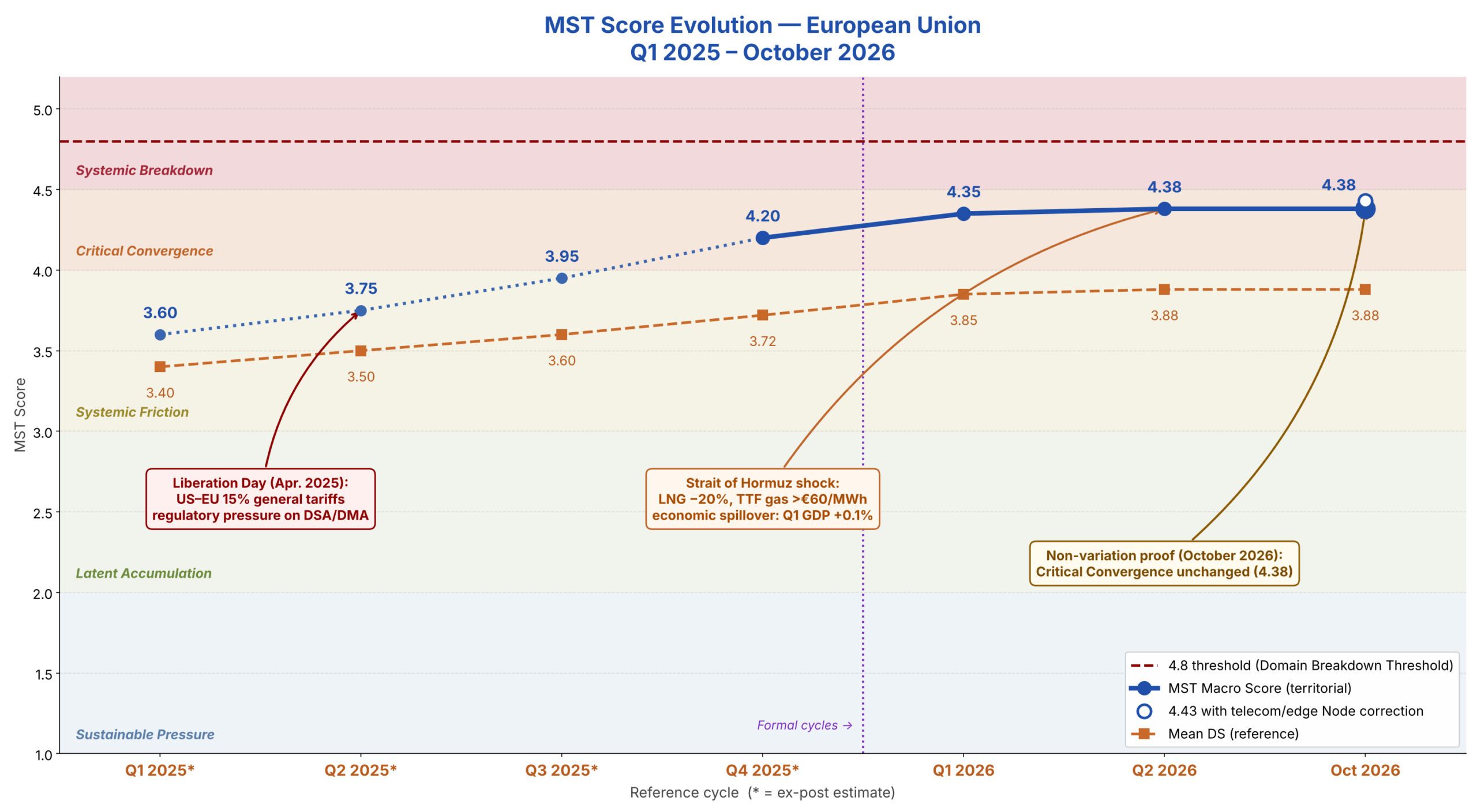
LEGEND ●━━● MST Macro Score. Composite value of the formal cycle (territorial). Solid line for formal cycles (Q1 2026 – October 2026); dotted for the ex-post estimates Q1–Q4 2025. ○ Macro Score with the telecom/edge Node correction (October 2026: 4.43).
■ – – ■ Mean DS (reference). Arithmetic mean of the DS of the six domains. Supporting value. Dashed orange line. — — — 4.0 threshold. Entry into the Critical Convergence band. Key structural reference.
━━━━ 4.8 threshold. Domain Breakdown Threshold. With DN Security 4.7 (with Node correction) and DN Energy 4.6, remaining distance: 0.1 and 0.2.
⋮ ⋮ ⋮ Framework separator. Start of formal MST v3.1 cycles (Q4 2025 / Q1 2026). Left: ex-post reconstructed estimates. Right: formal cycles.
NOTES — Significant structural changes Q2 2025* (est.) | +0.15 Macro Score. Liberation Day (Apr. 2025): general 15% US–EU tariffs, sectoral tariffs, regulatory pressure on DSA/DMA. First driver of the acceleration towards Critical Convergence.
Q4 2025*→Q1 2026 (30 Mar 2026) | +0.15 Macro Score. Start of formal MST v3.1 cycles. Baseline Macro Score: 4.35. MacroBase: Critical Convergence. 5 domains DN ≥ 4.0.
▸ Q1 2026→Q2 2026 (8 Jun 2026) | +0.03 Macro Score. Strait of Hormuz shock: LNG -20%, TTF gas >€60/MWh. DS Energy +0.1, DS Finance +0.1 (Q1 GDP spillover +0.1%). Non-variation proof in 4 domains. MacroBase unchanged: Critical Convergence.
▸ Q2 2026→October 2026 (14 Oct 2026) | 0.00 territorial Macro Score (4.38); 4.43 with the telecom/edge Node correction. Non-variation proof: Russian hybrid campaign and French sovereign debt documented but not validated. MacroBase unchanged: Critical Convergence.
Valid Structural Adjustments in the Current Cycle
The 14 October 2026 cycle produces no valid structural changes. The two June changes — Energy +0.1 for the Strait of Hormuz shock and Finance +0.1 for the economic spillover — remain incorporated in the baseline. Two pieces of evidence, however, document a deterioration and were examined as candidates.
Russian hybrid campaign — NOT VALIDATED. Between August and September: a drone carrying explosives near Leipzig/Halle airport, close to a cargo aircraft bound for Ukraine, publicly attributed to Russia; a drone shot down in Lithuania; the violation of Finnish airspace on 25 September; the Danish assessment of a “low but growing” risk of a limited attack. On 28 September the Council began preparing an emergency protocol against hybrid threats. It is the intensification of a campaign already under way before June: corroborated by two types of source, not the three required for a change.
French sovereign debt and contagion — NOT VALIDATED. The yield on French 10-year government bonds rose from 3.86% in early August to 4.93% on 1 October, its highest level since 2002; the spread over the German Bund reached its highest since 2011–12 in early October, then partly eased. In early October the spreads of Italy, Spain, Belgium, Portugal and Greece also widened; on 8 October the ECB President reminded Eurogroup ministers that the Bank has instruments against disorderly markets. The French 2027 budget goes to a vote on 17 November. The deterioration is documented, but with two types of source and with spread data that are not consistent across providers: it remains the main financial signal for the next cycle.
The other evidence in the cycle is CONTINUITY or below threshold: gas storage at 72% on 1 October, within the scenarios forecast in April; ECB rate hikes on 11 June and 10 September (deposit rate at 2.50%) with inflation at 3.8% in September (flash estimate); implementation of the EU–US trade agreement; entry into force of the AI Omnibus and of the Cyber Resilience Act reporting obligations; new return rules adopted on 1 October, still too recent.
Strategic picture by Domain
In October 2026 the European Union is in a configuration that combines three dimensions of structural pressure at the same time, each with its own trajectory and with potential for mutual amplification.
The first dimension is the exogenous energy shock, which changed conditions in the European gas market and triggered a chain of effects on economic growth and, in the October cycle, on inflation and interest rates. The EU responded with budgetary measures and supply diversification, but dependence on imported LNG remains a structural vulnerability that cannot be resolved in the short term.
The second dimension is transatlantic pressure, which has consolidated on several fronts at once: trade (tariffs and sectoral duties), regulatory (pressure on the enforcement of the digital package) and informational (US sanctions on European officials working against disinformation). Their simultaneity creates long-term structural friction.
The third dimension is internal governance friction, which includes the implementation of the Migration Pact, operational since June 2026, and latent tensions over digital governance and the rule of law. Budapest’s pro-EU turn after Magyar’s victory partly reduces this pressure, but its effects on EU governance will be measured in later cycles.
Faced with these lines of pressure, the EU has shown that its adaptive capacity is still operational: budgetary responses, common defence instruments and internal political cohesion continue to perform a containment function. However, this capacity shows signs of progressive weakening compared with previous cycles. In the October cycle these three dimensions are joined by two signals not yet validated: the Russian hybrid campaign and the strain on French sovereign debt.
Regional security
Security remains the domain with the highest pressure in the entire macro-area, in line with the trajectory consolidated in the baseline (DS 4.3, DN 4.6; 4.7 with the telecom/edge Node correction). In the June 2026 cycle the Union activated the SAFE instrument – which finances common defence for 16 Member States – and updated the EU Defence Readiness Agenda at the Foreign Affairs Council of 12 May 2026. The first session of the EU–Japan defence industry dialogue was also launched. This evidence confirms the defence-strengthening trajectory already incorporated in the baseline, without introducing structurally new factors.
In the October cycle the Russian hybrid campaign against Member States intensified: the drone carrying explosives near Leipzig/Halle airport, a drone shot down in Lithuania, the violation of Finnish airspace on 25 September; on 28 September the Council launched an emergency protocol against hybrid threats. The deterioration has not yet been validated. Pressure in the security domain therefore remains unchanged from June, but at an already high level. The domain is now close to the maximum alert threshold: any unanticipated escalation in the European military context could be enough to change the configuration of the entire macro-area.
Energy and supply
Energy is the domain that drove the June cycle. The near-closure of the Strait of Hormuz cut LNG flows to the European Union by 20% and pushed the TTF gas price above €60/MWh – more than double its level at the start of the year. Europe’s dependence on imported liquefied natural gas is confirmed as the macro-area’s main point of exposure to exogenous geopolitical shocks. This was the first genuine structural change of 2026: a new event, with effects lasting more than 100 days and simultaneously involving energy markets, geopolitics and security of supply.
The European response – €14.5 billion in budgetary measures, supply diversification, stockpiling – mitigated the impact without eliminating it. On 1 October gas storage stood at 72%, within the scenarios forecast in April, with LNG availability still a binding constraint: the vulnerability remains the one recorded in June, with no measured change. Winter 2026-27 is the next test.
Finance and economic resilience
The energy shock found a direct transmission channel into the European economy. EU GDP grew by just +0.1% in the first quarter of 2026 – four times less than forecast – signalling a slowdown that goes beyond mere cyclical volatility.
The European Commission and the ECB flagged a concrete risk of stagflation. The ECB raised rates on 11 June and again on 10 September (deposit rate at 2.50%), citing inflationary pressures linked to the conflict in the Middle East; in September euro area inflation rose to 3.8% (flash estimate). EU GDP grew by 0.7% in the second quarter: the picture remains mixed.
The combination of rising borrowing costs and weak growth increases pressure on the financial system, especially for countries with high public debt and less fiscal space. The October cycle confirms this with the strain on French debt: the 10-year yield at 4.93% on 1 October, its highest since 2002, the spread over the Bund at its highest since 2011–12 and initial contagion to other countries; the ECB pointed to its instruments against disorderly markets. The deterioration is documented but not validated, and the vote on the French budget on 17 November is the main trigger. The direct link between the financial domain and the energy shock makes the two domains a chain to be monitored together.
Regulatory
The regulatory domain maintains stable structural pressure (DS 3.7, DN 4.0), with evidence confirming trajectories already present in June.
Trade tensions with the United States remain high – general tariffs of 15%, 107% duties on Italian pasta, $7 billion in sanctions on large technology platforms – but do not amount to an escalation compared with the context already incorporated in the baseline. On 25 June the Council approved the tariff commitments of the EU–US trade agreement, applied from July.
Two elements deserve attention for the next cycle. The first is the implementation of the Migration Pact, operational since June 2026, alongside the new return rules adopted by the Council on 1 October: a restrictive turn with potential long-term implications for internal governance and for relations with third countries.
The second is Magyar’s victory in Hungary: the end of Orbán’s long tenure opens the prospect of Budapest realigning with mainstream EU positions, with possible positive effects on European regulatory cohesion.
Cognitive-informational
Cognitive pressure remains at moderate levels, with evidence confirming a trajectory of friction already consolidated between the European Union and the United States.
Two signals characterised the June cycle: the US threat of tariffs over European enforcement of the Digital Services Act and the AI Act; and the sanctions announced by the State Department under Marco Rubio against European officials working on counter-disinformation policies.
Both confirm existing trends, without structurally altering the governance of the European information space.
The October cycle adds Russian narrative campaigns on the Baltic and the update of the European tools for electoral integrity under the Digital Services Act: both threat and response were already present in the baseline.
Managing the digital sphere and disinformation nonetheless remains one of the main points of friction in transatlantic relations: a domain in which the gap between the European regulatory model and the positions of the US administration continues to widen.
Technological-industrial and infrastructure resilience
The technological domain maintains stable structural pressure (DS 3.7, DN 4.0), with the European Union joining the so-called Pax Silica – the US-led coordination agreement for the AI chip supply chain – as the main evidence of the cycle.
Joining consolidates Europe’s integration into Western strategic architectures in the technology sector, confirming a direction already under way before March. Dependence on external supply chains for advanced semiconductors and digital infrastructure remains a long-term structural issue. Investment under the European Chips Act and partnerships with trusted partners partly mitigate this exposure, but do not resolve it in the short term.
In the October cycle the AI Omnibus (27 July) and the Cyber Resilience Act reporting obligations (11 September) came into force: scheduled implementation, with no measured structural effects. The “Telecommunication networks and edge access” Node adds 0.1 to the net pressure of Security, Cognitive and Technological in the value used (4.43), without changing the band.
ICA — Structural resilience
High (ICA: 3.5)
The European Union’s adaptive capacity remains unchanged at 3.5 in the October cycle as well, which records no valid structural changes.
In June the two valid changes (+0.1 each) did not meet the requirement for an ICA change: the sum of the changes (+0.2) was below the 0.3 threshold required by the method. The policy responses activated – €14.5 billion in energy measures, the SAFE instrument for common defence, supply diversification – show that adaptive capacity is still operational and functioning.
The critical signal is that in all six domains pressure exceeds adaptive capacity (ICA 3.5 < DS in every domain), and the net pressure amplification mechanism is active across the entire structure of the macro-area.
If the energy shock or the strain on sovereign debt persist beyond the current cycle or intensify, the conditions are created for an erosion of adaptive capacity in future cycles.
Conditions for Change
Conditions That Could Worsen the Configuration
Sovereign debt and spreads. If the strain on French bonds persists after the vote on the 2027 budget on 17 November and contagion to other countries consolidates, the Finance domain could record a change in the next cycle. Any use by the ECB of its instruments against disorderly markets should also be followed.
Russian hybrid campaign. If drone attacks, sabotage and airspace violations continue and are confirmed by more types of source, pressure in the Security domain could increase. With DN 4.7, the Domain Breakdown Threshold is 0.1 points away.
Gas and energy supply. Winter storage and LNG availability will determine whether the Hormuz shock consolidates as a structural condition or eases. It is the most important signal for the Energy domain in the next cycle.
Monetary policy. Further rate hikes amid weak growth would increase financial pressure, especially on highly indebted European countries.
The energy–economy chain. The energy shock has already produced measurable effects on growth. If this transmission intensifies in the coming months, the conditions for a more significant deterioration of the European economic picture would strengthen, with a possible update of the overall systemic amplification indicator.
Proximity to the maximum alert threshold. Both domains are already close to the threshold. Even a limited further deterioration – a military escalation, a new energy shock, a supply crisis – could be enough to change the configuration of the entire macro-area.
Digital governance. If US pressure on the enforcement of the DSA, the DMA and the AI Act turns into concrete executive measures, the regulatory domain could deteriorate significantly in transatlantic relations.
Conditions That Could Stabilise the Configuration
Gas under control. Lower prices and a winter without storage tensions would reduce energy pressure and ease transmission to the financial domain.
Hungary after Magyar. If Budapest’s pro-EU turn produces concrete effects on EU governance – co-decision, rule of law, internal cohesion – it could translate into lower internal regulatory pressure in the next cycle.
Common defence. The actual deployment of the SAFE instrument and of the EU Defence Readiness Agenda will determine whether European defence strengthening remains a trajectory or becomes real operational capability. In the medium term (2026–2030), the Union’s trajectory will depend on its ability to reduce structural energy dependence, consolidate technological autonomy and maintain internal cohesion in a context of persistent transatlantic pressure.
Learn More
→ Geopolitical Macro-Areas Dossier
Explore the regional strategic analyses of the international system.
→ Global System Assessment Dashboard
Consult the public summary of the system’s current configuration.
–> How to Read an MST Assessment
→ MST Framework
Learn more about the framework used to assess structural pressure and adaptive capacity.
Methodological Note
This analysis derives from the application of the Multi-System Tension (MST) framework, developed to assess structural pressure, adaptive capacity and systemic configurations through validated open-source evidence. The values reported are not forecasts, but a summary of the structural state observable in the cycle considered.
The Macro Score is calculated as the average of the normalised pressure values across the six domains analysed, increased by the systemic amplification indicator. The territorial value determines the band; the value used includes Strategic Node corrections and is the one that enters the Global System Assessment (GSA), the index of the state of the international system.
The ICA – Adaptive Capacity Index – measures the system’s capacity to respond to and absorb structural pressures without configurational transformation.
CSR Italia — MST v3.2 — Cycle: 14 October 2026 — European Union macro-area